Gidrox 12V DC RV Air Conditioner Review: Battery-Powered Cooling for Off-Grid Campers
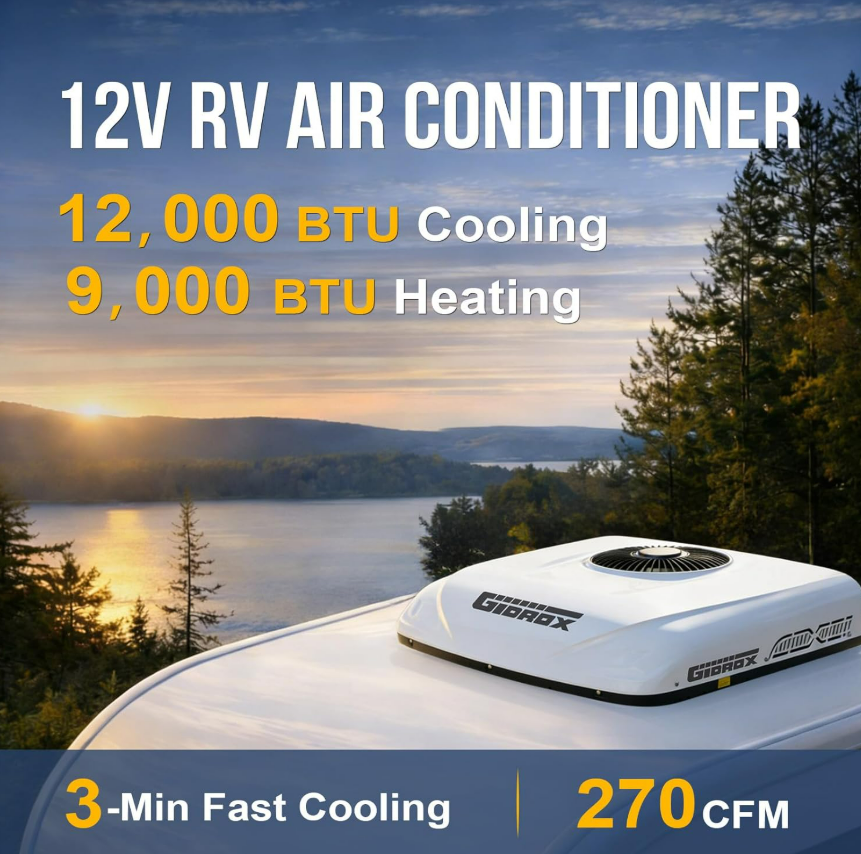
The Gidrox 12V DC RV air conditioner is built for a very specific kind of RV owner: someone who wants roof-mounted cooling without depending on shore power, a gas generator, or a big inverter running all afternoon. It is rated at 12,000 BTU cooling and 9,000 BTU heating, runs directly from a 12V battery system, and is marketed for camper vans, trucks, skoolies, and off-grid RV builds.
As an Amazon Associate, we may earn from qualifying purchases.
I’m Mike Reyes, an RVIA-Certified Technician. Most of the 12V rooftop AC questions I get are not about cold air. They are about current draw, battery sizing, roof openings, wire length, voltage drop, and whether the thing will still feel useful after sunset. That is the right way to look at this Gidrox unit. A 12V RV AC is not just an air conditioner. It is part of the electrical system.
This review is based on the supplied product specs, listing screenshots, feature graphics, and owner feedback images. I will use the numbers provided, but I will not pretend every runtime claim applies to every camper. Battery chemistry, cable size, solar input, insulation, outdoor temperature, and thermostat setting can change the result fast.
Quick Verdict
The Gidrox 12V DC RV air conditioner is one of the more interesting options for off-grid campers because it removes the inverter from the cooling equation. That matters. A traditional 115V rooftop AC needs AC power. If you are living from batteries, that usually means running through an inverter, losing efficiency, and adding another failure point. This Gidrox unit runs on 12V DC directly.
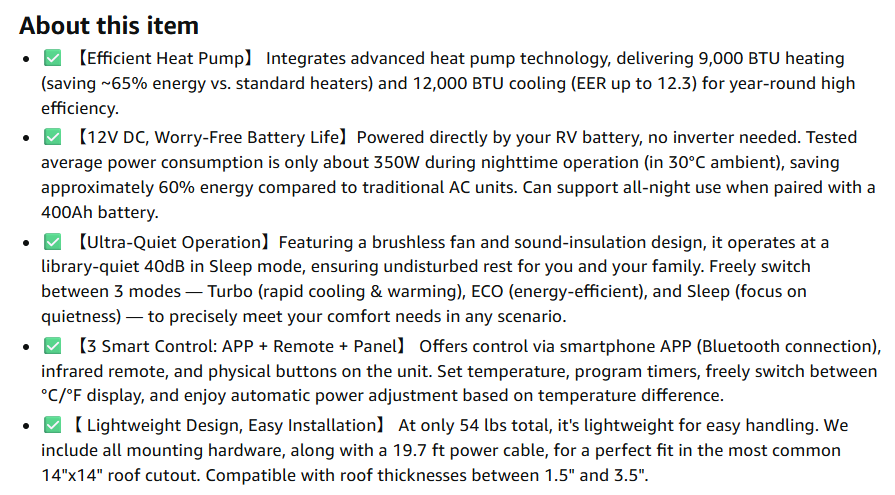
The biggest strengths are clear: direct 12V operation, 54 lb weight, 14 x 14 inch roof opening fit, 12,000 BTU cooling, 9,000 BTU heat pump, app control, remote control, Sleep/Eco/Turbo modes, and quiet low-power operation. The supplied materials claim 40 dB in Sleep mode, 43 dB in Eco, and 53 dB in Turbo. If your bed is right under the plenum, that noise range matters more than the logo on the shroud.
I would consider it for a van, truck camper, skoolie, compact travel trailer, or solar-heavy RV where the owner understands 12V wiring and battery math. I would not choose it blindly for a large Class A, a poorly insulated rig, or anyone expecting house-style cooling from a single 12V roof unit in desert heat.
Key Specifications
Here are the most useful specs pulled from the supplied product images and listing text.
| Feature | Gidrox 12V DC RV Air Conditioner Details |
|---|---|
| Power type | 12V DC |
| Rated cooling capacity | 12,000 BTU |
| Rated heating capacity | 9,000 BTU |
| Heat type | Heat pump |
| Airflow | 270 CFM |
| Weight | 54 lb |
| Roof opening | Standard 14 in. x 14 in. RV A/C opening |
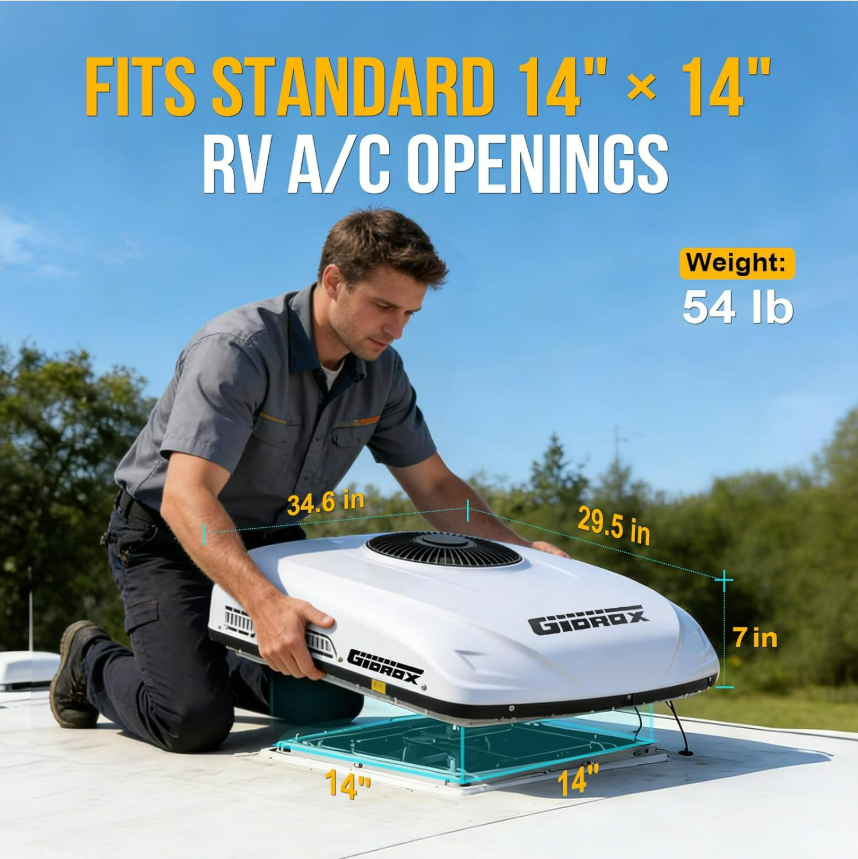
| Product dimensions shown | 34.6 in. x 29.5 in. x 7 in. |
| Roof thickness compatibility | 1.5 in. to 3.5 in. |
| Power cord length | 19.7 ft |
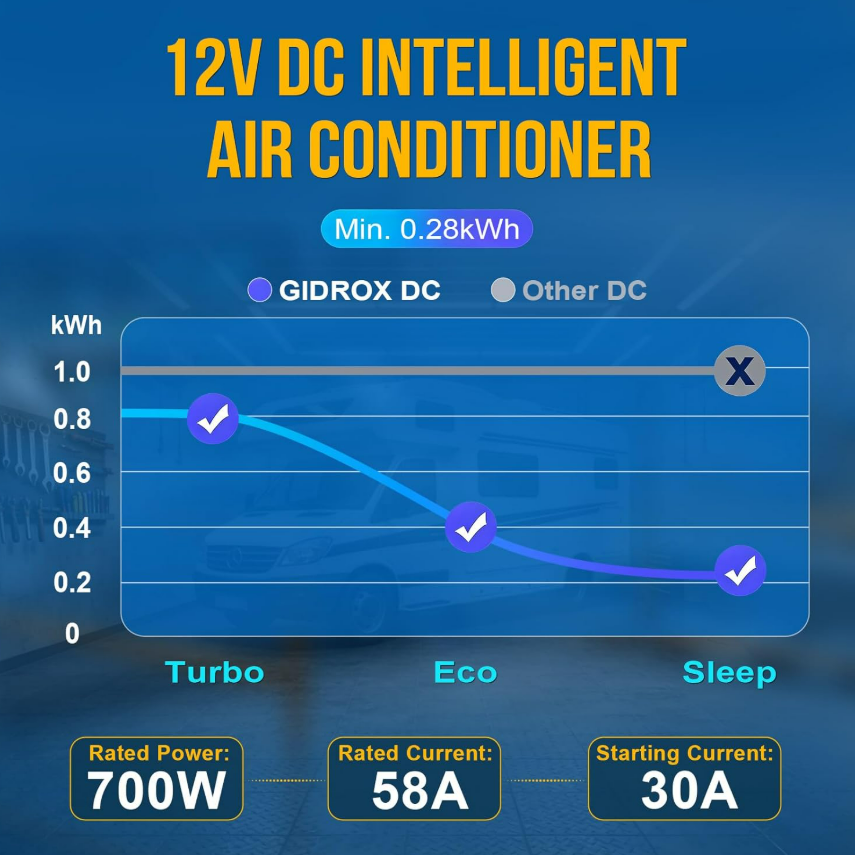
| Rated power | 700W |
| Rated current | 58A |
| Starting current | 30A |
| Minimum energy use claim | 0.28 kWh |
| Operating voltage range | 12V–13.5V |
| Low-voltage protection | Below 10.5V triggers error and shutdown |
| Controls | App, infrared remote, physical buttons |
| Modes | Turbo, Eco, Sleep |
| Sleep mode noise claim | 40 dB |
| Eco mode noise claim | 43 dB |
| Turbo mode noise claim | 53 dB |
| EER claim | Up to 12.3 |
| Battery runtime claim | Varies by battery and mode; examples include 400Ah Eco and 600Ah LiFePO4 mode estimates |
The three specs I would circle first are 12V DC power, 54 lb weight, and the voltage range. A light rooftop unit is nice, but the electrical side decides whether this product is a good fit. At 58A rated current, cable sizing and voltage drop cannot be treated casually.
First Impressions
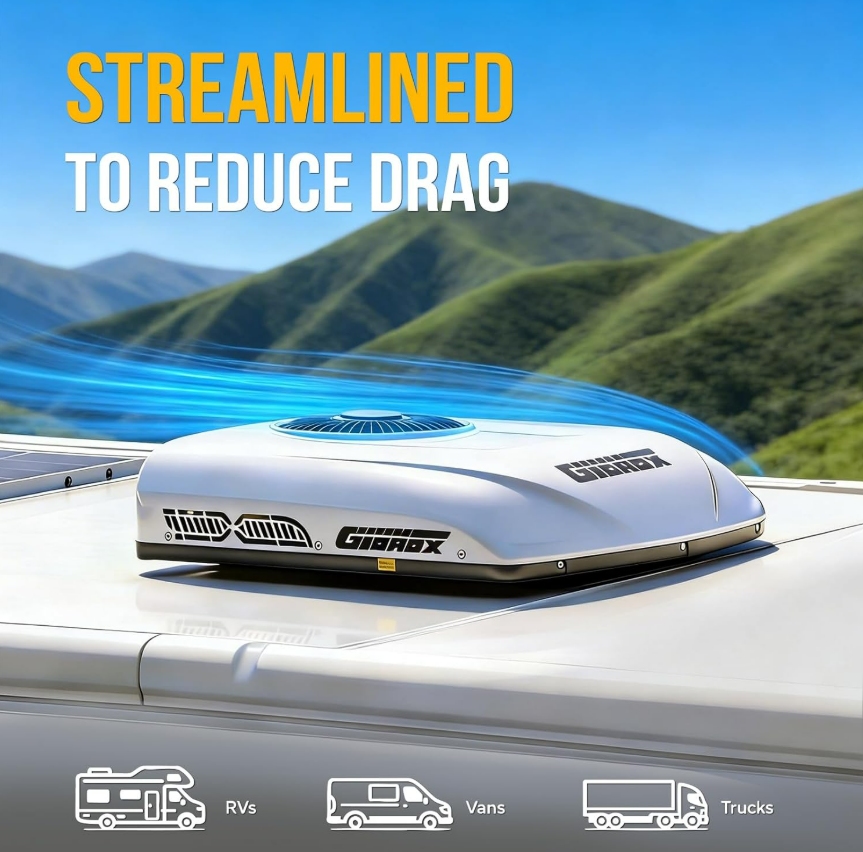
The Gidrox has a low, rounded rooftop profile with a center fan intake on top and side vents around the shroud. At 7 inches tall, it sits much lower than many traditional RV rooftop AC units. That helps with looks, rooftop clearance, and possibly wind behavior.
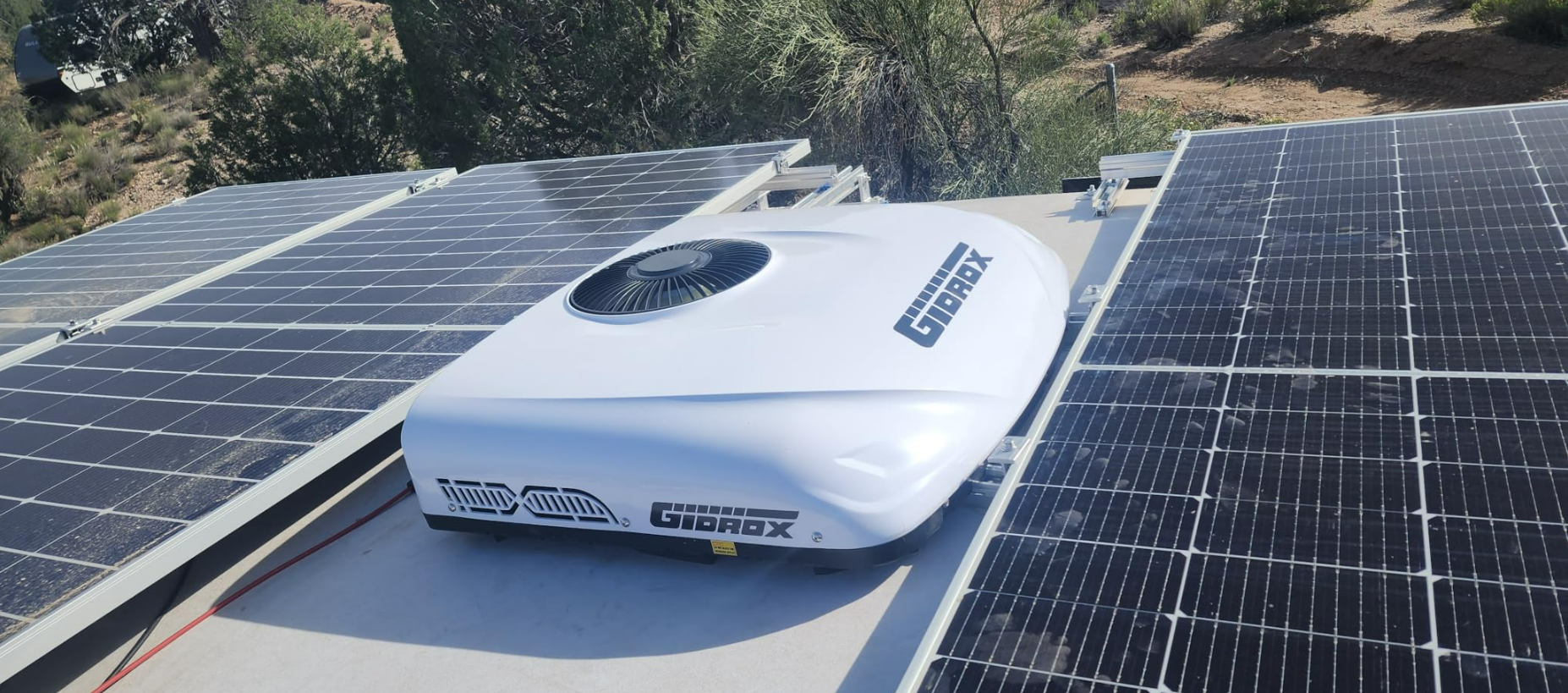
The shroud looks more like a modern van or truck camper AC than a tall rectangular RV rooftop box. That is a good match for builds with solar panels, roof racks, Starlink mounts, vents, and antennas. The supplied rooftop photo shows it sitting between solar panels, which is exactly the use case many buyers have in mind.
My first concern with any low-profile rooftop unit is service access and heat rejection. A shallow unit still needs enough airflow around the condenser section. Do not crowd it so tightly with solar panels or roof rails that it cannot breathe. A pretty roof layout that traps hot air around the unit will cost you performance.
The 54 lb weight is a real advantage. Traditional rooftop units can be heavy enough that getting them onto the roof becomes a job by itself. This one still needs careful lifting, but it is much more manageable for two people than a big 100 lb-style rooftop unit.
Setup and Daily Use
Gidrox markets the unit as fitting standard 14 x 14 inch RV A/C openings. That is helpful because many campers already use that roof cutout for AC or vent installations. The supplied installation image also lists roof thickness compatibility from 1.5 to 3.5 inches and a 19.7 ft power cord.
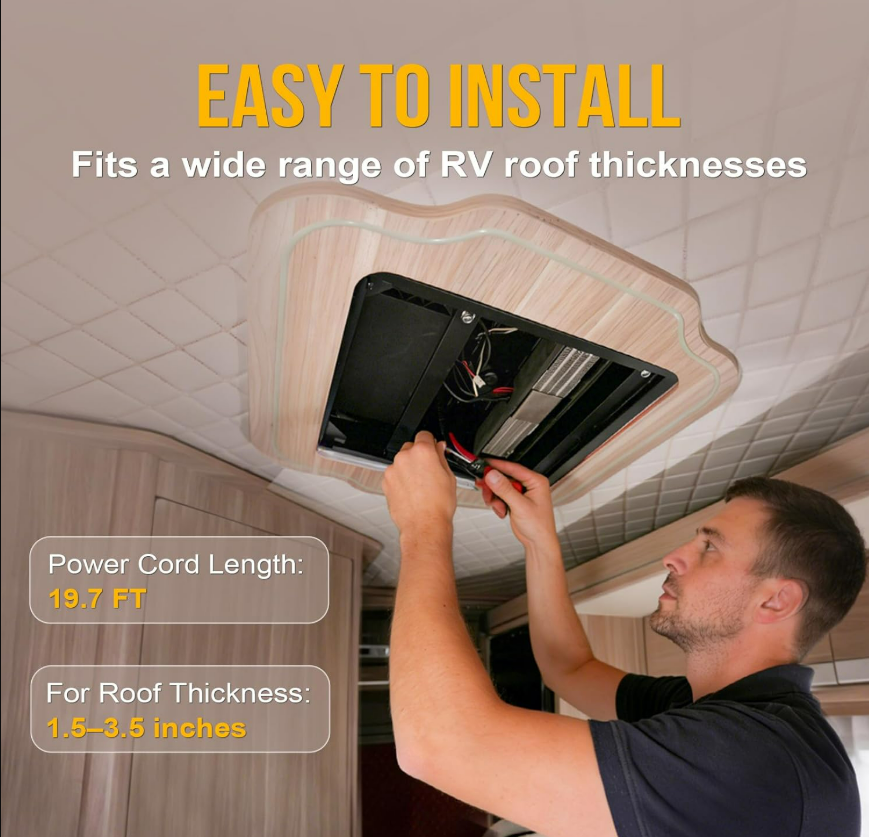
That does not mean every install is easy. A 12V rooftop AC has a different problem than a 115V unit. Instead of asking, “Where is the AC breaker?” you ask, “Can my 12V wiring safely carry this current without too much voltage drop?”
Mike’s install note
At 58A rated current, I care about cable length, wire gauge, fuse placement, battery distance, and termination quality. A loose crimp or undersized cable can create heat and voltage drop. The supplied FAQ says the stable operating input range is 12V to 13.5V, and the unit shuts down below 10.5V. That low-voltage protection is useful, but you do not want to hit it during a hot night because the wiring is marginal.
For a DIY van or skoolie builder, I would mount the battery bank as close as practical to the main DC distribution path, use the correct fuse or breaker, and avoid skinny wire runs. If you are not comfortable sizing DC cable for a 50A-plus load, get help before installation.
In daily use, the three-mode setup makes sense. Turbo is for getting the temperature down. Eco is for holding comfort with less power. Sleep is for nighttime when noise and runtime matter more than fast pull-down.
The supplied app and remote controls are also useful. A roof unit that can be adjusted from bed or from outside the van is not just a convenience feature. When you are managing battery use, being able to switch from Turbo to Eco or Sleep without getting up can save meaningful watt-hours overnight.
Thermal Performance & Airflow Test
A 12V RV air conditioner needs to be judged differently from a household-style AC. The question is not only, “How cold does it blow?” The real question is, “How much comfort does it deliver per amp-hour?”
The Gidrox is rated at 12,000 BTU cooling and 270 CFM airflow. That is a useful number for vans, truck campers, compact RVs, and smaller travel trailers. It may not be enough by itself for a long motorhome sitting in full desert sun with weak insulation and a windshield acting like a greenhouse.

Cooling behavior
The supplied product materials claim 3-minute fast cooling. I would treat that as a best-case pull-down claim, not a promise that every RV will cool in three minutes. In a small van that has been shaded, you may feel cold air quickly. In a heat-soaked bus conversion, the walls, floor, cabinets, and mattress all hold heat. The AC has to cool the contents of the space, not just the air.
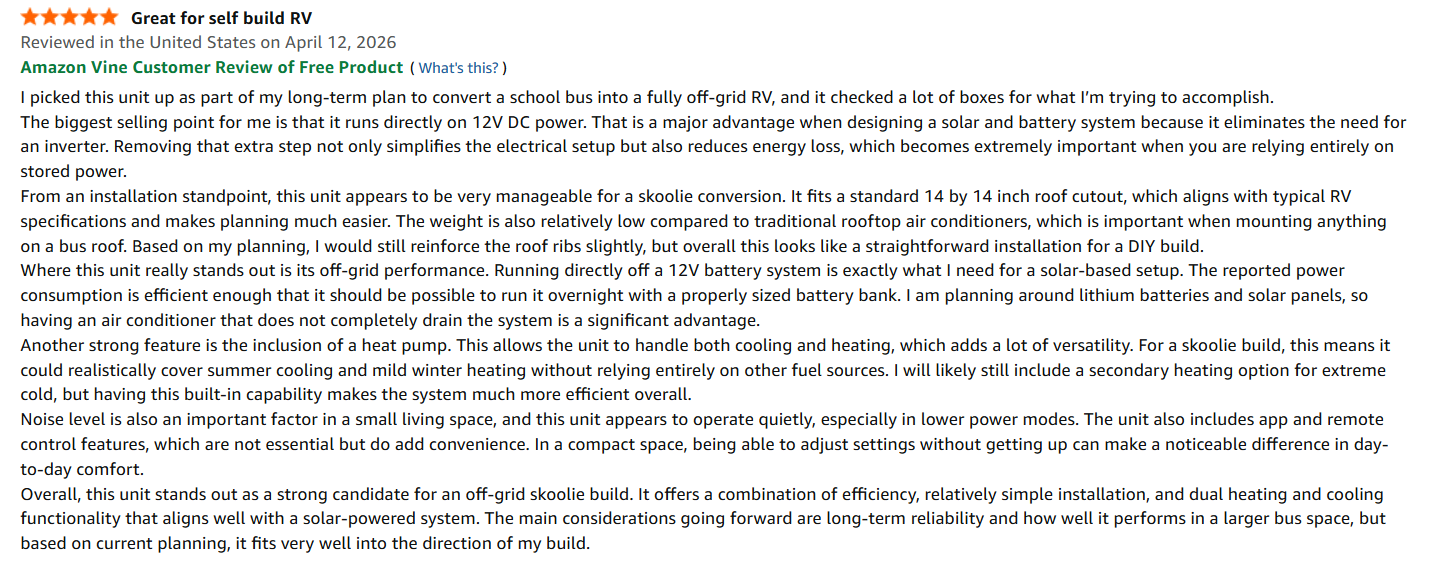
The owner review screenshot from April 2026 is useful because it points to the right kind of installation. The reviewer liked the direct 12V DC power because it avoided the need for an inverter, and they were planning around lithium batteries and solar panels. That is exactly where this unit makes sense.
For real cooling performance, insulation is the quiet partner. A van with Thinsulate, insulated window covers, sealed doors, and a white roof will give this AC a much easier life than a dark box truck with bare metal ribs and big glass.
Heat pump performance
The built-in heat pump adds flexibility. The listing says 9,000 BTU heating and claims about 65% energy savings versus standard heaters. The heat pump is most useful for cool mornings, damp evenings, and shoulder-season camping.
A 12V heat pump is not a magic winter furnace. Once outdoor temperatures get low enough, heat pump efficiency drops. For mild nights, it can keep the interior comfortable without propane. For freezing conditions, I would still want a diesel heater, propane furnace, or another cold-weather heat source.
Battery Runtime and Off-Grid Reality
This is the section that decides whether the Gidrox belongs on your roof.
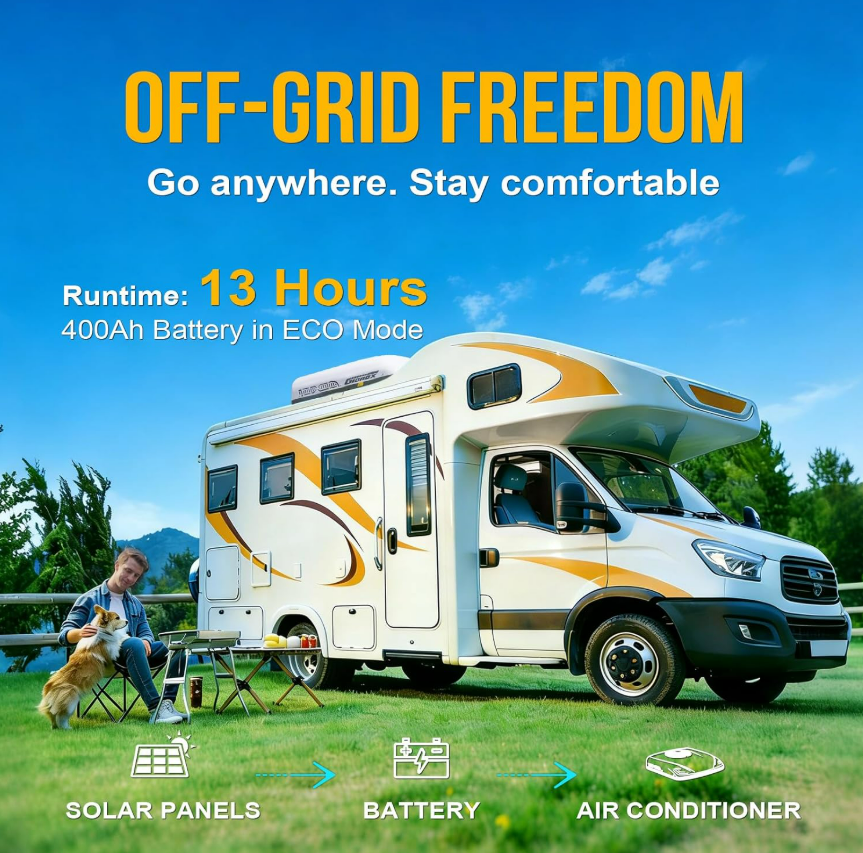
The supplied materials give several runtime examples. One FAQ says that paired with a 12V 600Ah LiFePO4 battery, it can run for about 10 hours in continuous Turbo mode and about 26 hours in continuous Sleep mode. Another image says 13 hours with a 400Ah battery in Eco mode. The product bullets also mention about 350W average power consumption during nighttime operation at 30°C ambient.

Those numbers are useful, but they require context. A 12V 600Ah LiFePO4 bank is not a small battery. It is a serious bank. A 400Ah battery is also substantial. Runtime depends on usable battery capacity, battery health, wiring losses, compressor speed, fan mode, outdoor heat, interior setpoint, and whether solar is contributing while the unit runs.
Technician battery math
A 12V 400Ah lithium battery bank stores roughly 5.1 kWh nominal energy. A 600Ah bank stores roughly 7.7 kWh nominal energy. You should not plan to use every watt-hour. Battery management systems, voltage sag, temperature, and other loads all reduce what you should count on.
If the unit is drawing around 350W in a mild nighttime scenario, then long overnight runtime is believable with a large lithium bank. If it is running closer to the 700W rated power in hot conditions, runtime drops fast. Add a fridge, lights, water pump, router, fans, and device charging, and your real number changes again.

This is why I like the Eco and Sleep modes. The unit is not only about maximum cooling. It is about stepping down after the cabin is comfortable. The best way to use a 12V AC is often to cool the space hard before bed, then let Sleep mode hold the line overnight.
Noise, Sleep Mode, and Cabin Comfort
The supplied noise graphic lists 53 dB for Turbo, 43 dB for Eco, and 40 dB for Sleep. That is quiet on paper. More important, the unit uses a brushless fan and sound-insulation design according to the product text.
In a small RV, noise quality matters as much as noise level. A soft fan sound can disappear into the background. A high-pitched whine or plastic buzz can ruin sleep even at a lower decibel rating.
What I would listen for
After installation, I would test all three modes with the cabin quiet. Listen for roof vibration, plastic resonance, fan imbalance, and plenum rattle. If the unit sounds rough, do not assume it is normal. Check mounting tension, roof framing, interior trim, and whether anything is touching the plenum.
A 40 dB Sleep mode claim is attractive, but a loose panel can make that irrelevant. Good installation protects the quiet rating.
Controls, App, Remote, and On-Unit Buttons
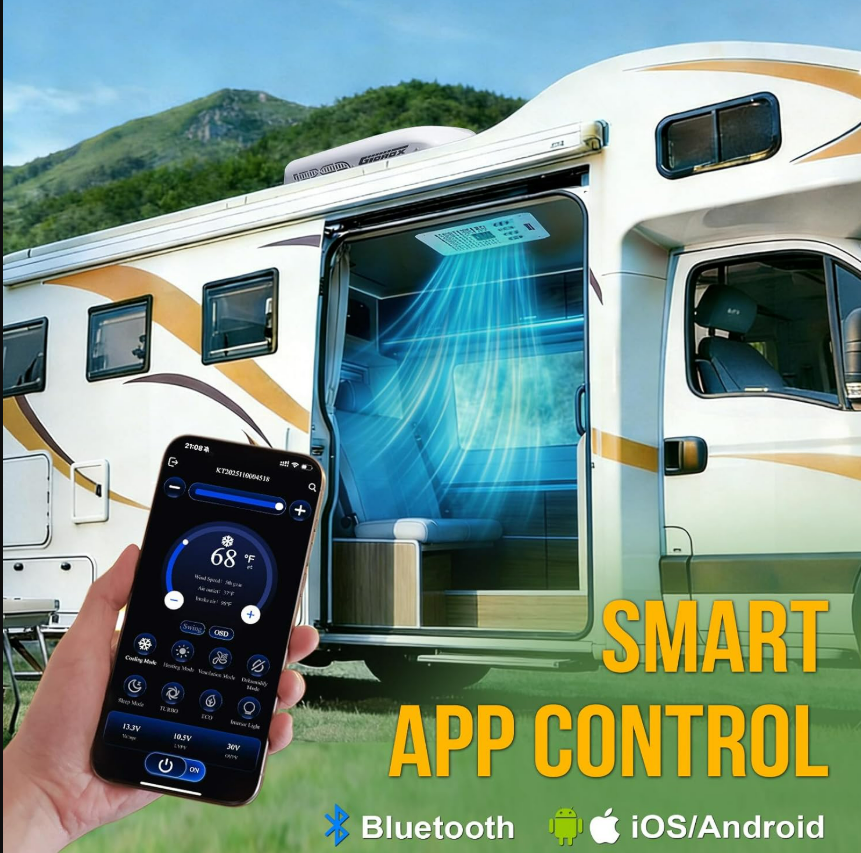
The Gidrox gives you three control methods: smartphone app, infrared remote, and physical buttons on the unit. That is the right mix. App-only controls are a bad idea in an RV because phones die, Bluetooth can be annoying, and guests may not have the app installed.
The supplied app graphic shows Bluetooth support for iOS and Android. That means expectations should be realistic. Bluetooth is usually local-range control, not true internet control from miles away. For most campers, that is fine. You want to change temperature from the bed, not manage the AC from another state.
The product text says you can set temperature, program timers, switch between °C and °F, and use automatic power adjustment based on temperature difference. That kind of control is more useful on a battery-powered AC than on a normal shore-power unit. When every amp-hour matters, mode choice becomes part of energy management.
The infrared remote is also useful. If the phone app acts up, the remote keeps the unit practical. Physical buttons are the final backup. That is how RV gear should be designed.
Build Quality and Owner Feedback
One owner review says the unit felt substantial after removing the cover and seeing the copper tubing and internal components. That matches what I would want to see in a rooftop AC. Clean tubing layout, tidy wiring, and solid internal mounting matter because road vibration punishes sloppy construction.
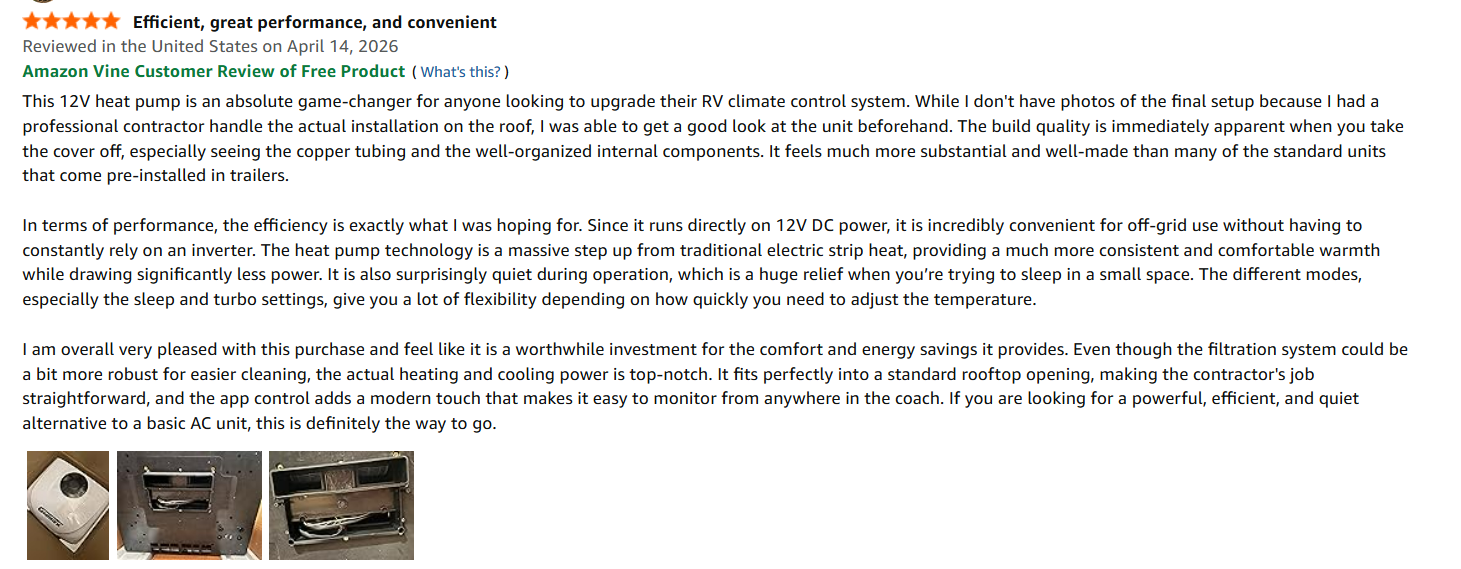
The same review also notes that the filtration system could be more robust for easier cleaning. That is a fair criticism. RV AC filters collect dust, pet hair, pollen, cooking residue, and road grime. If the filter setup is fussy, owners clean it less often. A dirty filter reduces airflow and hurts performance.
The other owner review focused on a self-build skoolie project and called out direct 12V operation as the main reason for choosing it. That is the most convincing use case to me. This product is not trying to be a cheap replacement for every old rooftop AC. It is trying to solve the inverter-loss problem for battery-based builds.
What I Like
I like the direct 12V DC design. Avoiding the inverter is the whole point of this product, and for off-grid builds, that can simplify the system.
I like the 54 lb weight. It makes roof handling easier and reduces the load added to the roof.
I like the 14 x 14 inch opening compatibility. A standard roof cutout keeps the install from becoming a fabrication project.
I like the three control options. App, remote, and physical buttons are better than relying on only one control path.
I like the mode spread. Turbo, Eco, and Sleep are easy to understand and match how people actually use AC in a camper.
I also like the low-profile shroud. On a solar-heavy roof, keeping the unit lower helps with layout and clearance.
What Could Be Better
The runtime claims need clearer test conditions. Battery size is only one part of the story. Outdoor temperature, humidity, set temperature, insulation, solar input, and other loads all matter.
The filter design may not satisfy owners who camp in dusty places or travel with pets. Based on owner feedback, easier filter access and a more robust filtration setup would be welcome.
The low-voltage shutdown is useful, but buyers need stronger wiring guidance. At this current level, wire gauge mistakes can cause real problems.
The 12,000 BTU rating is not a fit for every RV. Large Class A motorhomes, poorly insulated buses, and rigs with lots of glass may need more cooling capacity or multiple units.
The heat pump should be described with more cold-weather guidance. Buyers need to know where supplemental heat ends and furnace weather begins.
Who Should Buy It
Buy the Gidrox 12V DC RV air conditioner if you are building or upgrading an off-grid camper with lithium batteries and solar.
It is a strong match for camper vans, truck campers, skoolies, compact travel trailers, cargo trailer conversions, and work trucks that need cooling without shore power.
It also fits owners who want overnight cooling without running a generator. If you already have a 400Ah to 600Ah lithium setup, the runtime claims become much more realistic.
This is also a good option if you want a lightweight rooftop AC and prefer a low-profile shape around solar panels.
Who Should Skip It
Skip it if you want the cheapest possible rooftop AC replacement. A 12V DC unit is usually bought for electrical-system advantages, not lowest upfront cost.
Skip it if your RV has a small lead-acid battery bank. This product makes the most sense with LiFePO4 capacity and proper wiring.
Skip it if you need to cool a large, poorly insulated RV in extreme heat with one rooftop unit. The 12,000 BTU rating has limits.
Skip it if you are not comfortable planning 12V high-current wiring. This is not like wiring a small fan or LED light.
Skip it if you need strong winter heat. The heat pump is useful, but it should not be your only cold-weather plan.
Buying Advice
Before buying, confirm your roof opening, roof thickness, battery capacity, wire path, fuse or breaker plan, and solar charging capability. The opening and roof thickness are easy to measure. The electrical side deserves more care.
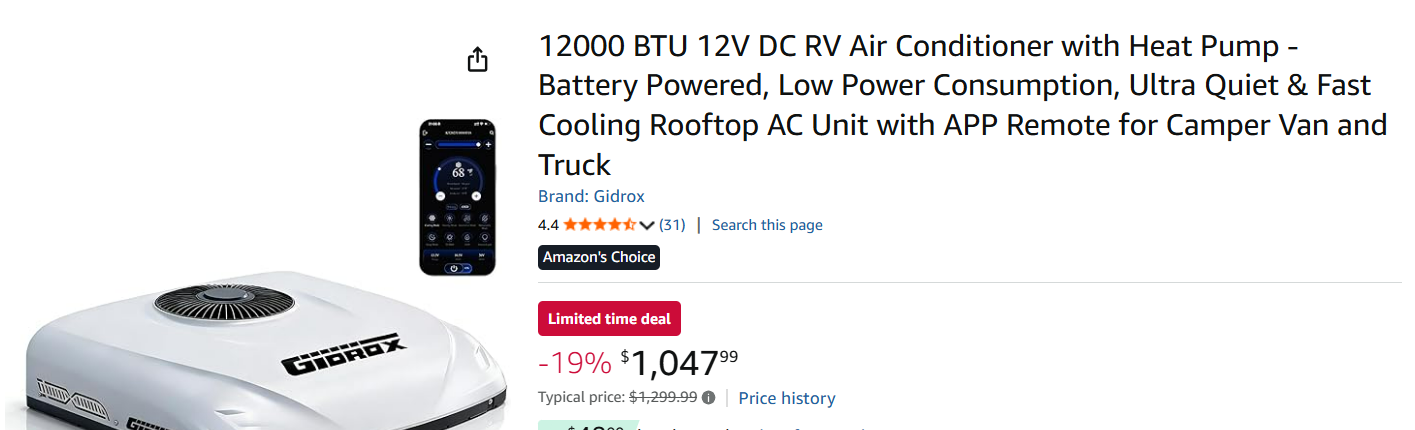
At the time of writing, pricing may change. Check the current seller page before buying, and compare the full installation cost, not just the unit price. You may need heavier cable, proper lugs, a fuse or breaker, sealant, roof support work, or professional help.
I would not buy this unit until I had a simple power plan written down: battery size, expected loads, wire length, fuse size, solar input, and realistic overnight runtime. That one page will tell you more than any ad image.
For solar-heavy builds, plan the roof layout before cutting anything. Leave enough space around the unit for airflow and service access. Do not box the AC in with panels so tightly that the condenser air has nowhere to go.
Final Verdict
The Gidrox 12V DC RV air conditioner is a serious option for off-grid campers who understand battery power and want roof-mounted cooling without the inverter step. Its strengths are direct 12V operation, 12,000 BTU cooling, 9,000 BTU heat pump output, low-profile 54 lb design, standard 14 x 14 inch opening fit, quiet Sleep mode, and flexible controls.
I would not oversell it as the answer for every RV. The right buyer has lithium capacity, decent insulation, proper wiring, and realistic expectations. In that setup, this unit makes sense. It can cool a compact camper, reduce generator dependence, and fit neatly into a solar-based build.
For a van, skoolie, truck camper, or smaller RV that already has a real battery system, the Gidrox 12V DC RV air conditioner deserves a close look. For a large rig with weak insulation and minimal batteries, fix the power and heat-load problem first.
FAQ
How long can the Gidrox 12V DC RV air conditioner run on batteries?
The supplied materials give examples of about 10 hours in Turbo and about 26 hours in Sleep mode with a 12V 600Ah LiFePO4 battery. Another image claims 13 hours with a 400Ah battery in Eco mode. Real runtime depends on temperature, insulation, battery health, wiring, solar input, and other loads.
Does this 12V RV air conditioner need an inverter?
No. The main advantage is that it runs directly on 12V DC power. That can reduce inverter loss and simplify off-grid electrical design compared with a traditional 115V AC rooftop unit.
What battery size should I use?
The product materials reference 400Ah and 600Ah battery examples. For practical overnight cooling, a large LiFePO4 bank is strongly preferred. Small lead-acid batteries are not a good match for this kind of continuous high-current load.
What voltage does the Gidrox 12V AC require?
The supplied FAQ lists a stable operating input voltage range of 12V to 13.5V. If input voltage drops below 10.5V, under-voltage protection triggers an error and the unit shuts down.
Is the Gidrox 12V DC RV AC quiet?
The supplied graphics claim 53 dB in Turbo, 43 dB in Eco, and 40 dB in Sleep mode. Actual cabin noise depends on installation, roof framing, plenum fit, vibration, and fan setting.
Does it have heating?
Yes. The supplied materials list a 9,000 BTU heat pump. It is useful for cool mornings and mild shoulder-season camping, but it should not be treated as a primary heater for freezing conditions.
Does it fit a standard RV roof opening?
Yes, the supplied materials say it fits a standard 14 x 14 inch RV A/C opening. The listed dimensions also show a 54 lb unit with a 7 inch height. Measure your roof opening and roof thickness before buying.
Can I control it with a phone?
Yes. The product materials show Bluetooth app control for iOS and Android, plus an infrared remote and physical buttons on the unit. Bluetooth should be treated as local control, not long-distance internet control.