Disclosure: This post contains affiliate links. I may earn a small commission at no extra cost to you if you purchase through these links.
Most RV AC roundups talk about the same three or four brands. Coleman Mach, Dometic, Furrion, maybe a TURBRO. ASA Electronics and their Advent Air line rarely come up in conversation, and I think that’s a mistake — not because they’re perfect, but because at the price point and with the feature set, they’re solving a problem a lot of people have.
That problem is this: your 30- or 34-year-old Coleman or Dometic finally gave out. You need 15,000 BTU because your rig is big enough to warrant it. You want something that drops into the existing hole, plugs into the existing wiring, and actually cools the thing. You don’t need WiFi. You don’t need an inverter compressor. You need cold air now.
The ASA Electronics ACM150B Advent Air 15,000 BTU RV Air Conditioner in black is that unit. Amazon’s Choice badge, 4.2/5 across 36 reviews, at around $892. Let’s get into it.
What Is the Advent Air ACM150B, Really?
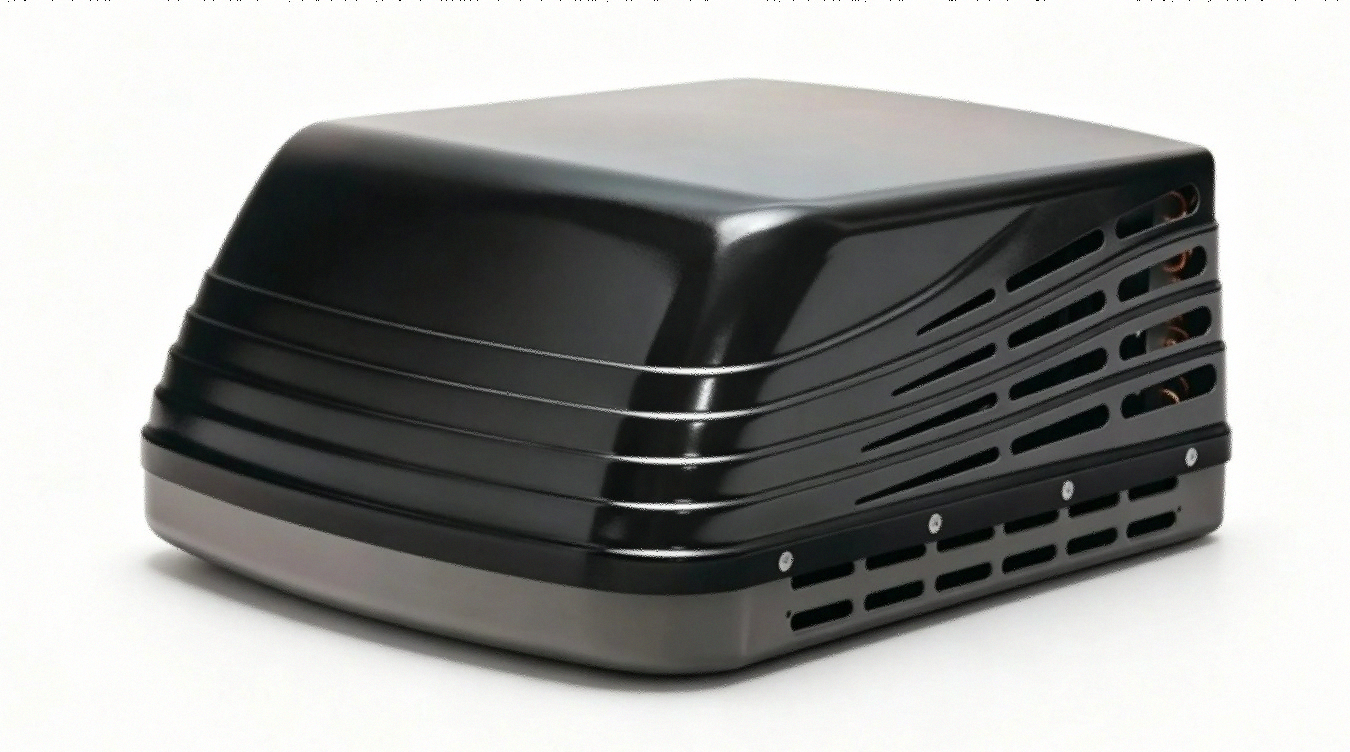
ASA Electronics has been making RV HVAC equipment since the 1970s under the Advent Air brand. They’re not a startup chasing trends — they make equipment for the RV OEM market and sell replacement units. The ACM150B is their 15,000 BTU rooftop air conditioner in the black colorway (the white version is the ACM150W, same unit different shroud color). It’s designed for both ducted and non-ducted ceiling systems, which makes it genuinely versatile across a wide range of RV configurations.
What’s interesting about Advent is their independent lab testing claim: ARI standard testing reportedly shows their units averaging 10% greater actual cooling output than the rated BTU. On a 15,000 BTU unit, that’s roughly 16,500 BTU in real-world cooling. That’s not marketing fluff — the Air-Conditioning and Refrigeration Institute has standardized testing protocols, and if Advent’s numbers hold up under those conditions, it means you’re getting more cooling headroom than the nameplate suggests.
Specs That Actually Matter
| Spec | Value |
|---|---|
| Cooling Capacity | 15,000 BTU (averages ~16,500 BTU per ARI testing) |
| Fan Speeds | Three (High / Medium / Low) |
| Airflow | Not officially published |
| System Compatibility | Ducted and Non-Ducted |
| Roof Opening Required | 14.25” x 14.25” standard |
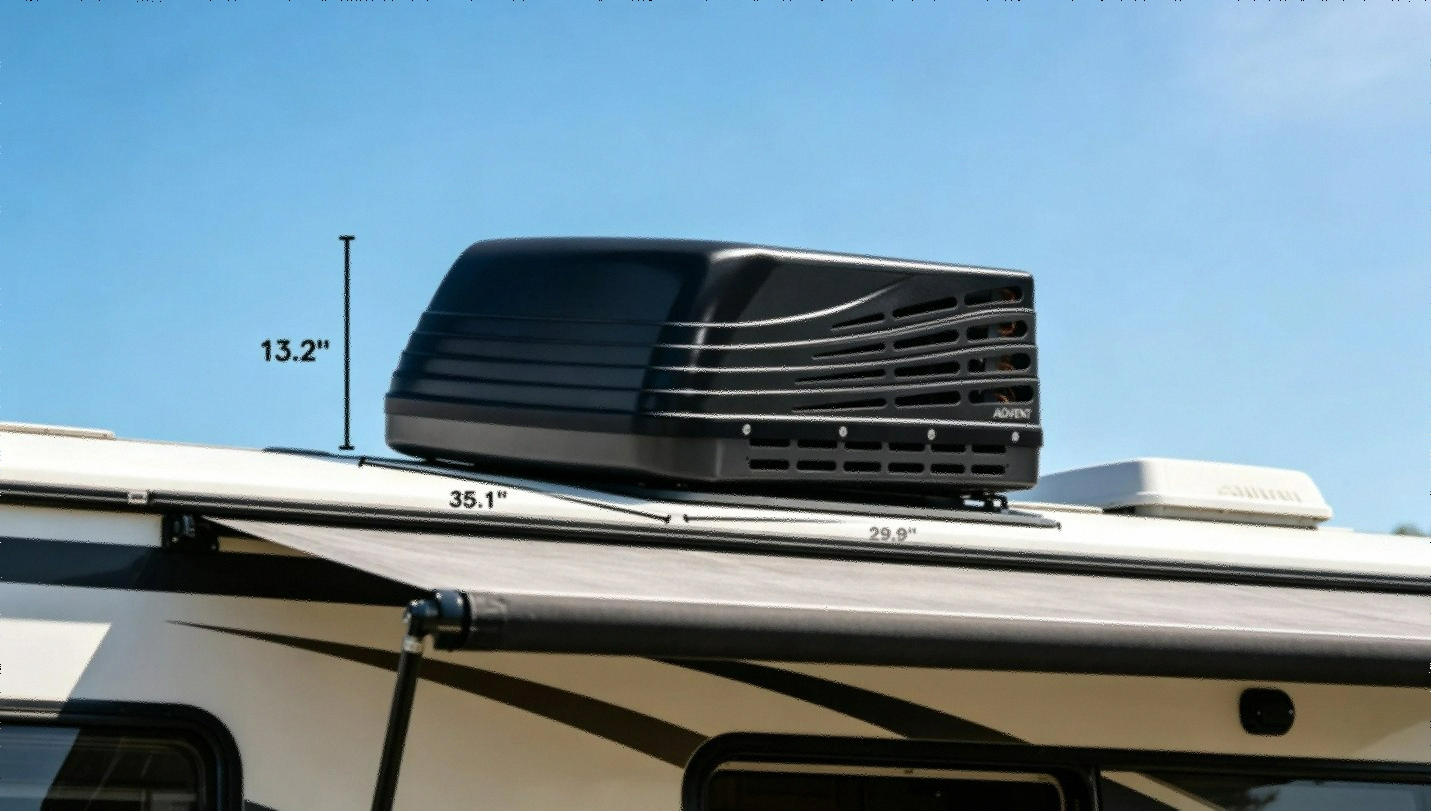
| Roof Unit Dimensions | 35.1”L x 29.9”W x 13.2”H |
| Refrigerant | Non-ozone depleting (environmentally friendly) |
| Overload Protection | Yes (motor overload protector included) |
| Filter | Removable and washable |
| Frame Construction | Composite foam and metal (rigid) |
| Water Seal Gasket | Extra-thick premium gasket |
| Heating Option | Electric element available separately |
| Warranty | 2-year factory warranty |
| Amazon Price (2026) | ~$892 |
A few things I want to flag from this spec list:
The three-speed fan is more useful than it sounds. Most budget rooftop units give you high and low. Having medium means you can find a genuine middle ground between “blast furnace” airflow and “barely moving air.” Ronald M., who installed two of these on his 37-foot ducted RV, specifically called out the fan speeds: very good cooling on high, pretty quiet on low.
The composite foam and metal frame is an engineering choice that actually pays off. This construction approach reduces vibration and resonance compared to all-plastic housings, which is one reason the noise profile tends to be better than cheaper units despite being a traditional on/off compressor design.
The extra-thick water seal gasket matters more than people realize. A bad gasket or thin gasket is how you get water intrusion through the roof opening. With RVs sitting in sun, rain, and temperature swings for years, a premium seal is long-term protection against interior damage.
The 15,000 BTU Question: Do You Actually Need It?See Today’s Deal on Amazon
Before getting into the review mechanics, let’s be honest about when 15K BTU makes sense versus 13.5K.
The general rule of thumb in RV cooling: you need roughly 20 BTU per square foot of living space, adjusted upward for desert climates, black roofs, and poor insulation. A 25-foot Class C with decent insulation in moderate climate? 13,500 BTU is fine. A 37-foot fifth wheel in Texas summer with two slideouts? You probably want 15K minimum, and possibly a second unit.
The ACM150B is specifically positioned for larger rigs and hotter climates where that extra headroom matters. Glen Lewis replaced a Coleman Mach 3 that died, ran the Advent through 100-plus degree days, and found it a clear improvement — both in cooling performance and in the direct wire harness hookup that eliminated adapter hassle.
If you’re trying to decide between 13.5K and 15K, consider: you can’t add BTUs after the fact, but you can run a 15K unit at lower capacity by relying on the thermostat. Getting the bigger unit isn’t wrong-sizing — it’s buying headroom.
covers the 13,500 BTU segment in detail if you’re comparing directly.
Installation: What Real Owners Say
The consistent theme across reviews is that installation is genuinely straightforward — with a few specific caveats you’ll want to know about before you start.
The Good News
Ronald M. installed two of these on a 37-foot ducted RV and found them easy once the old units were off the roof. They came with new thermostats included in his ceiling control panel purchase. Glen Lewis noted the wire harness hookup was direct and simple — better than what he experienced with the Coleman it replaced.
Michael S. described it as plug-and-play and was able to push the unit up a leaned ladder by himself (though having two people is still strongly recommended — this is a heavy rooftop unit). He added a useful tip: make sure the mounting bolts don’t contact anything they shouldn’t. That’s what caused his previous unit to fail after 18 months — vibration-induced bolt contact wearing on a component over time.
Marc Milner: great replacement AC, works great, keeps him cool, would purchase again. Short review but from someone with first-hand installation experience.
The Issues to Watch For
Jim S. would have given the unit 5 stars if there had been installation guidance included. There wasn’t. He got it working but it took a couple of days of troubleshooting because of missing information. Lesson: do your research before your installation day. Watch YouTube videos specific to your RV’s existing AC configuration. The unit isn’t complicated, but “not complicated” and “no instructions” are different things.
The Amazon Customer (first review) had a packaging issue — the vent side was dented/crunched during shipping, with minimal protective padding in the box. The fan didn’t come on initially, required going through the unit to check for damage, and worked fine on the second attempt. They still gave it 5 stars and are happy with the purchase, but this is the same shipping vulnerability we saw with the Coleman Mach line.
⚠️ Watch Out: Inspect the unit immediately on arrival, before your installation day. Document any shipping damage with photos. The 30-day return window starts at delivery, not installation — don’t discover a problem after your window closes.
💡 Pro Tip: No instructions in the box is apparently a feature, not a bug, with this unit. Owners consistently say it’s straightforward once you’ve done one. But if this is your first rooftop AC swap, spend an evening on YouTube first. Search your specific RV model + “roof AC replacement” — you’ll find someone who’s done it.
Cooling Performance: The 16,500 BTU Claim Put to the Test
Here’s what the ARI testing claim means in practice. ARI (now AHRI) testing is done under controlled conditions — specific indoor and outdoor temperatures, specific airflow setups. If Advent’s units consistently outperform their rated capacity under those conditions, it suggests the coil design and refrigerant circuit are sized more generously than the nameplate implies.
Real-world owner feedback tracks with this. The Amazon Customer who replaced a 34-year-old Coleman noted the Advent was “hopefully a more efficient unit” — which is a reasonable expectation given that decades of refrigerant and coil improvements separate old Coleman tech from current Advent units. The Anonymous Amazon Customer who had a Dometic OEM unit said the Advent “blows that one out of the water, it’s quieter, colder and easy/simple to install” — so impressed they immediately ordered a second one.
Ronald M. running two units in a ducted 37-footer reported great cooling results on high fan speed. For reference, ducted systems distribute cooled air more evenly and generally feel more comfortable than direct-dump non-ducted systems because you don’t get the blast-right-below-the-unit effect.
In 100-plus degree heat, Glen Lewis found it a genuine upgrade over his failed Coleman. That’s the real-world test that matters most for desert RVers.
Noise Level: Better Than Expected, But Not Silent
The composite foam and metal frame construction pays dividends here. Multiple reviewers described the ACM150B as quieter than whatever it replaced, and the original Amazon customer specifically noted it as “a bit quieter of course than the old one.”
Ronald M. found it “pretty quiet on low speed,” which matters a lot if you’re trying to sleep with the AC running — a low-speed operation that doesn’t sound like a jet engine at 2 AM is a legitimate quality-of-life improvement.
Michael S. described it as quieter than the Dometic it replaced.
That said, this is still a traditional on/off compressor unit. When it kicks on, you hear it. When it cycles off, you hear the silence. The cycling sound is present — it’s just less jarring than older generation units or thinner-framed competitors.
If true whisper-quiet operation is your priority, the conversation shifts to inverter compressor units like the TURBRO or Furrion lines. Related Post: Furrion Chill Cube 18K Review covers a premium variable-speed option for comparison.
Ducted vs. Non-Ducted: The ACM150B Handles Both See Today’s Deal on Amazon
This is actually a meaningful differentiator. Some RV AC units are designed only for non-ducted (direct dump) ceiling assemblies, which limits compatibility with RVs that have ductwork running through the ceiling.
The Advent ACM150B works with both system types. Ronald M. runs two of them in a ducted 37-foot RV and they work great. The Amazon Customer who bought it for a fifth wheel bought the matching ceiling assembly from Advent and reported it fit good and worked well.
If your current setup is ducted (cold air flows through registers rather than coming directly out of the ceiling unit), verify your ceiling assembly compatibility before ordering. The non-ducted ceiling assembly from ASA Electronics (model ACDB) is sold separately and has over 340 reviews on Amazon.
Durability: The Honest Picture
With only 36 reviews total, the dataset is smaller than for the Coleman Mach line (364 reviews) or major competitors. The 4.2/5 average with 66% five-star reviews and 11% one-star reviews tracks similarly to market norms for rooftop ACs in this price range.
The most concerning negative review is from David Mata: the capacitor failed at 8 months, and after warranty service, the compressor failed at 18 months. He also described a frustrating customer service experience where he felt misled about reimbursement for a service call.
That’s a legitimate concern. A capacitor failure at 8 months is earlier than expected, though capacitors are a known failure point in AC units (and a relatively cheap fix when caught in warranty). The compressor failure at 18 months on a replaced unit is harder to evaluate without knowing the service conditions.
The 2-year factory warranty is Advent’s protection mechanism here. It’s better than the standard 1-year warranty on some competing units. Whether Advent’s warranty service experience is consistently good is harder to verify — David Mata’s experience was clearly poor, while the Amazon Customer noted that customer service was helpful in pre-purchase communication.
Michael S. pointed out a useful maintenance note: check that your mounting bolts aren’t in contact with anything, because that’s what caused his previous unit’s early failure. Bolt rattle + vibration over time = worn components. It’s a 5-minute check during installation.
ACM150B vs. The 15K Competition: Where It Fits
At 15,000 BTU, you’re comparing against a different field than the 13.5K segment.
| Model | BTU | Type | Heat | Price (approx.) | Notes |
|---|---|---|---|---|---|
| ASA Advent ACM150B | 15,000 | On/Off | Add-on only | ~$892 | This review unit, black |
| Dometic FreshJet 3 (15K) | 15,000 | Variable Speed | Optional | ~$949 | Premium build, quiet |
| TOSOT 16K | 16,000 | On/Off | Heat Pump | ~$949 | Good value, more BTU |
| Furrion Chill Cube 18K | 18,000 | Variable Speed | Heat Pump | ~$929 | Top of market, most cooling |
| Coleman Mach 15 | 15,000 | On/Off | Electric add-on | ~$1,054 | Most parts-available |
The ACM150B’s competitive position is clear: it’s the most affordable 15K BTU option from a brand with RV-specific engineering heritage. It undercuts the Coleman Mach 15 by over $160, offers ducted/non-ducted flexibility, and comes with a longer factory warranty.
Where it loses ground: no inverter compressor, no built-in heat pump, smaller review base than Coleman or Dometic, and less established reputation for warranty service reliability.
The Furrion Chill Cube 18K is worth a look if you’re in a larger rig and want variable speed technology. Related Post: Furrion Chill Cube 18K Review has the full breakdown. For solar and off-grid focused builds, the 12V inverter options are a different conversation entirely — Related Post: GIDROX 12000 BTU 12V RV Air Conditioner Review covers that territory.
The Black Shroud: Why It Matters More Than Aesthetics
Most RV rooftop ACs come in white or arctic white. The ACM150B in black is one of relatively few 15K options available in a dark colorway.
Why would you want a black shroud? A few reasons:
Some RV designs have black or dark roofs and want visual consistency. Some owners have black or dark-colored rigs where a white rooftop unit looks out of place. And some people just like the aesthetic — a black unit on a black or dark grey roof looks intentional rather than tacked-on.
The tradeoff is minimal in practice. Black absorbs slightly more solar heat on the shroud surface, but the rooftop AC shroud is not part of the refrigeration circuit — it’s just a protective housing. The coils and internal components are the same regardless of exterior color.
If you’ve been hunting for a 15K black RV AC without wanting to special-order through an RV dealer, this is one of the easiest Amazon options to find.
Washable Filters: The Feature You’ll Actually Use
This is a small thing but I appreciate that it’s specifically called out in the product description. Removable and washable filters mean you’re not buying replacements every few months.
Dirty filters reduce airflow, reduce cooling efficiency, and strain the motor. An RV AC filter accumulates road dust, campground particulates, and everything the blower pulls in. In a unit without washable filters, people either ignore maintenance (bad) or buy replacement filters repeatedly (annoying and expensive).
The ability to pop the filter out, rinse it, let it dry, and reinstall is genuinely convenient for full-timers or frequent travelers. It takes 15 minutes twice a season and extends the life of the unit.
Who Should Buy the ASA Electronics ACM150B Advent Air?
This is the right unit if:
- You have a larger RV (28+ feet) where 15K BTU is appropriate sizing
- You camp primarily on shore power and want reliable cooling without complexity
- You’re replacing a failed Coleman, Dometic, or Carrier unit and want a less expensive alternative
- Your RV has a dark or black exterior and you want visual consistency
- You run a ducted ceiling system and need confirmed ducted compatibility
- You want a longer 2-year factory warranty without paying Coleman Mach 15 prices
Look elsewhere if:
- You’re building a solar or battery-primary rig (no inverter compressor here)
- You need heating capability without a generator or shore power (no heat pump)
- Your rig is under 25 feet where 13.5K BTU is more appropriately sized
- Warranty service reliability is your primary concern — the review base is too small to be definitive
- You want the most parts-available, most serviced brand in North America (that’s still Coleman Mach)
Advent Air ACM150B FAQ
Q: Is this unit compatible with my existing Coleman or Dometic wiring? With the purchase of a separate adapter kit (ASA sells ACCOLKIT for Coleman AC135 compatibility), the Advent can replace select Coleman and Carrier rooftop units. Glen Lewis noted direct wire harness hookup worked well as a Coleman replacement. Verify your specific model compatibility before ordering.
Q: Does it come with a ceiling assembly? No. The ACM150B is the rooftop unit only. The matching non-ducted ceiling assembly (ACDB) and ducted options are sold separately by ASA Electronics. Ronald M. replaced the ceiling control panels along with his rooftop units.
Q: What’s the power requirement? Standard RV power — 115 VAC, 60Hz. It will run on 30-amp shore power service. Wattage specifications aren’t published on the Amazon listing but at 15K BTU on a traditional compressor, expect startup surge around 15+ amps and running draw in the 13–15 amp range.
Q: Can I add heat later? Yes. An electric heat element option is available separately. This is resistance heating, not a heat pump, so it works best when you’re on shore power rather than trying to run it off batteries or a small generator.
Q: Does it include installation instructions? Multiple reviewers note it does not include instructions. Jim S. specifically marked this as a negative — it added days to his installation. Watch YouTube and have your existing unit’s wiring documented before you start.
Q: Is it available in white? Yes, the ACM150W is the same unit in white. The ACM150B reviewed here is the black version.
Final Verdict
The ASA Electronics ACM150B Advent Air 15,000 BTU RV Air Conditioner in black occupies a real gap in the market: a genuine 15,000 BTU rooftop unit from an RV-heritage brand, priced lower than the Coleman Mach 15, with ducted/non-ducted compatibility and a 2-year warranty.
If you’re replacing a failed unit in a mid-to-large RV and want straightforward cooling without paying premium prices for inverter technology or heat pump functionality, this makes a lot of sense. The owner who replaced a 34-year-old Coleman, the guy who put two of them in a 37-foot ducted rig, the person who said it outperforms the Dometic it replaced — these are the use cases this unit was built for.
The small review pool means there’s less certainty about long-term durability than you get with a Coleman Mach that has 364 reviews and decades of service history. The packaging situation is a real flaw that ASA should fix. And if you need off-grid cooling, this isn’t the path.
But for shore-power camping in a larger rig, in black, at under $900? It’s a smart buy that most people overlook because they’ve never heard of Advent Air.
Prices and availability are accurate as of June 2026. Amazon prices fluctuate — check the current price before purchasing.