Best 12V RV Air Conditioner 2026: Off-Grid Cooling for Vans, Skoolies & Solar Builds
A 12V RV air conditioner is one of the most misunderstood products in the RV market. Half the buyers expect it to replace a regular rooftop AC. The other half expect it to run all day on a small battery. Both end up disappointed. The truth is narrower and more useful: a 12V DC air conditioner is a specialized tool for a specialized rig. When the build is right, it changes off-grid camping. When the build is wrong, it’s an expensive way to drain a battery bank in three hours.
This guide walks through what a 12V RV AC actually is, when it makes sense, when it doesn’t, and which models are worth your time in 2026. We are not pretending every off-grid camper needs one — most travel trailers will be happier with a traditional rooftop unit. But for the right rig, a 12V DC system is the difference between cooling and not cooling at all.
As an Amazon Associate I earn from qualifying purchases.
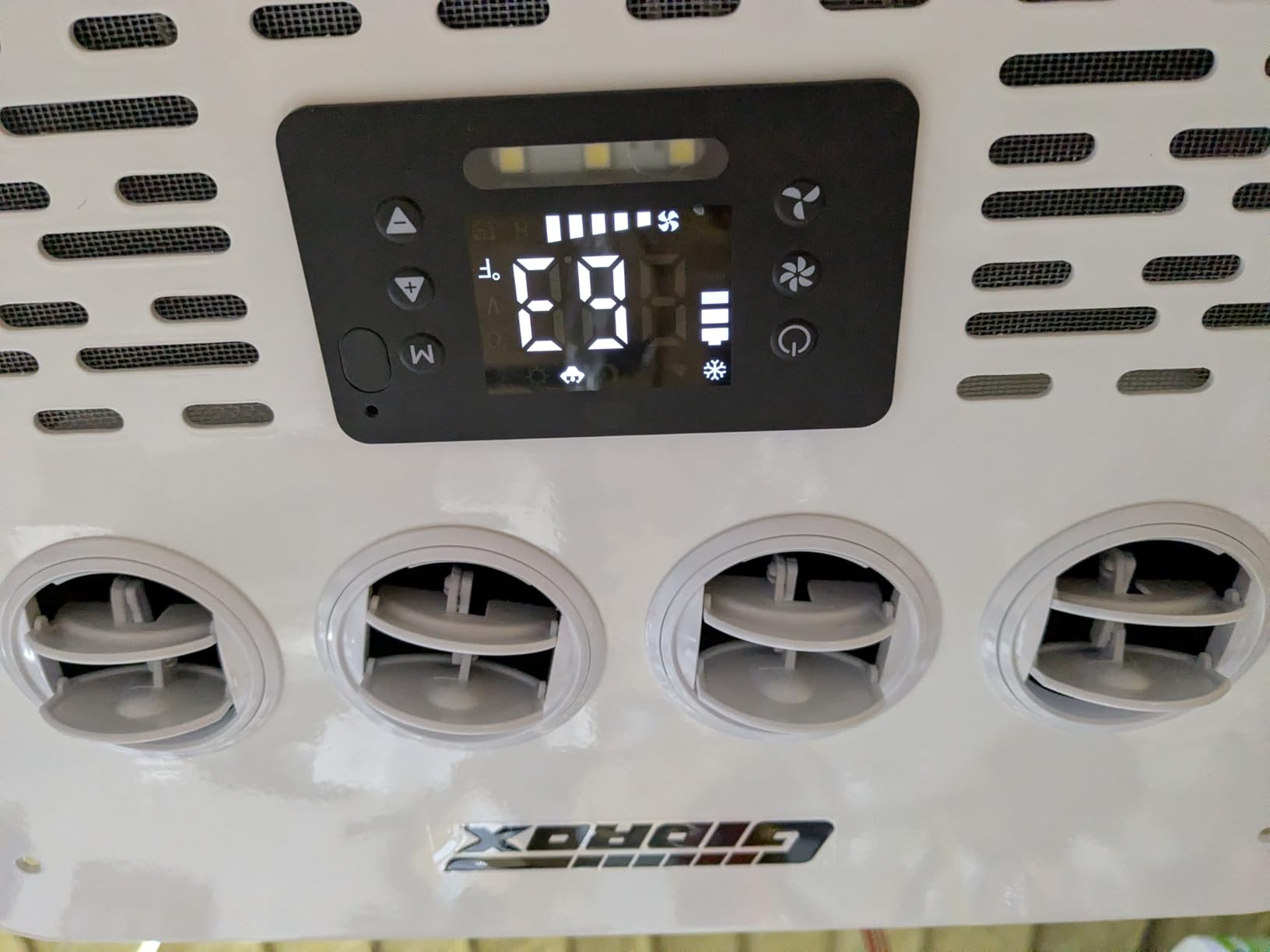
If you want the short answer: the Gidrox 12000 BTU 12V DC is our top pick for serious off-grid builds in 2026. It’s the option we evaluated in detail, and it represents the current state of where 12V rooftop AC technology is heading. We’ll cover why, what to compare it against, and the electrical work you need to plan before ordering.
Quick Answer: Should You Even Buy a 12V AC?
Before reading another word, run this three-question filter. If you answer “no” to any of them, a 12V AC is probably not the right product for you.
| Question | If yes → 12V is for you | If no → Get a 110V rooftop AC instead |
|---|---|---|
| Do you spend most nights off-grid (no shore power, no daily generator use)? | ✅ | ❌ |
| Do you have, or plan to install, at least 400Ah of lithium battery capacity? | ✅ | ❌ |
| Are you comfortable sizing 50A+ DC cable, fuses, and battery distribution? | ✅ | ❌ |
If you answered yes to all three, keep reading — a 12V system can transform your camping. If you answered no to any, save your money. A standard 110V rooftop unit running on shore power will outperform a 12V system every time, and it costs less. See our Best RV Air Conditioner 2026 guide for shore-power options.
What Makes a 12V RV AC Different (and Why It Matters)
The simplest way to understand a 12V RV air conditioner is by what it removes: the inverter.
A traditional rooftop RV AC needs 110V AC power. When you’re plugged into shore power, that’s free — the campground pedestal feeds AC straight to the unit. But when you’re running on batteries, you’re starting with 12V DC and converting it to 110V AC through an inverter. That conversion costs you energy. A typical pure sine wave inverter is around 85-92% efficient, which means 8-15% of your battery’s stored energy disappears as heat before the AC even turns on.
Multiply that loss across an 8-hour overnight run, and you’re throwing away significant battery capacity for no cooling benefit. A 12V DC AC unit skips this entire conversion step. The compressor and fan run directly off battery voltage. Same cooling, fewer watts in.
That’s the whole pitch. Everything else — quiet operation, low profile, modern controls — is secondary.
The hidden tradeoff: 12V means thicker wires
Skipping the inverter saves energy, but it creates a new problem: current. Power equals volts times amps. To deliver the same wattage at 12V instead of 110V, you need roughly nine times the current.
Here’s the practical impact. The Gidrox 12V draws 58A at rated load. A 110V rooftop unit pulling the same actual cooling power might only draw 12-14A. From a wiring standpoint, those are completely different installations:
- 110V at 14A → 14 AWG cable is fine for short runs
- 12V at 58A → You need 4 AWG to 6 AWG cable, with proper lugs, a high-amp fuse, and a battery bank within reasonable distance
This is the part that catches DIY builders. A 12V system is “simpler” because there’s no inverter, but the wiring needs more attention, not less.
Top Pick: Gidrox 12000 BTU 12V DC RV Air Conditioner
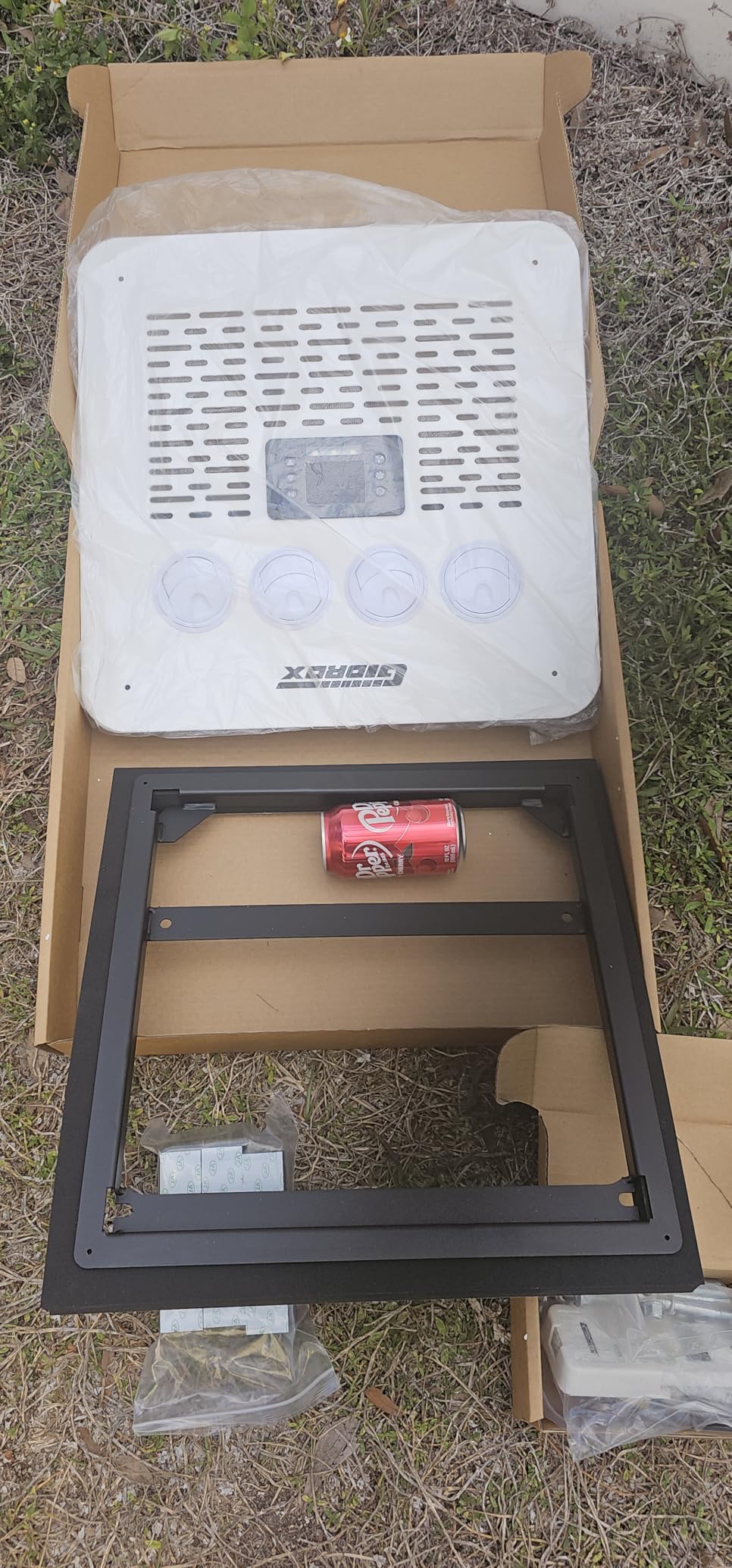
The Gidrox 12V DC is the strongest 12V RV AC option we’ve evaluated. It hits the right combination of specs for a real off-grid build, and the supplied product details suggest the engineering is aimed at the right use case.
Where it wins
- True 12V DC native operation — no inverter required, no conversion losses
- 12,000 BTU cooling, 9,000 BTU reverse-cycle heat pump — both summer and shoulder-season coverage
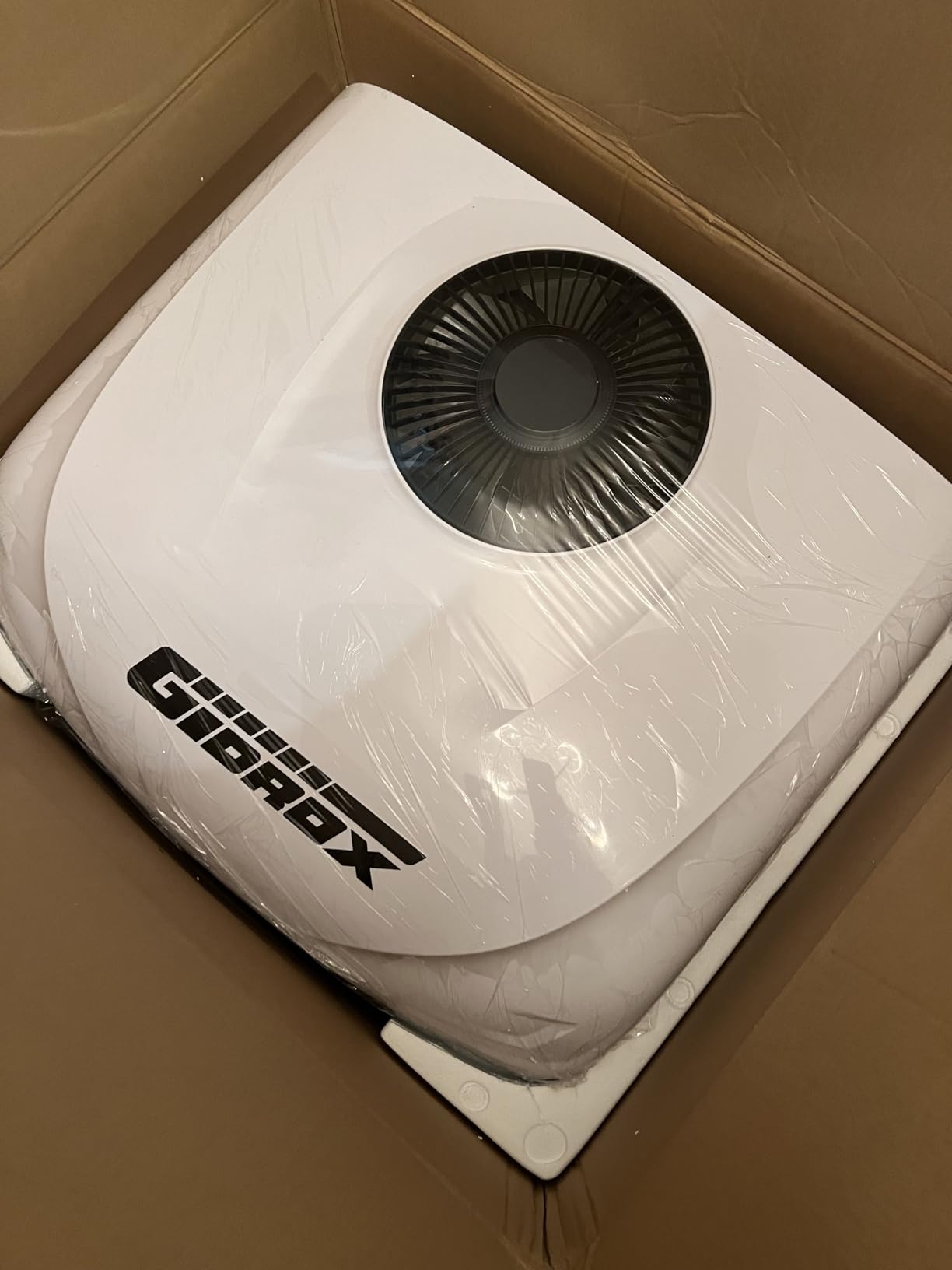
- 54 lb weight — manageable for two-person rooftop installation
- Standard 14 x 14 in. roof opening — fits most existing RV cutouts
- Three control layers — smartphone app (Bluetooth), infrared remote, physical buttons. Phone dies, remote works. Remote disappears, buttons work.
- 40 dB Sleep mode — quiet enough to actually sleep under
- Roof thickness compatibility from 1.5 to 3.5 in. — covers most camper roof builds
Where it falls short
The 12,000 BTU rating is the single biggest limit. That’s about 80% of what a typical 15,000 BTU rooftop unit puts out. For a Class A motorhome, a poorly insulated travel trailer, or any rig facing extreme desert heat above 100°F, that’s not enough. A van or truck camper with good insulation? Yes, it works. A 30-foot trailer with single-pane windows in Phoenix? It will run constantly and barely keep up.
The 58A current draw also means cable sizing is non-negotiable. A loose crimp or undersized wire will cause voltage drop, which can trigger the unit’s low-voltage protection (it shuts down below 10.5V). You don’t want to hit that threshold at 2 AM in the desert because of marginal wiring.
For full installation details, electrical sizing, mode comparisons, and owner feedback, our complete Gidrox 12V DC RV Air Conditioner review goes deep.
Check the current Gidrox 12V price on Amazon
Other 12V RV AC Options Worth Knowing About
The 12V RV AC market is small, but the Gidrox is not the only option. A few other models you’ll see mentioned in vanlife forums and Sprinter conversion threads — we haven’t evaluated them in detail, but here’s what each is competing on:
Velit 12V Air Conditioner — A relatively new entrant aimed at van builds. Markets aggressively on weight and BTU output. Worth a look if Gidrox is unavailable, though long-term reliability data is still thin in the community.
Dometic RTX 2000 — One of the original 12V RV AC products from a major established brand. Lower BTU output than the Gidrox (around 6,800 BTU), much higher price point. Often chosen by buyers who prioritize brand support over output.
RecPro 12V models — RecPro makes a few 12V variants alongside their 110V lineup. Mixed reviews on the 12V side compared to their solid 110V reputation. If you’re cross-shopping a heat pump, our RecPro 15K review is worth reading even though that unit is 110V — it shows the brand’s general design philosophy.
Mini split conversions — Some vanlife builders adapt residential 12V/24V mini split heads (e.g., 24V DC RV mini split units). The cooling can be excellent but installation is much more complex than a rooftop unit. Not a beginner project.
The honest summary: the Gidrox is currently the best balance of BTU output, features, install simplicity, and price among 12V rooftop options. Until a serious competitor shows up with verified long-term reliability data, it’s our recommended starting point.
How to Size a 12V Battery System for AC
This is the section that decides whether your 12V AC is a useful tool or a parked-on-the-roof regret. The math is not complicated, but it has to be done before you order anything.
Step 1: Estimate AC power consumption
The Gidrox draws roughly 700W at rated load and around 350W in mild Sleep mode operation. For planning, use these rules of thumb:
- Hot daytime (Turbo mode) → ~700W average
- Mild evening (Eco mode) → ~450W average
- Overnight (Sleep mode, comfortable cabin) → ~300-350W average
Step 2: Calculate overnight battery draw
A typical overnight scenario: cool the cabin for 1 hour in Eco, then run Sleep mode for 7 hours.
- 1 hour Eco at 450W = 450 Wh
- 7 hours Sleep at 350W = 2,450 Wh
- Total overnight = ~2,900 Wh, or about 240 Ah at 12V
Step 3: Match battery capacity
Don’t plan to use 100% of your battery’s nameplate capacity. Lithium iron phosphate (LiFePO4) batteries can safely deliver about 90% usable capacity, but you also want reserve for the fridge, lights, water pump, and device charging. A reasonable rule:
- 400Ah lithium bank → enough for one mild-weather night, no margin
- 600Ah lithium bank → comfortable margin for one hot night plus other loads
- 800Ah+ lithium bank → multi-day capability with solar recharge
The Gidrox product materials reference roughly 13 hours runtime with a 400Ah battery in Eco mode, and 26 hours of Sleep mode runtime with a 600Ah battery. Those numbers line up with the math above, but they assume nothing else is drawing from the bank. In a real van, you’ll be running other loads simultaneously.
Step 4: Plan solar to recover daily usage
Burning 2,900 Wh overnight means you need to put it back during the day. Solar input depends on panel wattage, sun hours, and weather. A practical guideline for hot-weather camping where you actually need the AC:
- 400W solar → recovers about 1,600-2,000 Wh per day on a sunny day. Not enough for daily AC use.
- 600W solar → recovers about 2,400-3,000 Wh. Enough for nightly AC use in good conditions.
- 800W+ solar → comfortable margin, including cloudy days and shaded campsites.
Solar input is the most variable number in the system. A 600W array under heavy clouds may only produce 800-1,000 Wh in a day. Plan for the worst case, not the best.
What Type of RV Actually Benefits from a 12V AC?
Not every off-grid rig should use a 12V AC. Here’s the honest breakdown by RV type.
✅ Strong fit: Sprinter / Promaster / Transit van conversions
Vans are where 12V AC technology was designed to live. Tight insulation, manageable cabin volume, modern lithium-and-solar electrical systems, and weight-conscious builds. A 54 lb rooftop unit drawing 12V DC fits this build pattern perfectly.
If you’re doing a Sprinter or Promaster conversion with at least 400Ah of lithium and 600W+ of solar, the Gidrox is a natural choice.
✅ Strong fit: Skoolies (school bus conversions)
Bigger interior volume, but typically built with serious electrical systems and good insulation upgrades. Skoolies often have roof space for substantial solar arrays. The 12,000 BTU rating may struggle in a long bus on a hot afternoon, but for overnight comfort, it usually works.
✅ Reasonable fit: Truck campers
Truck campers benefit hugely from 12V cooling because the alternative is running a generator or shore power, both of which limit where you can park. A small truck camper with good insulation and a meaningful battery bank is exactly where this product makes sense.
🟡 Marginal fit: Small teardrop trailers
A teardrop is small enough that 12,000 BTU is plenty. But teardrops often lack the battery capacity and solar input to actually support overnight AC use. If your teardrop has 400Ah lithium and 400W solar, sure. If it has 100Ah and 100W solar, no.
❌ Poor fit: Travel trailers and fifth wheels
This is where most 12V AC purchases go wrong. Travel trailers are typically used at campgrounds with shore power available. The owners assume “12V means I don’t need an inverter” but ignore that they don’t actually need 12V in the first place — they have shore power 80% of the time. A 110V rooftop unit costs less, cools harder, and uses shore power efficiently.
If you have a travel trailer or fifth wheel and want shoulder-season heat, the RecPro 15K Heat Pump is almost always a better choice.
❌ Poor fit: Class A motorhomes
Class A motorhomes are large, often poorly insulated relative to size, and almost always need 15,000+ BTU per zone. A 12,000 BTU 12V unit can’t keep up. Class A owners running off-grid usually need dual rooftop ACs and a generator, not a single 12V unit.
What About Soft Starters? The 110V Alternative
If you’re tempted by 12V because you want to run AC off batteries, there’s a middle path many RVers discover too late: a soft starter for your existing 110V rooftop AC.
A soft starter is a small device installed on the AC compressor that reduces the startup surge from 60-80A down to about 15-25A. This matters because the surge is what trips small generators and stresses inverters. With a soft starter, a standard 13,500 BTU rooftop unit can often be run from a 2,000W inverter and 400Ah lithium battery — a setup that previously required 3,000W of inverter and 600Ah of battery.
This is a much cheaper upgrade than buying a 12V AC unit, and it lets you keep your existing rooftop system. Common soft starter brands include MicroAir EasyStart and SoftStartRV. Expect to pay $300-$400 for a quality unit, plus 1-2 hours of installation time.
When does a soft starter beat a 12V AC unit?
- You already own a working 110V rooftop unit
- You camp off-grid only occasionally (weekends, not full-time)
- You want to keep installation simple
- Your battery bank is in the 200-400Ah range
When does a 12V AC still win?
- You’re building from scratch (no existing AC unit)
- You camp off-grid most of the time
- You have or want a serious 600Ah+ lithium build
- You want the lowest possible nighttime power draw (the 12V Sleep mode at 350W is hard to beat)
Installation: What to Plan Before You Order
A 12V RV AC install has more electrical work than a 110V install. Here are the things to plan before clicking “buy.”
Battery bank distance
The Gidrox ships with a 19.7 ft power cord, which sounds generous. In practice, it’s tight if your batteries are at the back of a van and the AC is at the front. Voltage drop increases with distance, and at 58A even 6 AWG cable starts to lose meaningful voltage over long runs. Plan to mount the battery bank as close to the main DC distribution as possible.
Fuse or breaker sizing
A 58A continuous load needs a properly sized fuse. Most installers use 80A or 100A class T or MRBF fuses for this kind of load. Don’t use a generic ATC fuse — they’re not rated for sustained high amperage and can fail during normal operation.
Roof opening preparation
The Gidrox fits a standard 14 x 14 in. roof cutout, but “standard” means different things on different rigs. If you’re cutting a fresh opening on a van conversion, make sure the framing supports the unit’s weight and that you’re not cutting through structural ribs. Pre-built RVs usually have the opening already prepped.
Solar charge controller capacity
If you have a 600W+ solar array, your charge controller needs to handle the full input. A 60A MPPT controller is the minimum for serious AC-supported builds. Some builders use dual controllers to split the array.
Heat rejection space around the unit
This one catches solar-heavy roof builds. A rooftop AC needs airflow around the condenser side to reject heat. If you crowd the unit with solar panels, roof rails, antennas, and Starlink mounts, you can suffocate it and reduce cooling output. Leave at least 12 inches of clear space around the unit on the airflow sides.

Frequently Asked Questions
What is the best 12V RV air conditioner in 2026?
The Gidrox 12000 BTU 12V DC is our top pick for 2026. It offers the best combination of BTU output, features, install compatibility, and price among current 12V rooftop options. It’s a strong fit for Sprinter conversions, skoolies, and serious off-grid builds with at least 400Ah of lithium battery capacity. For full details, see our Gidrox 12V RV AC review.
Can a 12V RV air conditioner run all night on batteries?
Yes, with a properly sized battery bank. Plan on roughly 240Ah of usable lithium capacity for an 8-hour overnight run in mild conditions, or 350Ah+ for hot nights. The Gidrox uses about 350W in Sleep mode, which means a 600Ah lithium bank can comfortably support overnight operation plus other RV loads like the fridge and lights.
Is a 12V RV AC more efficient than a regular rooftop AC?
In a battery-powered system, yes. A 12V DC unit skips the inverter conversion step, saving 8-15% of stored battery energy. In a shore-power scenario, the difference disappears — both unit types pull the same actual cooling power, and the 12V unit is no more efficient at the wall than a 110V rooftop AC.
How many watts of solar do I need for a 12V RV AC?
For daily off-grid AC use, plan on 600W of solar minimum, with 800W+ being comfortable. A 600W array typically recovers 2,400-3,000 Wh per sunny day, which roughly matches the 2,900 Wh used in a typical AC-running night. Cloudy days and shaded campsites reduce this significantly, so always size up if you can.
Can I use a 12V RV AC on my travel trailer?
Technically yes, but it’s usually the wrong choice. Travel trailers are typically used at campgrounds with shore power available, where a standard 110V rooftop unit is cheaper, cools harder, and runs without battery considerations. A 12V unit is built for off-grid situations — if that’s not your camping pattern, you’re paying for a feature you won’t use. See our Best RV Air Conditioner 2026 guide for shore-power-friendly options.
Will a 12V AC unit work on a Sprinter van conversion?
A Sprinter, Promaster, or Transit conversion is the ideal use case for a 12V RV AC. The cabin volume is small enough that 12,000 BTU provides real cooling, the modern lithium-and-solar electrical systems these vans typically use are exactly what 12V AC is designed for, and weight-conscious builds appreciate the 54 lb rooftop unit.
What’s the difference between a 12V RV AC and a soft starter?
A 12V AC is a complete air conditioning unit that runs on 12V DC battery power directly. A soft starter is an add-on device that modifies an existing 110V rooftop AC to reduce its startup surge, making it easier to run from an inverter. Soft starters are cheaper ($300-$400) and let you keep your existing AC, but they don’t deliver the same ongoing efficiency benefits as a true 12V DC unit.
Do 12V RV air conditioners need maintenance?
Yes, the same basic maintenance as any rooftop AC: clean the filter regularly, check the gasket seal, watch for vibration loosening fasteners after travel, and keep the condenser coils clear of debris. The Gidrox’s filter is accessible from inside the unit and should be checked every 1-2 weeks during active use, more often if you camp in dusty areas.
Final Recommendation
A 12V RV air conditioner is a specialized tool for a specialized rig. If you’re building a serious off-grid van, skoolie, or truck camper with at least 400Ah of lithium and 600W of solar, the Gidrox 12000 BTU 12V DC is the best option for 2026. It’s the only 12V rooftop unit currently delivering the right combination of BTU output, install simplicity, and quiet operation at a reasonable price.
If you don’t fit that profile — if you camp at campgrounds, drive a travel trailer, or run a Class A motorhome — save your money. A standard 110V rooftop unit will outperform a 12V system in your situation, often at a lower total cost. See our Best RV Air Conditioner 2026 guide for the right product in those scenarios.
For Sprinter conversions, skoolies, and dedicated off-grid builds where 12V makes sense:
- Read the full Gidrox 12V DC RV Air Conditioner review for installation, electrical sizing, and owner feedback in detail.
- Check the current Gidrox 12V price on Amazon to compare against your battery and solar budget.
The right setup makes off-grid summer camping genuinely comfortable. The wrong setup turns a $1,500 rooftop unit into expensive proof that you should have done the math first.