Best RV Air Conditioner with Heat Pump 2026: Cool Summer, Warm Shoulder Season
A RV air conditioner with heat pump is one of those upgrades that quietly pays for itself. Most RVers buy a cooling-only rooftop AC, then spend the next five years burning propane to take the chill off cool mornings — never realizing they could have moved heat instead of generating it for the same money. A reverse-cycle heat pump turns your AC into a two-season machine. It cools when it’s hot, warms when it’s cool, and uses dramatically less power than the resistive heat strips bolted onto cheaper units.
This guide is for RV owners who actually camp in spring and fall, not just July. We’ll walk through how heat pumps really work in an RV, when they earn their keep versus propane, and which units we recommend in 2026. We are not going to repeat what every “best of” article says. The interesting questions about RV heat pumps are about the physics — when the math stops working, what the breakeven temperature actually is, and what to do when the outside drops below 30°F.
As an Amazon Associate I earn from qualifying purchases.

If you want the short answer: the RecPro RV Air Conditioner 15K is our top pick for a 110V rooftop heat pump in 2026. For off-grid van builds where 12V battery operation matters more than total BTU output, the Gidrox 12V DC with its 9,000 BTU heat pump is the better choice. We’ll cover why, and walk through the parts of heat pump ownership that catch buyers off guard.
Quick Picks: Best RV AC with Heat Pump 2026
| Use case | Best pick | Heating output | Why |
|---|---|---|---|
| Travel trailer, fifth wheel, motorhome on shore power | RecPro 15K Heat Pump — read the full review | 15,000 BTU heating | Strong dual-season output, standard 14-inch roof opening, includes shroud and plenum |
| Sprinter van, skoolie, off-grid build with lithium batteries | Gidrox 12V DC — read the full review | 9,000 BTU heating | Direct 12V operation, runs heat pump from batteries without an inverter |
| Comparing against cooling-only premium units? | See our Best RV Air Conditioner 2026 guide | — | Includes the Furrion Chill Cube and full comparison matrix |
How an RV Heat Pump Actually Works (and Why Most People Misunderstand It)
The phrase “heat pump” sounds like marketing language. It isn’t. A real reverse-cycle heat pump uses the same physics as your AC running backwards. In cooling mode, it pulls heat from inside the cabin and dumps it outside. In heating mode, it pulls heat from outside air and pumps it inside.
That last sentence is the one that confuses people. Outside air at 40°F still contains usable heat energy — it just doesn’t feel like it to a human. A heat pump captures that heat and concentrates it indoors. The compressor does the work of moving heat instead of creating it from electricity.
The efficiency difference is significant. An electric heat strip uses 1 watt of electricity to produce 1 watt of heat — that’s 100% efficiency, mathematically the ceiling for resistance heating. A heat pump in mild conditions can deliver 2 to 3 watts of heat per watt of electricity consumed. The industry term is Coefficient of Performance (COP), and a typical RV heat pump runs around COP 2.5 in moderate weather. That’s why the RecPro materials describe an “efficient heat pump,” and it’s why a heat pump RV AC pulls less power for the same warmth than a unit with a heat strip.
Where the math breaks down
Heat pumps have a problem: they get less efficient as outside air gets colder. There’s less heat to grab, the compressor works harder, and at some point the unit either ices over or shuts down.
For a typical RV reverse-cycle heat pump, the practical performance curve looks roughly like this:
| Outside Temperature | Heat Pump Behavior | Realistic Heat Output |
|---|---|---|
| 50°F to 65°F | Excellent — high COP, fast warmup | Full rated output, typically 12,000-15,000 BTU |
| 40°F to 50°F | Good — slightly reduced efficiency | 80-90% of rated output |
| 32°F to 40°F | Marginal — defrost cycles begin | 50-70% of rated output, intermittent operation |
| Below 32°F | Poor — frequent defrosting, low efficiency | Use propane or diesel heat instead |
| Below 25°F | Most units shut down or refuse to start | Heat pump is not the right tool |
This is the part that catches buyers. They expect a heat pump to replace their propane furnace. It can’t. Below freezing, you still need propane. The heat pump’s job is to handle the 80% of cool weather that isn’t actually cold — the 45°F mornings, the 55°F evenings, the 50°F shoulder-season afternoons. That’s where the efficiency win is real, and where you’ll save the most fuel.
Top Pick for Shore-Power RVs: RecPro RV Air Conditioner 15K Heat Pump
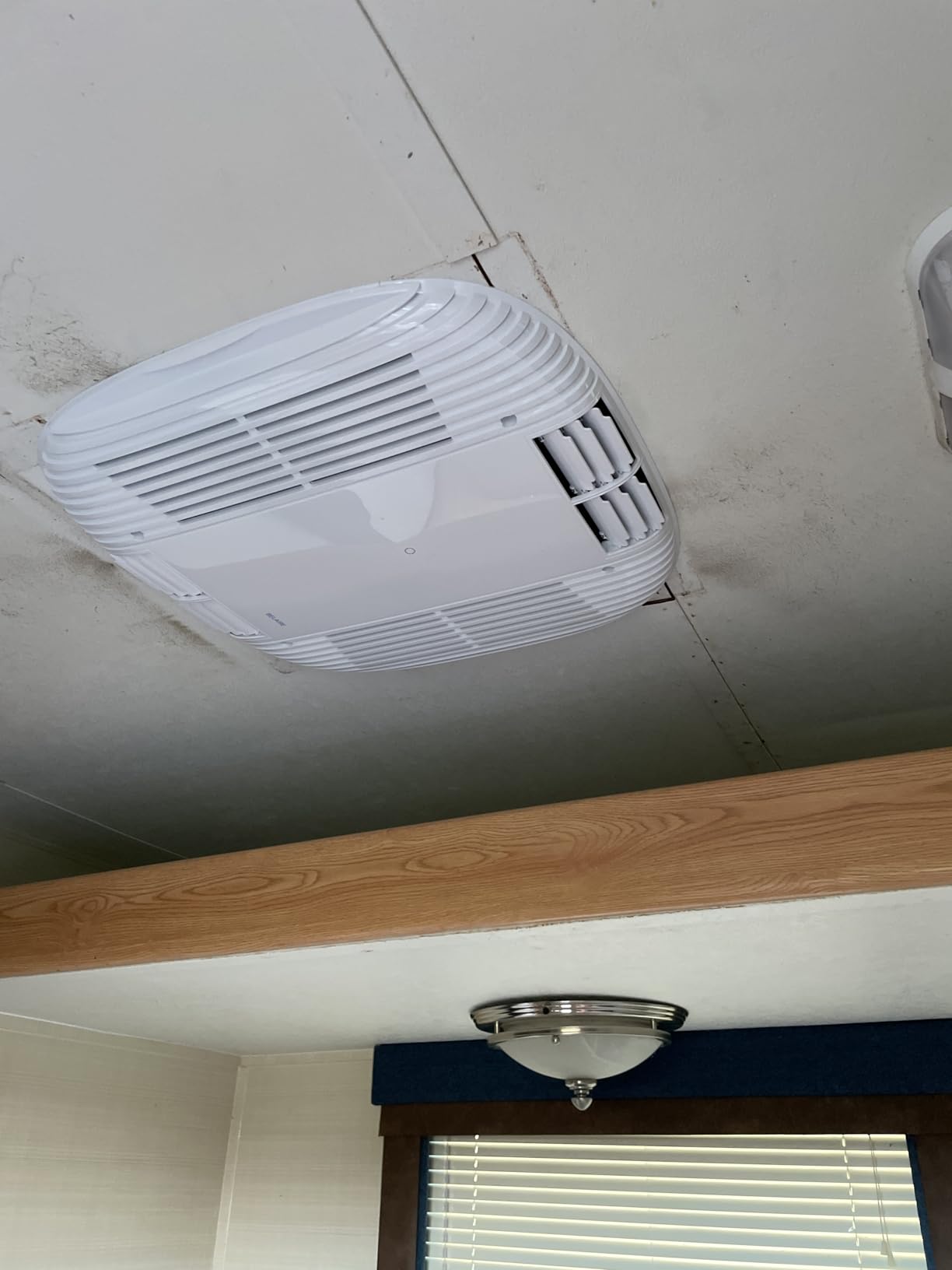
The RecPro 15K is our top pick for any RV that runs on shore power most of the time. It’s a standard 110V rooftop unit with a built-in reverse-cycle heat pump and a layout that fits the typical 14-inch roof opening on travel trailers, fifth wheels, motorhomes, and food trucks.
What makes it the right choice
- 15,000 BTU cooling AND 15,000 BTU heating — symmetrical capacity, not a token heat function bolted onto a cooling unit
- True reverse-cycle heat pump — the supplied product information explicitly states it uses an efficient heat pump rather than a resistive heat strip
- 341 CFM airflow — enough to actually distribute warm air throughout a typical RV interior
- Standard 14 3/16 in. x 14 3/16 in. roof opening — fits most existing rooftop AC cutouts
- Includes both exterior shroud and interior plenum — fewer parts to order separately
- Remote control with LED panel — no thermostat wiring project required
Where it has limits
The 1,300W heating input means it pulls about 12 amps when running on heat. On a 30A shore power pedestal, that’s manageable. On a small generator, it gets tight if you’re also running a microwave. And as covered above, the heat pump can’t keep up below freezing — that’s not a RecPro flaw, it’s reverse-cycle physics.
The full breakdown including install considerations, the standard 14-inch opening details, and noise reality is in our RecPro 15K Heat Pump review.
Check the current RecPro 15K price on Amazon
Top Pick for Off-Grid Builds: Gidrox 12V DC with 9,000 BTU Heat Pump
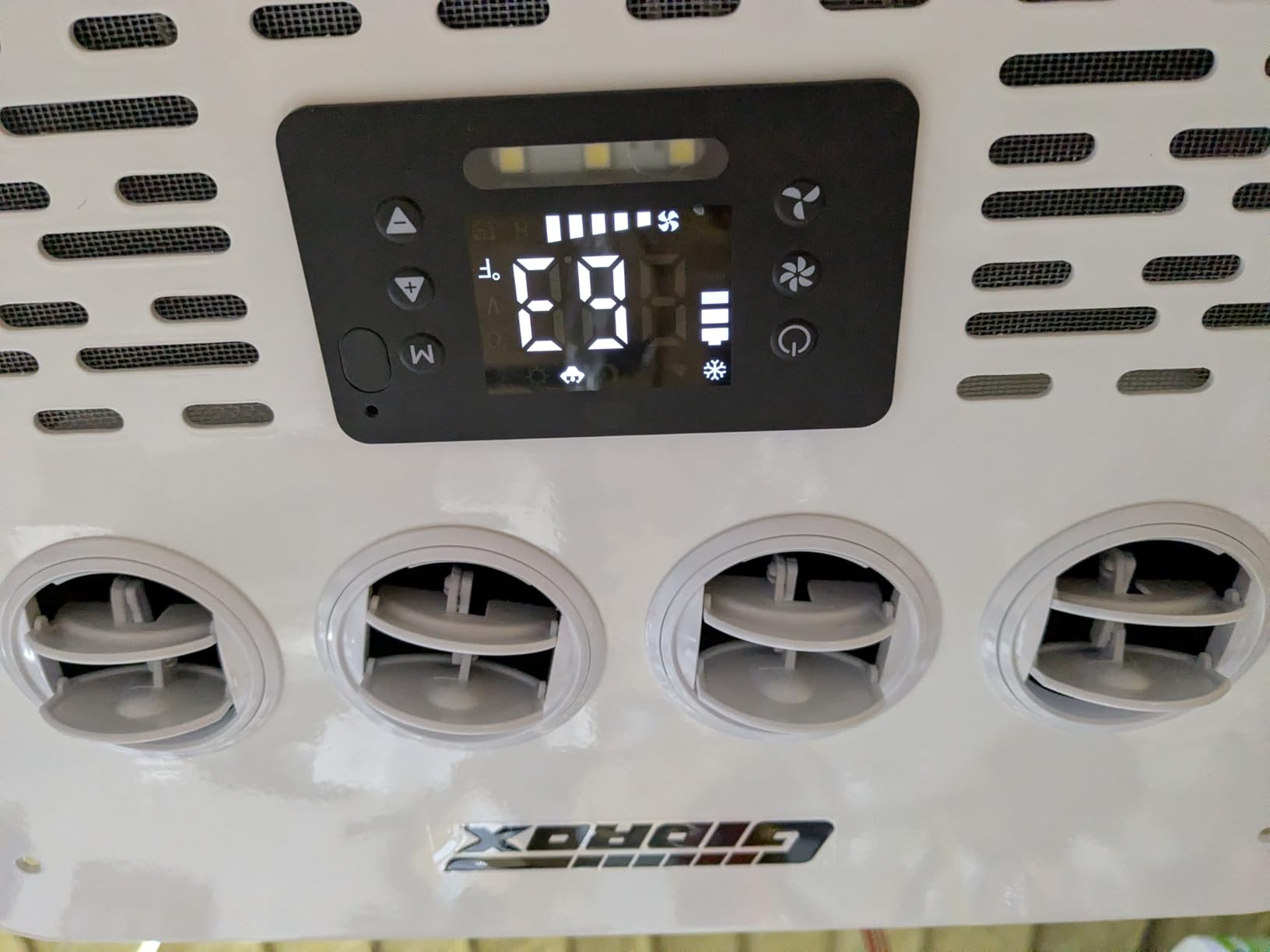
If you’re building a Sprinter, Promaster, skoolie, or any rig that lives off lithium batteries and solar, the Gidrox 12V DC is the only option that delivers a real heat pump from native 12V power. No inverter, no AC conversion losses, and 9,000 BTU of reverse-cycle heating capacity for cool van mornings.
What makes it work for off-grid heat
- 12V DC native operation — heat pump runs directly off lithium battery bank
- 9,000 BTU heating, 12,000 BTU cooling — proportional capacity, useful in both seasons
- 40 dB Sleep mode — quiet enough for overnight heat pump operation under your bed
- Standard 14 x 14 in. opening — fits most van roof cutouts and existing RV openings
- App, remote, and physical button controls — three layers of control redundancy
Where it falls short for heat
A 12V heat pump has the same outside-temperature limit as any heat pump — below freezing, output drops fast. But it has an additional limit specific to 12V systems: at colder outside temperatures, the compressor works harder and pulls more amps from the battery. If you’re already running close to your battery capacity for cooling, expect heating mode to drain the bank faster than cooling did in summer.
Realistic expectation: the Gidrox heat pump is best used for shoulder-season morning and evening warmups in mild climates, not all-night winter heat. For sub-40°F nights in a van, a diesel heater (Webasto, Espar, or Chinese diesel heater) is dramatically more efficient and won’t drain the battery bank.
Full installation details, electrical sizing, and mode performance are in our Gidrox 12V RV AC review.
Check the current Gidrox 12V price on Amazon
Heat Pump vs Propane Furnace: Which Should You Use?
This is the question every RV owner with a heat pump eventually asks. The answer is both, and knowing when to switch saves real money.
When the heat pump wins
A heat pump beats propane in every scenario where outside temperature is above about 40°F. The math is simple — propane costs roughly $4-$6 per gallon depending on region, and a 20-pound tank of propane delivers about 430,000 BTU of heat. That works out to about $0.012 per 1,000 BTU.
Electricity from a campground pedestal varies, but at $0.12 per kWh (a fair national average), the same 1,000 BTU from a heat pump running at COP 2.5 costs about $0.014. That looks like a wash — until you realize the heat pump is also dehumidifying the cabin, requires zero refilling trips, doesn’t trigger CO alarms, and doesn’t condense water inside the rig.
On shore power above 40°F, the heat pump always wins.
When propane wins
Propane wins in three specific scenarios:
- Below freezing outside — Heat pump efficiency falls off a cliff. Propane stays the same.
- Off-grid with limited battery capacity — A heat pump pulling 1,000W for hours will drain a battery bank fast. Propane uses minimal electricity (just for the fan and ignition).
- Boondocking without sun — If your solar isn’t keeping up with consumption, electric heat is the wrong tool.
The general rule: propane is the cold-weather and off-grid heater. Heat pump is the shoulder-season and shore-power heater. Both have a place. Most full-time RVers run their heat pump 80% of the heating season and propane 20%.
Realistic shoulder-season cost comparison
For a typical 32-foot travel trailer running 8 hours of heat per day at 50°F outside:
- Propane furnace: ~3 lbs of propane per day, costs about $1.80-$2.40
- Heat pump on shore power: ~6 kWh of electricity, costs about $0.72 (or free if it’s included in your campsite fee)
- Annual savings switching to heat pump for shoulder seasons: $200-$400 for a typical full-time RVer
Plus you’re not refilling tanks every week.
When You Need a Heat Strip Backup (and How to Tell)
Some RV ACs marketed as “with heat” use a resistive heat strip instead of a true heat pump. Less commonly, some heat pump units have a built-in heat strip as a backup for cold weather. Both deserve a quick reality check.
Heat strip = resistance heating
A heat strip is a coil of nichrome wire (like a toaster). Power flows through, the wire glows, the fan blows air across it. That’s it. The good news: it works at any temperature. The bad news: it costs roughly 2.5 times more to operate than a heat pump in the same conditions.
Cheap “RV AC with heat” units are usually heat strip units. The product copy may say “heating” without specifying “heat pump.” If the listing doesn’t explicitly say “reverse-cycle heat pump” or “heat pump,” assume it’s a heat strip and price your propane accordingly.
When backup heat strips make sense
Some premium RV heat pump units include a small heat strip for backup. The unit runs as a heat pump until outside temperature drops too low, then switches to the heat strip automatically. This is useful for full-timers who occasionally hit a cold snap and don’t want to manually switch heating systems.
Neither the RecPro 15K nor the Gidrox 12V includes an integrated heat strip backup based on the supplied product information. For sub-freezing camping with these units, plan to switch to propane manually.
What About Defrost Cycles? Why Your Heat Pump Pauses
If you’ve ever had a heat pump and noticed it occasionally stops blowing warm air for a few minutes, that’s a defrost cycle. Here’s what’s happening and why it’s normal.
When the heat pump pulls heat from cold outside air, the outdoor coil gets even colder than the air around it. If outside conditions are humid and below about 40°F, frost forms on that coil. Frost insulates the coil from the air, which kills heat transfer.
The unit handles this by briefly reversing into cooling mode. The hot refrigerant flows backwards through the outdoor coil, melting the frost. During this 3-5 minute cycle, the indoor air may feel cool because the unit isn’t producing heat. The fan may slow or stop entirely depending on the design.
This is normal and not a malfunction. A heat pump that defrosts 1-2 times per hour in cold humid conditions is working correctly. A heat pump that runs continuous defrost cycles or never produces heat is broken.
For RV owners new to heat pumps: don’t panic during defrost. Don’t unplug, restart, or “fix” anything. Wait 5 minutes. The unit will return to heating mode automatically.
Common RV Heat Pump Problems and What to Do
Heat pumps have a few common failure modes specific to the technology. Worth knowing what they look like.
Heat pump runs but cabin isn’t warming: Check the indoor filter first — a clogged filter kills airflow and the cabin never feels warm even when the unit is producing heat. Then check thermostat setpoint and mode selection (some units default to “auto” which can cycle between cool and heat).
Heat pump won’t engage in heating mode: Most reverse-cycle units have a minimum outdoor temperature lockout, typically around 25-30°F. Below this, the unit refuses to start in heat mode to protect itself. Check the supplied operating temperature range for your specific unit. If you’re above the threshold and it still won’t start, the reversing valve may be stuck — that’s a service call.
Excessive defrost cycles: This usually means humid outdoor conditions plus cold temperatures. It’s normal in spring rain or coastal fog at 35-40°F. If your unit is defrosting every 15 minutes for hours on end, the outdoor sensor may be miscalibrated.
Strange refrigerant noises during mode changes: Hissing, gurgling, and brief whooshing sounds when switching between cool and heat are normal. The reversing valve is changing direction and the refrigerant is finding new flow paths. Continuous loud noises during operation are not normal.
Unit warm in cooling mode, cool in heating mode: The reversing valve is stuck in one position, or the unit is wired incorrectly. Either way, this is a service issue, not a DIY repair.
Frequently Asked Questions
What is the best RV air conditioner with heat pump in 2026?
The RecPro RV Air Conditioner 15K is our top pick for shore-power RVs. It includes a true reverse-cycle heat pump, 15,000 BTU output in both cooling and heating, a standard 14-inch roof opening fit, and full installation hardware. For off-grid builds where 12V battery operation matters, the Gidrox 12V DC with its 9,000 BTU heat pump is the better choice because it runs the heat pump directly from batteries without an inverter.
Is a heat pump really better than a heat strip in an RV?
In mild conditions (above 40°F outside), a heat pump uses about 40% of the electricity that a heat strip uses for the same amount of heat. In cold conditions (below 32°F), the gap narrows and eventually the heat strip wins on raw output. For RVers who camp mostly in spring, summer, and fall, a heat pump is dramatically more efficient. For winter campers in freezing climates, propane is still the right answer.
Will an RV heat pump work in the winter?
A reverse-cycle RV heat pump works well down to about 40°F outside, marginally between 32-40°F, and poorly below freezing. Most units automatically refuse to start when outside temperatures drop below 25-30°F. For sub-freezing camping, plan to use propane heat as your primary system and treat the heat pump as a shoulder-season tool.
Can I run a heat pump on solar power?
Yes, but only if your battery and solar system is sized for it. A 110V rooftop heat pump pulls 1,000-1,500 watts during operation, which means a serious inverter and battery bank. A 12V DC unit like the Gidrox is dramatically more solar-friendly because it skips the inverter conversion. Plan on 600W+ of solar and 400Ah+ of lithium for meaningful off-grid heat pump use.
How much can a heat pump save on propane?
For a typical full-time RVer, switching from propane to heat pump heating during shoulder seasons saves $200-$400 per year, plus eliminates frequent propane refill stops. The savings come from heat pump efficiency (COP 2.5 vs 1.0 for resistance heating) and from avoiding the high cost of propane in some regions.
Does a heat pump work as well as my home heat pump?
A residential heat pump is sized for a specific home with proper ducting and insulation. An RV heat pump is sized for a much smaller space with much weaker insulation. The RV unit will heat faster than a residential unit because of the smaller volume, but it will also lose heat faster when the cabin walls are thin. Realistic expectation: a heat pump RV AC keeps a well-insulated 32-foot trailer comfortable down to about 40°F outside.
Can the Furrion Chill Cube also do heating?
The base Furrion Chill Cube is primarily a cooling unit, though some Chill Cube package variations include heating capability. Verify the exact model and seller listing before assuming heating is included. For a comparison of all three top picks including the cooling-focused Furrion, see our Best RV Air Conditioner 2026 buyer’s guide.
What’s the breakeven temperature where I should switch from heat pump to propane?
The general guideline is 40°F outside. Above that, the heat pump is cheaper, more comfortable, and quieter. Below 40°F, propane starts winning on raw heat output. Below 32°F, propane is clearly the better choice. Below 25°F, the heat pump may not even start.
Final Recommendation
A heat pump RV AC is the right upgrade if you actually camp in cool weather — spring mornings, fall evenings, shoulder-season weekends. For the 80% of cool weather that isn’t actually cold, a reverse-cycle heat pump pulls less power, generates less noise, and runs cleaner than burning propane.
Our picks for 2026:
- Most shore-power RVers wanting heat plus cool → RecPro 15K Heat Pump — strong dual-season output, standard install, fair pricing.
- Off-grid van and skoolie builds → Gidrox 12V DC — only real 12V heat pump option, runs from batteries without inverter losses.
- Want to compare all 2026 picks side by side → See our Best RV Air Conditioner 2026 buyer’s guide for cooling-focused options like the Furrion Chill Cube.
- Considering 12V specifically? → Read our Best 12V RV Air Conditioner 2026 guide for the full off-grid analysis.
Whichever way you go, remember: a heat pump is a shoulder-season tool, not a winter furnace. Keep your propane system working as backup, learn the breakeven temperature for your unit, and you’ll get years of comfortable cool mornings without burning through tanks.