Best RV Air Conditioner 2026: A Practical Buyer’s Guide for Every RV Type
Every RVer eventually faces the same question. The old rooftop unit is loud, weak, or both. A new one costs serious money, and the listings online all sound the same: “best cooling,” “ultra quiet,” “energy efficient.” After looking at the actual products, the honest answer is that the best RV air conditioner is not one model. It is whichever model matches your RV size, your power setup, and the way you actually camp.
This guide cuts through the marketing. It walks through how to choose an RV AC the right way, then recommends three units that earned a spot after a careful look at specs, owner feedback, and design tradeoffs. We are not pretending to have run every brand through a desert lab. What we have done is read the listings line by line, compare the specs that actually matter, and write down honest tradeoffs that most “best of” articles skip.
As an Amazon Associate I earn from qualifying purchases.
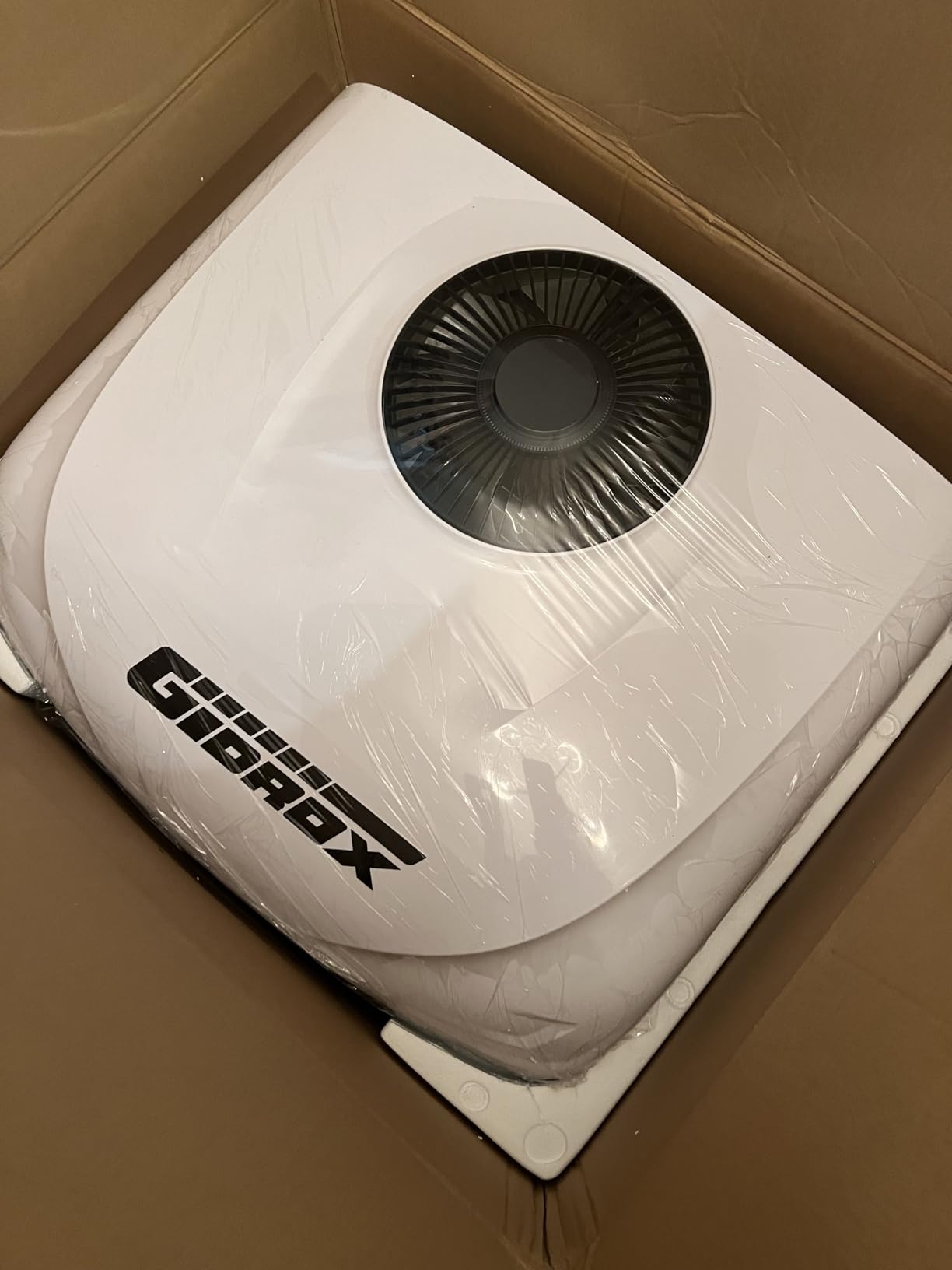
If you only have two minutes, here is the short version. For most RV owners on shore power who want a meaningful upgrade, the Furrion Chill Cube 18K BTU is the strongest overall pick. For van conversions, skoolies, and serious off-grid builds, the Gidrox 12000 BTU 12V DC removes the inverter from the equation. For travel trailers and fifth wheels that want heat plus cool at a friendlier price, the RecPro 15K Heat Pump is the practical middle ground.
Quick Picks at a Glance
Three different RVs need three different air conditioners. Use the table to find your match, then read the section that fits your situation.
| If your RV is… | Best pick | Why |
|---|---|---|
| A travel trailer or motorhome on shore power, you sleep light, hate AC noise | Furrion Chill Cube 18K BTU — read the full review | Variable speed compressor cools steadily without slamming on and off |
| A van, truck camper, or skoolie running off lithium batteries and solar | Gidrox 12000 BTU 12V DC — read the full review | Direct 12V operation, no inverter losses, app and remote control |
| A travel trailer or fifth wheel where shoulder-season heat matters too | RecPro 15K Heat Pump — read the full review | Built-in reverse-cycle heat pump for cool mornings, standard 14-inch roof opening |
How to Actually Choose an RV Air Conditioner
The wrong way to shop is to type “best rv ac” into Google and order whichever rooftop unit looks shiny. The right way takes about ten extra minutes and saves a lot of regret later. There are five questions that decide everything.
1. How big is your RV, and how hot do you camp?
BTU rating is the single most useful spec, but it is also the most misunderstood. The general industry guideline looks like this:
- Up to 26 feet, mild climates — A single 13,500 BTU rooftop unit is usually enough.
- 26 to 32 feet, moderate climates — A 15,000 BTU unit, or a well-installed 13,500 with sealed ducts.
- 32 to 40 feet, hot climates — A 15,000 BTU unit at minimum. An 18,000 BTU unit like the Furrion Chill Cube gives real cooling headroom.
- Over 40 feet, or any RV in 100°F+ desert heat — Plan for two AC units. One unit fighting the Arizona sun in a Class A is a losing battle.
Insulation, window count, awning shade, and roof color matter as much as length. A poorly insulated 28-foot trailer in direct sun behaves like a 35-foot rig from a heat-load standpoint. If your current AC almost keeps up but never wins, sizing up one tier is usually the right move.
2. What’s your power source?
This is the question most buyers skip and later regret. There are three realistic categories.
Shore power (110V/30A or 50A) — You’re plugging into a campground pedestal most of the time. Almost any rooftop AC works here, including the Furrion Chill Cube and the RecPro 15K. The only thing to watch is total amp draw if you also run a microwave, electric water heater, and converter at the same time.
Generator — Same as shore power, but generator size matters. The Furrion Chill Cube and similar variable-speed units are easier on smaller generators because they don’t slam on with a hard startup surge. A 2200W inverter generator can run a single 13,500 BTU unit if you size carefully and don’t run the microwave at the same time. A 15K BTU unit is borderline. An 18K BTU unit needs more headroom — a 3000W to 3500W generator is more honest.
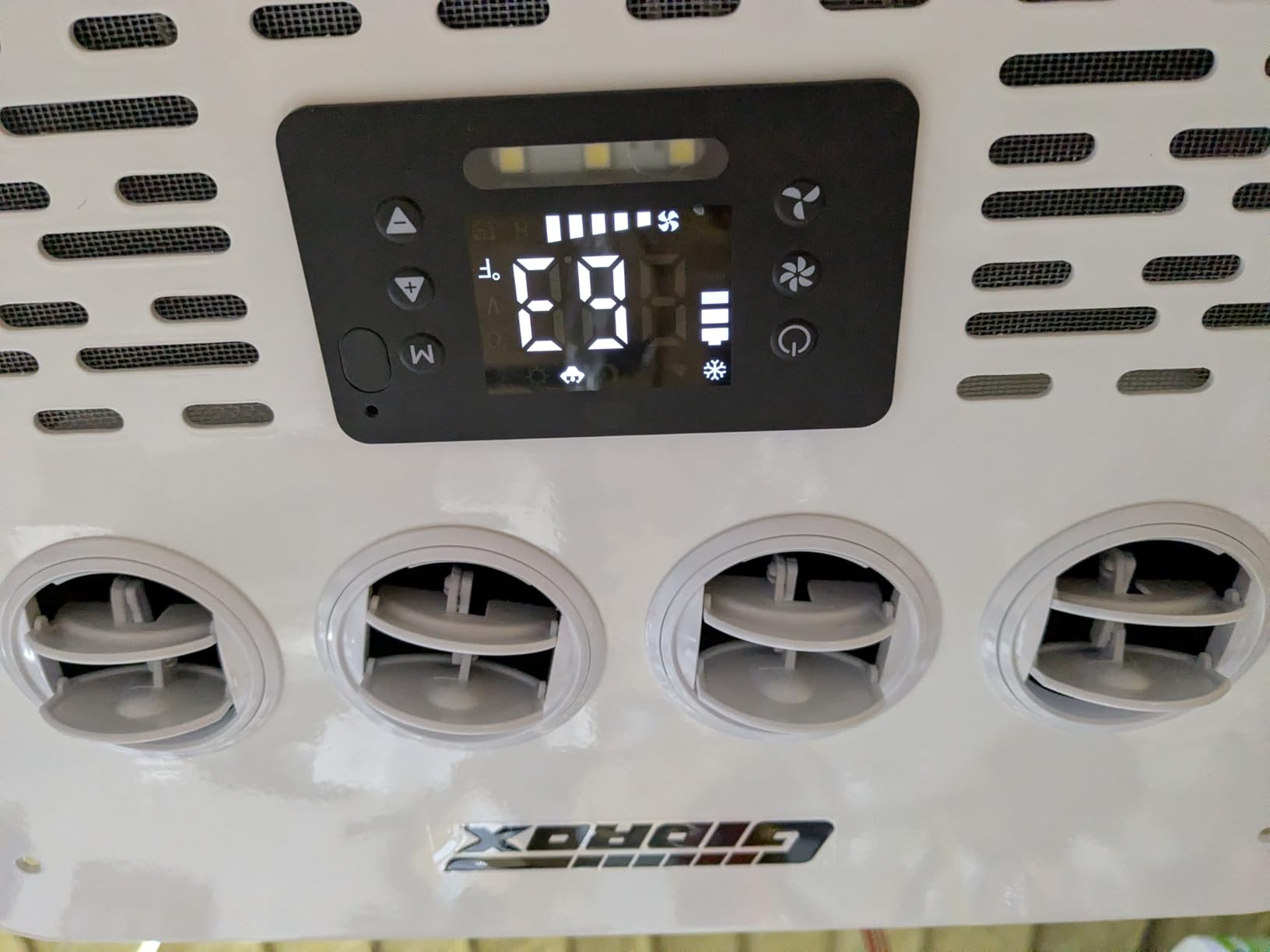
Battery + solar (off-grid / boondocking) — This is where the math gets serious. A traditional 110V rooftop AC running through an inverter will burn through a battery bank fast because of inverter losses. If you live in a van, drive a Sprinter conversion, or have a serious lithium-and-solar build, a 12V DC unit like the Gidrox skips the inverter entirely. That is the whole point of the product, and we cover it in detail in our 12V RV AC review.
3. Do you need heat too?
A surprising number of RVers buy an AC, then discover they wanted a heat pump. The difference is real money in shoulder seasons.
A cooling-only AC is what most older rooftop units are. They cool, period.
A heat strip (sometimes confusingly called a “heat pump” in product copy) is a resistive electric heating element. It works, but it draws a lot of watts and only blows mildly warm air. It’s a propane-saver, not a furnace replacement.
A true reverse-cycle heat pump moves heat from outside to inside instead of generating it. It is much more efficient than a heat strip in mild conditions, which means fewer watts pulled and more comfort per amp-hour. Both the RecPro 15K and the Gidrox 12V include reverse-cycle heat pumps. The Furrion Chill Cube on its own is cooling-focused, though some Chill Cube package variations include heating capability.
Heat pumps are not winter furnaces. Below about 40°F outside, efficiency falls off. For sub-freezing camping, you still want a propane furnace or diesel heater as your primary heat source.
4. How quiet do you actually need it?
This is the spec that decides whether you’ll love or hate the unit at 2 AM.
Traditional single-speed RV ACs run at one volume: loud. They turn on, roar, get the cabin cold, shut off, and then slam on again twenty minutes later when the heat creeps back in. In a small bedroom under the unit, this cycle is exactly what wakes you up.
A variable-speed inverter compressor changes the experience entirely. The Furrion Chill Cube uses one. Once the cabin is at temperature, the compressor steps down to a low speed instead of stopping. The cabin temperature stays steady, the noise stays at a low background hum, and your sleep stays uninterrupted.
Decibel ratings on listings should be read with caution. The number is usually measured under the manufacturer’s preferred conditions. What matters is the type of noise:
- Variable-speed compressor units like the Furrion Chill Cube have a steady, low fan tone.
- 12V units with brushless fans like the Gidrox claim 40 dB in Sleep mode, which is genuinely quiet for a rooftop AC.
- Single-speed units like older Coleman and Dometic models cycle harder and feel louder than the dB rating suggests.
If you sleep with the AC on, this is not a nice-to-have. It’s the whole game.
5. Will it actually fit your RV?
A 14-inch by 14-inch roof opening is the closest thing to a standard in the RV world. All three of our top picks fit this opening. But “fits the standard opening” doesn’t mean every install is plug-and-play. Things to check before ordering:
- Roof opening size — Measure twice. Older RVs have been opened up by previous installs and may not be square anymore.
- Ducted vs. non-ducted — A ducted RV has air channels running through the ceiling. A non-ducted RV blows from a single ceiling plenum. Buying the wrong configuration is an expensive mistake.
- Air Distribution Box (ADB) — Some rooftop units, especially the Furrion Chill Cube, may have the ADB sold separately. Verify what’s in the box before you click “buy.”
- Roof thickness — Most units fit roofs between 1.5 and 3.5 inches thick. The Gidrox specifically lists this range.
- Power supply at the unit — A 12V DC unit needs heavy-gauge cable from the battery bank. A 110V unit needs a properly fused circuit.
Top Pick: Furrion Chill Cube 18K BTU (Best Overall RV AC for 2026)
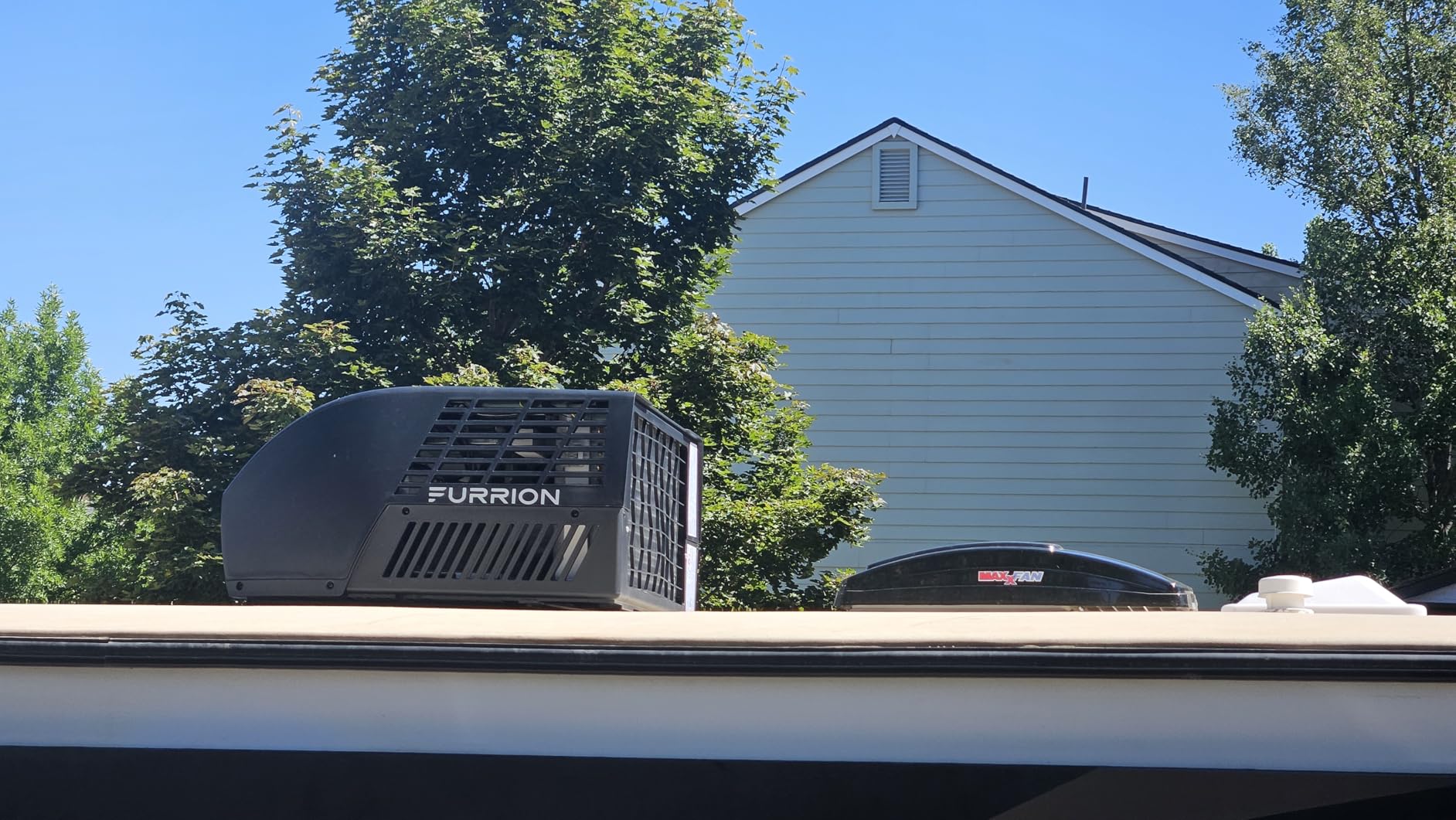
The Furrion Chill Cube earns the top spot because it solves the single biggest complaint RV owners have about rooftop ACs: the rough start-stop cycling. A variable-speed inverter compressor changes the entire ownership experience.
The short case for it:
- 18,000 BTU cooling — real headroom for hot climates and larger RVs
- Variable-speed compressor — smoother temperature, less noise, easier on generators
- R32 refrigerant — newer and more efficient than older R410A systems
- 72.4 lb weight — lighter than many comparable rooftop units
- Aerodynamic low-profile shroud — better for solar-heavy roofs
Where it falls short: the Air Distribution Box may be sold separately, the listing can be confusing about what’s included, and the 18K BTU draw is more than a small generator can comfortably handle. This is not a casual purchase. It rewards careful buyers who verify compatibility before clicking. We cover all of this in detail in our full Furrion Chill Cube 18K review, including the parts hunt some buyers run into.
Best for: Travel trailers, fifth wheels, and motorhomes on shore power where comfort and quiet operation matter. Especially good for RVers replacing a tired old 13.5K unit.
Check current Furrion Chill Cube price on Amazon
Top Pick for Off-Grid: Gidrox 12000 BTU 12V DC
If you boondock, run on lithium and solar, or live in a Sprinter conversion, this is a different category entirely. Standard rooftop ACs running through an inverter waste energy on inverter losses. The Gidrox skips the inverter entirely by running directly on 12V DC.
The short case for it:
- 12V DC native operation — no inverter required
- 12,000 BTU cooling, 9,000 BTU heat pump — covers most van builds
- 54 lb weight — manageable for a two-person rooftop install
- 40 dB Sleep mode noise claim — quiet enough to sleep under
- App, remote, and physical button controls — three layers of redundancy
- Standard 14-inch roof opening fit
Where it falls short: at 58A rated current, the wiring side is where DIY builders get into trouble. Cable gauge, fuse placement, voltage drop, and battery distance all matter. This is not a unit to install with skinny wires and a hopeful attitude. The 12,000 BTU rating is also less than a 110V rooftop unit, so if your van is poorly insulated or you camp in extreme heat, it can struggle. Full electrical sizing details are in our Gidrox 12V RV AC review.
Best for: Sprinter conversions, skoolies, truck campers, smaller travel trailers built for off-grid use, and any rig with a serious lithium battery bank and solar input.
Check current Gidrox 12V price on Amazon
Top Pick for Value: RecPro RV Air Conditioner 15K Heat Pump
The RecPro 15K hits the sweet spot for shore-power RVers who want both cooling and shoulder-season heating without paying premium prices. It’s a 110V rooftop unit with a built-in reverse-cycle heat pump, a remote control, and standard installation hardware.
The short case for it:
- 15,000 BTU cooling and 15,000 BTU heating — strong dual-season capability
- Reverse-cycle heat pump — better than a resistive heat strip for mild cool weather
- Standard 14-inch roof opening — fits most RVs without modification
- Includes both exterior shroud and interior plenum — fewer parts to chase down
- Remote control and LED panel — no separate thermostat wiring needed
- 341 CFM airflow — enough to actually move air through a non-ducted setup
Where it falls short: the 59.1 dB rated noise level is louder than the variable-speed Furrion. Some product graphics show conflicting noise figures (around 55 dB), which we’d like to see clarified. The one-year warranty is also shorter than what you get from premium brands. The full breakdown including the install details is in our RecPro RV Air Conditioner 15K review.
Best for: Travel trailers, fifth wheels, food trucks, enclosed trailers, and RVers who want the simplicity of a 110V rooftop unit with bonus heat pump capability for shoulder seasons.
Check current RecPro 15K price on Amazon
Side-by-Side: Which One Is Right for You?
| Spec | Furrion Chill Cube 18K | Gidrox 12V DC | RecPro 15K Heat Pump |
|---|---|---|---|
| Power source | 110V AC | 12V DC | 110V AC |
| Cooling capacity | 18,000 BTU | 12,000 BTU | 15,000 BTU |
| Heating | Cooling-focused (varies) | 9,000 BTU heat pump | 15,000 BTU heat pump |
| Compressor type | Variable-speed inverter | DC inverter | Single-speed |
| Listed noise | ~60 dB | 40-53 dB by mode | 59.1 dB |
| Weight | 72.4 lb | 54 lb | Standard rooftop weight |
| Refrigerant | R32 | (not listed) | R410A |
| Roof opening | Standard | 14 in. x 14 in. | 14 3/16 in. x 14 3/16 in. |
| Best use | Hot climates, light sleepers | Off-grid van life | Dual-season trailer use |
What About BTU Sizing? A Quick Reference
The most common sizing mistake is buying purely on BTU rating without considering the rest of the picture. Use this as a starting point, then adjust for insulation, sun exposure, and climate:
- Tent trailers, pop-ups, very small campers (under 18 ft) — 9,000 to 12,000 BTU is enough. The Gidrox at 12,000 BTU works well here if you’re off-grid.
- Van conversions, truck campers (18-22 ft) — 12,000 BTU off-grid (Gidrox) or 13,500 BTU rooftop on shore power.
- Travel trailers, mid-size motorhomes (22-32 ft) — 13,500 to 15,000 BTU. The RecPro 15K covers this range well.
- Class A motorhomes, fifth wheels (32-40 ft) — 15,000 BTU minimum, 18,000 BTU preferred. The Furrion Chill Cube 18K is a good fit here.
- Anything over 40 ft, or any rig in extreme desert heat — Plan on dual AC units. One unit will lose the fight in 110°F sun.
Installation: What to Expect
Replacing an existing rooftop AC sounds simple — bolt the new one in, hook up the wires, install the plenum. In practice, three things commonly go wrong.
Roof condition. If the previous unit sat on the roof for a decade, the gasket area is probably caked in old sealant residue, the framing might be soft from past leaks, and the opening might be slightly out of square. Don’t rush the prep. Clean the surface, inspect the framing, and reinforce any soft spots before mounting the new unit.
Air separation in the plenum. Inside the ceiling, the supply air (cold) and return air (warm cabin air going back to the unit) must stay separated. If they mix, the unit short-cycles and your cabin never gets cold. This is one of the most common reasons a new AC underperforms.
Power supply reality check. For 110V units, confirm your breaker panel can handle the amp draw. For 12V units like the Gidrox, the wire gauge and battery distance matter more than the AC unit itself. A 58A current draw through skinny wire creates voltage drop and heat — neither of which you want on a hot summer night.
If any of these feel uncertain, a mobile RV technician installing a rooftop AC typically charges $300-$600 in labor. That’s cheap insurance compared to ruining a $1,500 unit on a rushed install.
Frequently Asked Questions
What is the best RV air conditioner overall in 2026?
The best overall RV air conditioner for most shore-power RVers is the Furrion Chill Cube 18K BTU. Its variable-speed inverter compressor solves the rough on-off cycling that defines older rooftop ACs, and the 18,000 BTU rating provides cooling headroom for larger or hot-climate rigs. For off-grid van conversions, the Gidrox 12V DC is the better pick because it removes inverter losses entirely.
How many BTUs do I need for my RV air conditioner?
A general guideline: 13,500 BTU covers RVs up to about 32 feet, 15,000 BTU is recommended for Class A motorhomes 32-40 feet, and 18,000 BTU or dual units are needed for rigs over 40 feet or for anyone camping in 100°F+ desert heat. Insulation quality, window count, and sun exposure can shift these numbers by one tier.
Is a 12V RV air conditioner worth it?
For dedicated off-grid builds with substantial lithium battery banks and solar input, yes — a 12V unit like the Gidrox eliminates inverter losses and simplifies the electrical system. For RVers who mostly use shore power or generators, a 110V rooftop unit is usually a better value because it costs less and produces more cooling per dollar.
What is the difference between a heat pump and a heat strip in an RV AC?
A heat strip is a resistive electric heating element that works like a hair dryer — it converts watts into mild warmth and pulls a lot of power. A reverse-cycle heat pump moves heat from outside to inside, which is far more efficient in mild conditions. Both the RecPro 15K and the Gidrox 12V include true reverse-cycle heat pumps. Heat pumps are not winter furnaces — below about 40°F outside, their efficiency drops significantly.
Can an RV air conditioner run on solar power?
A traditional 110V rooftop AC running through an inverter requires a substantial system: a 3,000W or larger inverter, a 600+ Ah lithium battery bank, and 800W+ of rooftop solar to recover daily consumption. A variable-speed unit like the Furrion Chill Cube is more solar-friendly than a single-speed unit because it draws less power once the cabin is cool. For dedicated off-grid use, a 12V DC unit drawing 600-900 watts is dramatically more efficient than going through an inverter.
How loud is a quiet RV air conditioner?
Listed decibel ratings vary from about 40 dB (Gidrox in Sleep mode) up to 65+ dB (older single-speed units). What matters as much as the number is the type of noise: variable-speed and inverter-driven compressors produce a steady low fan tone, while single-speed compressors cycle harder and feel louder than the rated dB suggests. A unit listed at 60 dB with steady operation often feels quieter than one listed at 55 dB that cycles aggressively.
Should I replace my old 13.5K RV AC with a 15K or 18K unit?
It can be a good upgrade if your current unit struggles to keep up in hot weather, cycles loudly at night, or pulls hard on your generator. Before upgrading, verify three things: the roof opening will accommodate the new unit, your electrical system can handle the higher amp draw, and your existing duct or plenum setup will work with the new model. The 14-inch roof opening is fairly standard, but ducted versus non-ducted compatibility is the detail that catches buyers most often.
Final Recommendation
There is no single “best RV air conditioner” — there is the best one for your RV, your power setup, and the way you camp. Pick by use case:
- Most shore-power RVers who want a real upgrade → Furrion Chill Cube 18K. The variable-speed compressor changes how the unit feels in daily use. Full review →
- Off-grid van life, skoolies, serious solar builds → Gidrox 12V DC. The only way to skip the inverter and keep it simple. Full review →
- Travel trailers and fifth wheels wanting heat plus cool → RecPro 15K Heat Pump. Standard install, useful shoulder-season heat, fair price. Full review →
Whichever way you go, do not skip the install details. A premium AC on a rushed install will underperform a budget unit on a careful install every single time. Measure twice. Verify what’s in the box. Check the roof opening. Confirm your power supply. Then enjoy a cool RV.