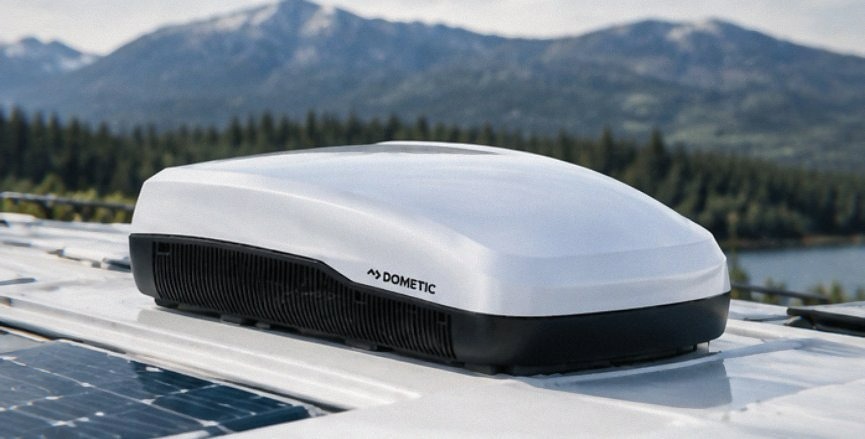
I bought the Dometic FreshJet 3 Series 15K BTU because my old rooftop unit finally croaked in the middle of a July heat wave in southern Utah, and I needed cold air fast. Not a project. Not a research rabbit hole. I needed a box on my roof pushing cold air by the weekend. That’s the honest reality of why most of us end up buying this unit — you’re not comparison shopping, you’re sweating.
Contents
- What It Actually Cools
- The Install: What Nobody Tells You
- Noise, Drainage, and the Stuff You Live With
- Power Draw and Pedestal Reality
- How It Stacks Up Against the Alternatives
- Who Should Buy This and Who Should Walk Away
What It Actually Cools
My rig is a 30-foot travel trailer with a single roof vent and no ductwork to speak of — this unit dumps air straight out of the ceiling assembly. On a 102°F afternoon in Moab with the trailer parked in full sun, I can pull the interior from mid-90s down to about 76°F in roughly 25 minutes. That’s with the awning out and a reflective windshield cover on, which matters more than people admit.
The 15K BTU rating is real. This isn’t the anemic 13.5K unit that came with the trailer from the factory. When I swapped over, the difference in recovery time after opening the door to let the dog in and out was noticeable — not dramatic, but I stopped feeling like I was losing ground every time someone walked through.
The trade-off is that 15K BTU is a lot of cooling for a small box, and it cycles hard. On a mild 85°F day it’ll short-cycle if you don’t bump the thermostat up a couple degrees. I run mine at 74°F and let it do its thing rather than chasing 68°F, which it simply won’t hold in direct sun.
The Install: What Nobody Tells You
The unit itself is heavy — this is a two-person job or a one-person job with a rented lift and a lot of swearing. I used a buddy and a ladder and we got it up there, but I’d budget a full afternoon if you’re doing it yourself.
The mounting frame uses the standard 14” x 14” roof opening, so if you’re replacing an existing unit it drops right in. That part is genuinely easy. What’s not easy is the ceiling assembly — the interior shroud that bolts up from below. The screws are soft, the plastic is thin in places, and if you overtighten you’ll strip the mounting holes and then you’re drilling new ones. I stripped one. I fixed it with a slightly larger screw and a washer. Learn from me.
The control box wiring is straightforward if you’ve done any 12-volt work. If you haven’t, pay someone. The thermostat is a wall-mounted digital unit that comes with the kit, and running that wire through the ceiling and down an interior wall was the most tedious part of the whole job — about two hours of fishing wire through insulation.
If you buy through a link on this page I may earn a small commission. It does not change what you pay.
Noise, Drainage, and the Stuff You Live With
The compressor is loud. Not “you can’t sleep” loud, but it’s a deep drone that fills the trailer when it kicks on, and if you’re sitting directly under the ceiling assembly you’ll raise your voice to talk over it. The fan on high is a steady rush of air that’s honestly more noticeable than the compressor. I sleep fine with it running — it’s white noise after the first night — but my wife wears earplugs when it’s on high. That’s the truth of it.
Condensation drainage is the thing that bit me. The unit has a built-in drain pan, but on humid mornings in the Pacific Northwest I get water dripping down the side of the trailer if I don’t keep the drain holes clear. Pine needles, pollen, one wasp nest — I check them every couple weeks now. A five-second visual check saves you a water stain on your siding.
The filter is a washable mesh screen behind the return grille. Pop it out, rinse it in the sink, let it dry, put it back. Do it monthly in dusty country or you’ll lose airflow and the unit will work harder than it needs to. It takes two minutes and it’s the single easiest thing you can do to keep this thing alive.

Power Draw and Pedestal Reality
This is where the FreshJet 3 will humble you if you’re not paying attention. On a 30-amp hookup, running this unit plus the microwave plus the coffee pot at the same time will trip the pedestal breaker. Every time. I learned this the hard way at a campground in Idaho at 6:45 in the morning, and the guy in the next site was not impressed with my language.
The rule in my rig is simple: AC on, one big appliance at a time. Fridge and lights and phone chargers are fine. The microwave and the coffee maker are not friends with the air conditioner. If you’ve got a 50-amp rig with a proper load center, you’ve got more headroom, but a 30-amp trailer needs discipline.
I haven’t tried running this on a small generator, and I wouldn’t. The startup surge on a 15K BTU compressor is significant — you need a serious inverter generator or a soft-start kit, and even then it’s marginal. Shore power or a big onboard genny is the realistic answer.
How It Stacks Up Against the Alternatives
At just over a thousand bucks, this sits in the middle of the rooftop AC market. The cheaper units — the off-brand 13.5K boxes you see for $600 to $700 — will cool your rig, but they’re louder, they use cheaper components, and the thermostats are crude. I’ve owned one. It lasted four seasons and then the fan bearing went.
The premium options from the big competitors run $1,300 to $1,500 and give you slightly better efficiency and a quieter fan, but you’re paying a lot for marginal gains. The FreshJet 3 splits the difference well — it’s a name-brand unit with a real warranty and a decent track record, and it doesn’t feel like a compromise.
If you’re replacing a dead unit and you want something that’ll last, the FreshJet 3 at this price is a sensible buy. If you’re building out a van or a small trailer and you’ve got the budget, the quieter premium units are worth a look. If you’re pinching pennies, the cheap units will get you through a summer or two — just know what you’re getting.
Who Should Buy This and Who Should Walk Away
Buy the Dometic FreshJet 3 if you’ve got a 25-to-35-foot rig, you’re mostly on shore power, and you want a name-brand 15K BTU unit without paying premium prices. It cools hard, it installs in a standard opening, and it’s been reliable for me through two full summers and one shoulder season.
Walk away if you’re trying to run AC off a small generator, if you’re in a rig with existing ductwork that this won’t tie into cleanly, or if you’re expecting whisper-quiet operation. This is a working air conditioner, not a hotel unit. It makes noise, it draws serious amps, and it needs a little maintenance attention.
For me, it’s been the right call. My trailer is cold when I need it cold, and I haven’t had to think about it since the install. That’s what I paid for.