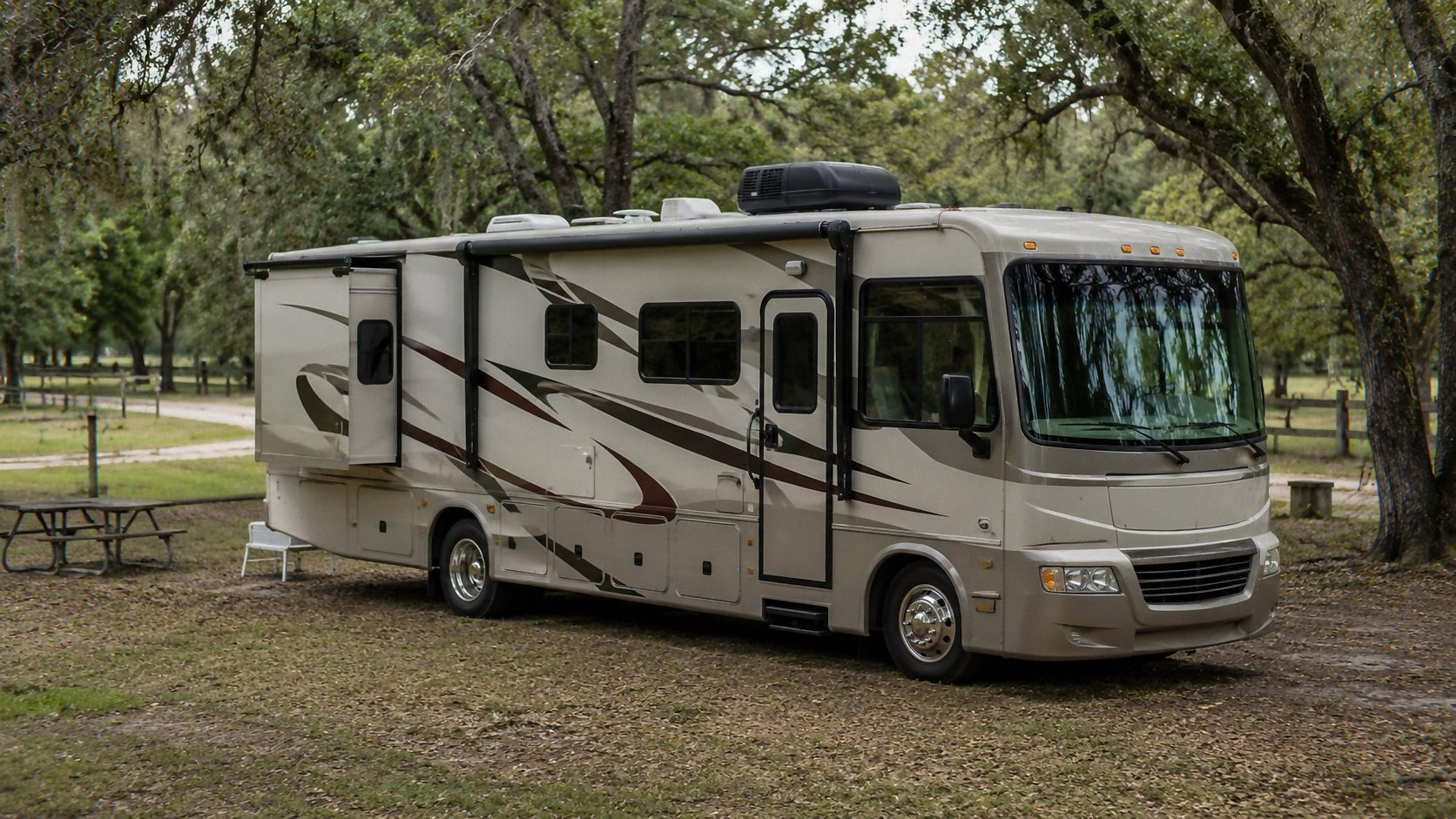
My old RV rooftop unit chose a Tuesday afternoon in July to give up. Not a gradual decline. Just… nothing. One minute it was humming along, the next it was a hot metal box strapped to my roof that did absolutely nothing except mock me from above. Ninety-eight degrees outside, my 40-foot rig turning into a mobile pizza oven, and me sweating through a shirt I’d just changed.
That’s the kind of moment where you stop researching and start buying.
I’d been eyeing replacements for a while anyway. My old Coleman had started making this noise—kind of a rattling groan when the compressor kicked in—and I knew its days were numbered. I just kept hoping it’d make it through one more summer. It didn’t.
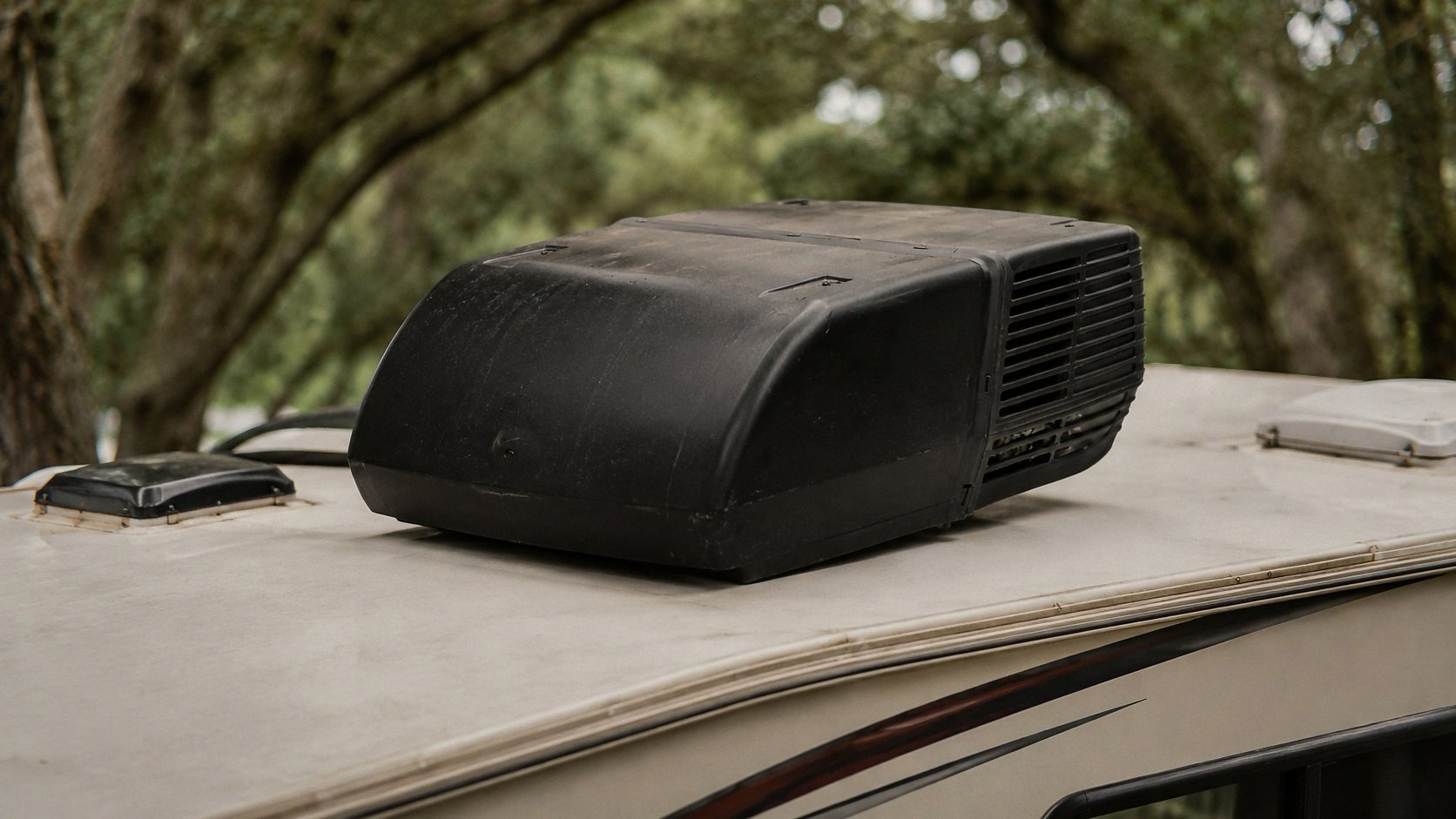
So after a lot of late-night scrolling and way too many YouTube installation videos, I landed on the Coleman-Mach 48204-069 Mach 15 Plus, 15,000 BTU A/C. Let me be clear: I didn’t buy this because I thought it was the prettiest or the quietest. I bought it because it’s the most powerful RV air conditioner you can buy. 15,000 BTUs. When your RV is a giant aluminum and fiberglass solar collector, raw cooling output is the only metric that actually matters.
First impressions that almost made me return it
The box arrived faster than I expected. Ordered on Sunday, showed up at my RV park on Tuesday—which, if you’ve ever tried to get anything shipped to a temporary campsite address, you know is basically a miracle. Rob Crawford’s review on Amazon mentioned this too, and I completely get it. Having a 100-pound AC unit show up while you’re still set up in a park is a huge relief because you don’t have to coordinate delivery with a campground office or worry about it sitting in a package locker somewhere.
But unboxing it was a journey.
The listing says “Includes wood skid.” It absolutely did not. Thick cardboard wrapped around the bottom instead. At first I was annoyed because I’d been expecting wood, something solid to slide it up the ladder. But honestly? The cardboard ended up being better. It was lighter and I could wiggle it onto the roof without needing a second person to balance a heavy wooden base. If you read the reviews, a lot of people mention this discrepancy. Coleman, if you’re listening—update your listing or put a note in the box because the initial WTF moment is real.
One thing nobody tells you: the rubber gasket has that new-rubber smell—the kind that’s not quite toxic but definitely not pleasant—and it lingers in the cabin for about three days after install. I don’t know why. It just does.
Getting this 100-pound beast onto the roof
This is where the whole experience shifted from “I’m in over my head” to “okay, maybe I can do this.”
Two ladders. One brother who owes me a favor. About an hour of sweating and grunting. This isn’t a one-person job if you value your back.
One thing I’ll say for the Mach 15 Plus: the design is simple enough that a reasonably competent person with basic tools can handle it. It’s pretty much plug-and-play if your old unit was also a Coleman. The mounting holes lined up. The wiring harness matched. If you have a previous Coleman Mach unit, this is the easiest RV AC installation you’ll ever do—because it’s literally designed as a drop-in replacement.
But here’s the kicker that nearly tripped me up. The unit doesn’t come with a control box. Not included. If your old control box is dead or you want a new one with the unit, you’re buying it separately. I was lucky—my old controller worked fine. But I saw other reviews where people got stuck because they didn’t realize this. If you’re replacing a non-Coleman unit or your thermostat is shot, factor that into your budget.
Cool air? Yeah, it actually works See Today’s Deal on Amazon
Turning it on for the first time was like watching a patient come back to life.
The compressor kicked in, the fan spun up, and within a couple minutes, I was feeling cold air coming out of the vents. My RV is 40 feet with three slides and honestly? Terrible insulation. The walls are maybe R-7 on a good day. And this little black roof box managed to get the interior from 90°F down to 75°F in about four hours.
That’s not even the impressive part. According to some guy in the reviews who apparently knows his stuff and grew up servicing R12 and R22 units—mine was pushing out 45°F air at the discharge vents while the return was pulling in 75°F. A 30-degree differential. I’ve never seen that in any AC. Not in a house, not in a car, definitely not in an RV. It’s genuinely shocking. The thing cycles on and off now—set the thermostat to 75 and it actually maintains it, which means it’s not running constantly and my generator isn’t gasping for air.
But let me be real about the airflow. The Mach 15 Plus is designed for ducted systems. If your RV has those cheap plastic vents spread throughout the ceiling, this thing will push air into all of them. Not evenly, not perfectly—the front bedroom vent always gets less than the living area—but enough that you’re not roasting while you sleep.
If you’re looking for a more budget-friendly option, I’d also consider the Dometic FreshJet series. I reviewed the [Dometic FreshJet 3 Series 13,500 BTU] a while back and it’s a solid runner-up, but it doesn’t have the raw cooling power of this Coleman.
The cons I didn’t see coming
That control board situation
You really do need to buy the control module with freeze sensor separately. The unit literally won’t function without it. Why would Coleman sell half a product? I don’t know. I’m not trying to make excuses for them. It’s annoying. If you’re buying this as a direct replacement for an old Coleman Mach unit that already has the control board, you’re fine. If not? Add another $100 to your budget.
Packaging is a coin flip
My box arrived intact. But M. Walker’s review says his arrived with a busted box and damaged casing. The unit still worked, but he was stuck with cosmetic damage. That’s the risk of buying heavy, bulky items on Amazon. The shipping carriers aren’t gentle with these things. If I were doing it again, I’d inspect the box immediately upon delivery and take photos before even opening it.
The quiet myth
I’ll be honest: this thing is not quiet. It’s quieter than my 12-year-old unit. It’s not quieter than a mini-split or a window unit. It’s still a rooftop RV AC. If you’re in a campground with hookups and you’re sleeping in the bunk above the AC, you’re going to hear it. It’s got that low-frequency hum that travels through the roof structure. On the plus side, the white noise makes it easier to sleep—except when it cycles off and the sudden silence wakes you up. But whatever. You don’t buy a 15,000 BTU rooftop unit for the whisper-quiet operation. You buy it because you don’t want to feel like you’re camping inside a hair dryer.
Lightning killed my previous unit. No, really.
This is a weird one but I’m mentioning it because a reviewer pointed it out and it made me realize I was being an idiot. My previous two Coleman units, both R410a, each lasted about five years. Both died during lightning storms. I thought it was bad luck. It’s actually just… lightning. Surges travel through power distribution lines from up to a mile away and can wreck the electronics in your RV and house.
So now I run a Hughes Autoformer and a surge protector between the pedestal and my RV. And I turn the AC off during storms. I know—who thinks about lightning when they buy an AC unit? But if you’re boondocking or park-hopping, it’s worth protecting a $1,000 investment.
The black color is a surprisingly smart move See Today’s Deal on Amazon
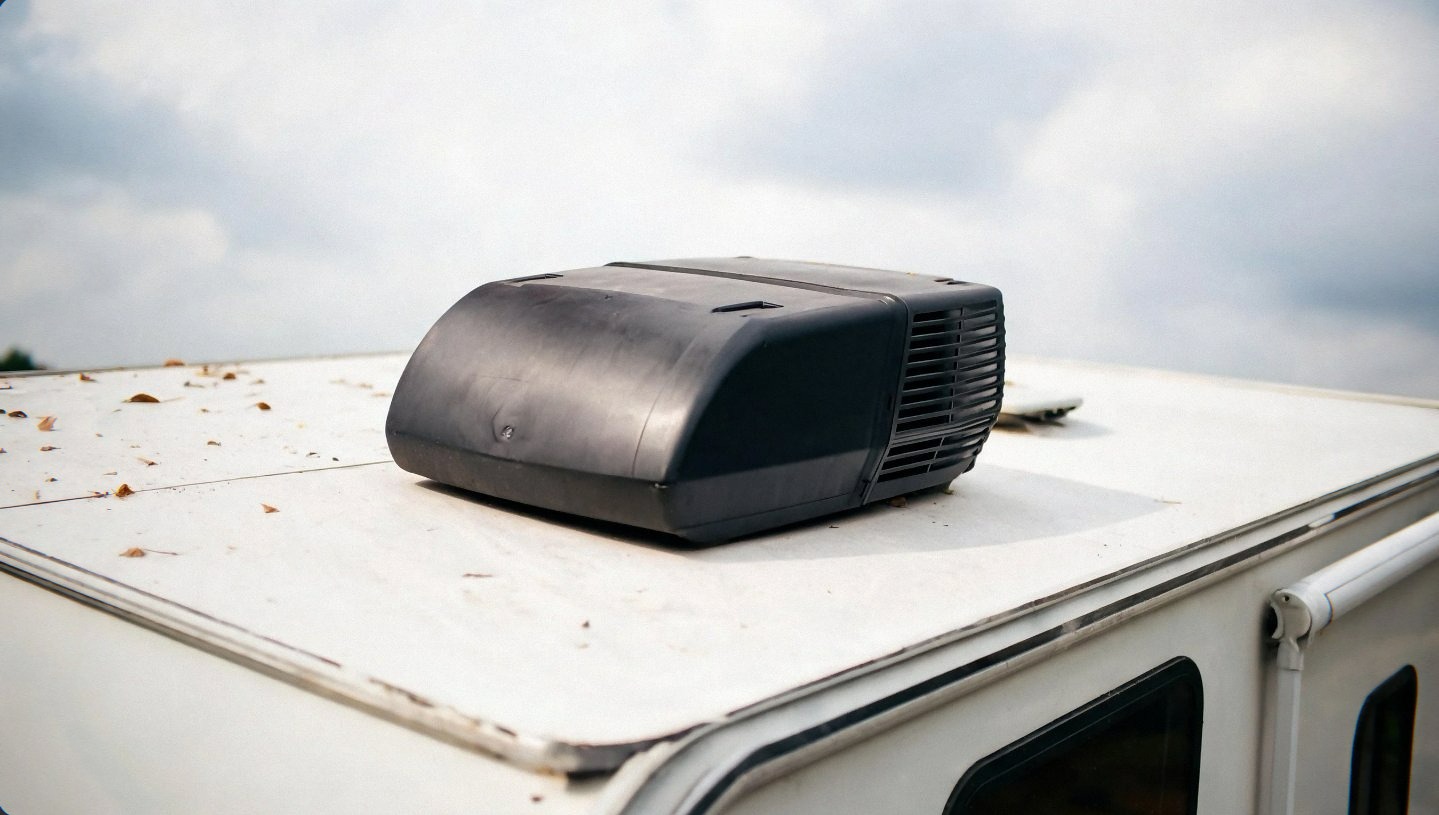
I didn’t buy the black version for aesthetics. I bought it because the black one was available sooner. But after using it? I’d recommend the black version over the white. It hides the roof dirt and oxidation that would make a white unit look gross in a couple years. It’s more aerodynamic. It looks less like a big white toaster sitting on your roof.
This RV air conditioner with heat pump comparison covers some of the other options if you want a unit that also heats, but I opted for a separate propane heater and this just for cooling.
Three weeks in: What I actually think
I’m sitting here writing this, sweating from the earlier climb onto the roof to check a sealant line. My coffee’s gone lukewarm because I forgot about it. The dog is sprawled on the vinyl floor directly under the vent because that’s where the air hits coldest. The unit’s cycling on and off in the background. And it’s 90°F outside and I’m wearing a sweatshirt inside the RV.
Three weeks. No issues. No strange noises. No moisture pooling on the ceiling. It’s just doing what it’s supposed to do. The remote thermostat in my bedroom actually matches the living room now, which is a first since I bought this rig.
I was talking to a buddy who replaced his with the Dometic Blizzard NXT 15K a few months ago—different unit, same capacity. And he’s happy. But the Dometic cost him more and from what he described, the Coleman install was easier. If you want an easier install, get the Coleman.
The one thing I’d warn you about: if you have a smaller RV, like 25 feet or under, 15,000 BTUs might be overkill. It’s the most powerful you can buy, and on a smaller rig, it’ll short-cycle, which isn’t great for the compressor long-term. But on a large rig like mine? It’s perfect.
If you grab one through the links here, I might get a small cut—costs you nothing extra and keeps the lights on. Just being honest.
One small detail that drove me crazy
The mounting bolts. The thing ships with four short bolts. My old unit had longer ones. There’s no note saying “you might need to reuse your old bolts” anywhere in the manual. The manual reads like it was translated from a language nobody speaks. The illustrations are basically hieroglyphics.
So I stood there with the unit on the roof, the gasket lined up, the bolts in my hand, and realized none of them reached the mounting brackets. I had to run back into the RV, dig through my toolbox, find the old bolts, and use those instead. If I’d been smarter, I would’ve just reused the old hardware from the start. This isn’t necessarily a flaw—it’s just the kind of thing you don’t know until you’re doing it.
And the LED on the control panel? It’s bright. Like, “find your way to the bathroom at 3 AM” bright. If the AC is in the common area of your RV, no big deal. But in a small rig where the control panel is near your sleeping area, you’re going to want to cover that LED with a piece of tape. It’s a little thing, but it’s a little thing that’s going to bother you more than you think.
The smell thing
I mentioned the gasket rubber smell earlier. It fades after a few days, but it’s there. Nobody told me that. I thought I had a wiring problem at first—that weird “hot electronics and rubber” smell—but no, it’s just the gasket off-gassing. It’s harmless. But if you’re sensitive to smells, be prepared to open windows for a couple days after install.
What I’d tell my buddy on the phone
If you’re replacing an old Coleman and you know your control box works, buy this. It’s the cheapest way to get 15,000 BTUs of cooling power in your RV. It’ll drop in with zero fuss. It cools better than anything else I’ve tried. And the airflow is exactly what a ducted system needs.
If you’re starting from scratch, just know you’ll need to buy the control board separately. And if you’re scared of climbing onto your roof with a 100-pound AC, get a friend or pay a mobile RV tech to install it—it’s worth the money to save your back.
My old unit lasted five years. I expect this one to do the same. Maybe longer, now that I’m more careful about lightning. If I had to pick between this and the Fogatti InstaCool Ultra, I’d take the Coleman because it’s simpler. Fewer parts. Less to break. The Fogatti is fine, but it’s got more electronics to go bad. For a roof that’s baking in 100-degree sun, simple wins.
Three weeks, no falls, one weird rubber smell that went away. I’ll take it.See Today’s Deal on Amazon
The dog just stretched and groaned. That’s my cue. RV is cooling, the coffee’s cold, and I’ve got a happy dog under the vent. I’m calling this a win.