Disclosure: This post contains affiliate links. I may earn a small commission at no extra cost to you if you purchase through these links.
I’ve been living and traveling full-time in an RV for going on six years now. I’ve sweated through Quartzsite in July, frozen through Colorado nights in October, and fried every mediocre rooftop AC unit I’ve ever owned somewhere in between. So when I say the TURBRO Inverter 13,500 BTU RV Air Conditioner with Heat Pump is worth writing about, I’m not just saying it to fill space on a page.
This is a long one. Grab a coffee. Or don’t — you can skip to whatever section matters to you.
Why Your RV Air Conditioner Matters More Than You Think
Most people buy the cheapest rooftop AC that fits their existing hole. I get it. You’re already dropping serious money on the rig, the campsite fees, the fuel, the unexpected tire that blew out somewhere in New Mexico. The AC feels like a commodity — 13,500 BTU is 13,500 BTU, right?
Wrong. The AC unit you choose affects your power draw, your battery bank size, your solar capacity requirements, how well you sleep, and whether your RV smells like a gym locker on day three of boondocking in August heat. It matters a lot.
The Problem with Traditional On/Off Compressor Units
Standard non-inverter RV ACs do one thing: they blast at 100% capacity until the thermostat trips, then shut off completely, then kick back on again. Every startup pulls a huge surge — we’re talking 25+ amps on older Coleman-style units. If you’re on shore power at a campground with 30-amp service, you’re already flirting with tripping the breaker every time you also try to use the microwave.
On battery power? Forget it. A traditional 13,500 BTU unit cycling on and off will drain a 200Ah lithium bank in a few hours. And it never really gets comfortable — you get blasted with cold air, then it stops, then the van heats back up, then it blasts again. Hot spike, cold spike, hot spike, cold spike.
Why Inverter Technology Changes the Game
An inverter compressor modulates speed. Instead of full-blast or nothing, it ramps up when it needs to cool fast, then settles into a low steady draw to maintain temperature. One verified buyer named Spiderjg ran this unit on 600Ah of lithium batteries through 95-degree heat for 13 hours straight and woke up with 43% battery remaining. His previous unit was drawing 25 amps continuously. This one clocked 7.8 amps at 71 degrees once it reached temperature.
That is not a small difference.
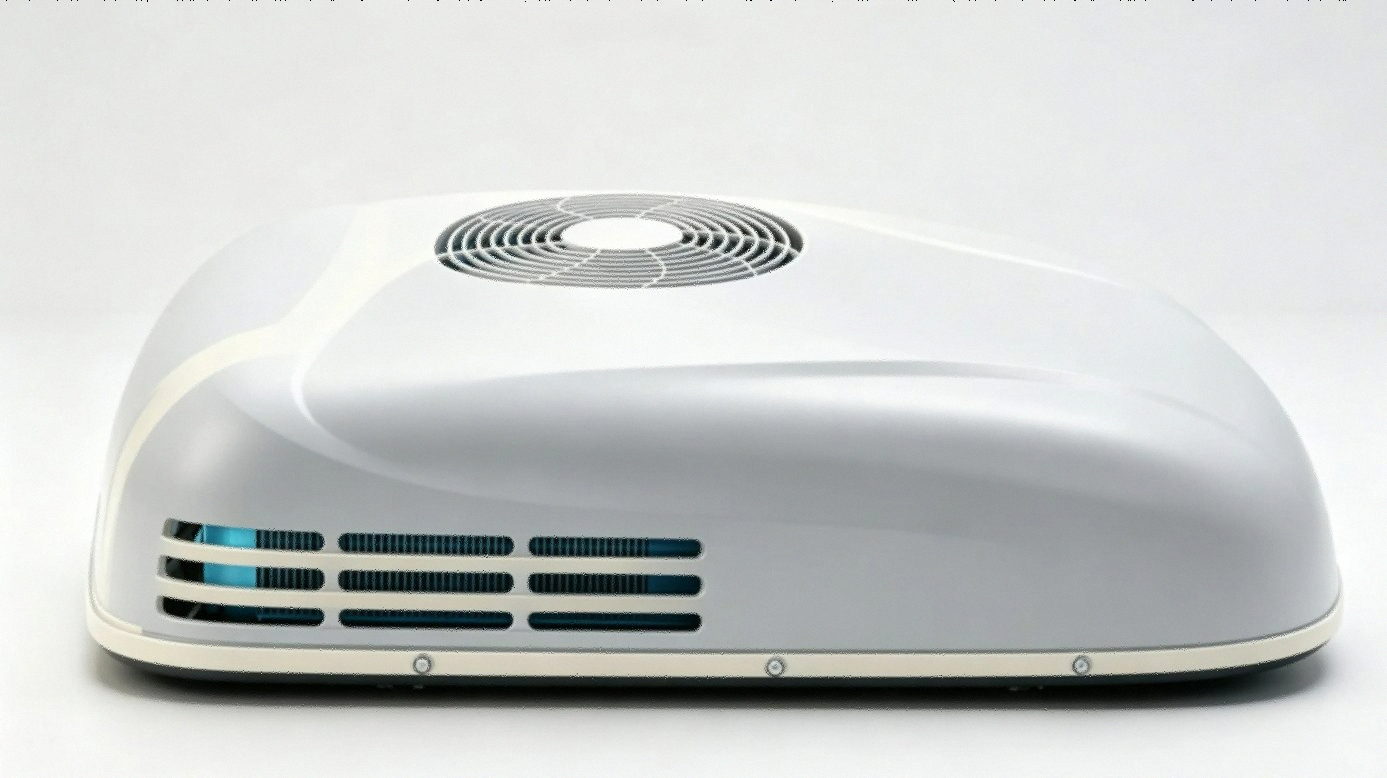
TURBRO Inverter 13.5K BTU RV AC: What You Actually Get
Let’s talk specs before opinions.
| Spec | Value |
|---|---|
| Cooling Capacity | 7,500 – 13,500 BTU (variable) |
| Heating Capacity | 7,200 – 13,500 BTU (heat pump) |
| Power Supply | AC 115V / 60Hz |
| Current Draw (Cooling/Heating) | 9.8–16.9A / 8.9–14.5A |
| Ambient Temperature Range | 19.4°F to 109.4°F |
| Rooftop Unit Dimensions | 29.1”W x 10.0”H x 41.6”D |
| Roof Opening Required | 14.25” x 14.25” |
| Refrigerant | R32 |
| Modes | Cooling, Heating (Heat Pump), Fan, Dry |
| Control Options | Remote, WiFi App |
| Min. Circuit Ampacity | 16A |
| Max. Circuit Protection | 25A |
| Current Amazon Price | ~$1,099 |
The unit ships in two separate boxes, sometimes arriving on different days. TURBRO is upfront about this — don’t panic when only one box shows up. Start the install after you have both.
Installation: Honestly Pretty Painless
Most reviewers say this went in easy. One guy — richard — replaced an older silicone-glued unit and said the removal was actually harder than putting the new one in. His advice: don’t slide it on the roof or you’ll damage the foam gasket. Have two people for the lift. The unit’s not featherweight.
You need a 14.25” x 14.25” roof opening and ceiling thickness between 1.02” and 3.93”. It fits most standard RV cutouts as a drop-in replacement.
One thing to note: the supplied bolts may be too short if you’re adding it as a third unit on a longer RV like a Montana fifth wheel. Buyer Shea hit this issue and had to order longer bolts separately. TURBRO’s customer service was responsive about it, but they didn’t have the longer bolts to ship — you’ll need to source them yourself.
💡 Pro Tip: Measure your ceiling thickness before ordering. If you’re between units and your old one was silicone-sealed, budget an extra 30–45 minutes for cleanup before the new unit goes on.
The ceiling assembly includes an atmosphere lamp — you can cycle it between blue, yellow, or white ambient lighting. Completely unnecessary feature that I will absolutely use every time.
Performance in Real Conditions
Here’s where opinions diverge. The reviews on Amazon split into two camps, and both are telling the truth — they’re just experiencing different variables.
When It Works, It Really Works
Rpresley replaced a Coleman 13,500 BTU unit in a Winnie ERA Sprinter van. The old Coleman blasted on high/medium/low with no temperature regulation, causing constant freeze-out and hot spikes. After years of misery, they went through a RecPro 9,500 BTU (not enough cooling power) before landing here. The TURBRO eliminated the temperature swings, uses less current, and includes a heat pump for shoulder-season nights.
Bob installed it on an off-grid black series camper to replace a knob-turner unit that was killing his solar system. Called it the best RV HVAC he’s ever encountered. The install was straightforward enough that he said even a novice could manage it with a couple of YouTube videos.
A Canadian buyer named kevin did a direct drop-in replacement for his existing 15K unit — done in an hour, works exactly as advertised.
When It Frustrates, Here’s Why See Today’s Deal on Amazon
The most detailed critical review comes from Meni, who installed two of these in a Fleetwood Bounder. His issue is specific and technical: the temperature sensor is located right next to the cold air outlet, under a plastic cover that chills rapidly when the unit runs. The sensor reads the ambient air coming back through the return path — which is much colder than the actual room temperature.
In his setup, the unit displays 62°F while every other sensor in the same space reads 74–75°F. Result: the inverter never ramps down, never reaches the efficiency it should theoretically achieve, and the energy savings disappear.
Carol S. Cates documented similar frustration, adding that the indoor unit feels like it got a smaller budget than the outdoor inverter module. The remote is clunky, toggling features requires pressing the same button multiple times, and the dry mode didn’t noticeably reduce humidity overnight.
⚠️ Watch Out: The thermostat accuracy issue is real and documented by multiple buyers. It’s most impactful if you’re running this unit expecting inverter-level efficiency from your solar/battery setup. If you’re on shore power and just want cooling that works without hot/cold spikes, you’ll probably be fine with it.
The noise level also gets mixed reviews. Some find it significantly quieter than whatever it replaced. Others find it loud. The truth is it’s louder than a properly ducted system — because it’s a direct-dump non-ducted unit, all the airflow turbulence exits into the room. That said, Vaughn U. noted in a May 2026 review that startup is around 1.6 amps and it starts fine off a 1,500-watt inverter with 200Ah of battery.
TURBRO 13.5K vs. The Competition: How Does It Stack Up?
Since we’re talking serious money here, it helps to know what else is out there.
| Model | BTU | Heat Pump | Inverter | Price (approx.) | Notes |
|---|---|---|---|---|---|
| TURBRO Greenland 13.5K | 13,500 | Yes | Yes | $1,099 | This review unit |
| FOGATTI 16K | 16,000 | Yes | Unknown | $1,104 | Higher BTU, 4.8 stars |
| TOSOT 16K | 16,000 | Yes | Unknown | $949 | Prime Day pricing |
| TURBRO 15K (electric heat) | 15,000 | No (electric) | No | $799 | Lower upfront cost |
| TURBRO 12V DC 9K | 9,000 | No | Yes | $899 | Off-grid/solar builds |
If you’re running a full solar/lithium setup and need maximum off-grid independence, the TURBRO 12V DC 9,000 BTU unit is worth a serious look — it runs directly from 12V DC, which eliminates inverter losses entirely. But for a full-size RV in serious heat, 9K BTU may not cut it.
The FOGATTI 16K is pulling higher ratings (4.8 stars with 23 reviews vs. TURBRO’s 3.9 with 70) and offers more cooling headroom. If you’re in a larger Class A or a hot climate, that extra capacity matters. On sale it’s $1,104, which is only $5 more than this TURBRO unit at regular price.
For most van and Class C owners in moderate-to-hot climates who want year-round capability without a generator, the TURBRO 13.5K with heat pump is a solid choice — with eyes open about the thermostat quirks.
Related Post: Best RV Air Conditioners 2026

Heat Pump: The Feature Nobody Talks About Enough
People obsess over BTU numbers and forget to ask: what happens when it’s 40°F at night in the high desert?
Traditional RV ACs either have no heating at all, or they include a basic electric resistance strip — which is about as energy-efficient as heating your RV with a toaster. You’re looking at 1,500 watts continuously for something that barely takes the chill off.
A heat pump works completely differently. It moves heat from the outside air into your rig instead of generating it from scratch, which means it delivers roughly 3–4x the heating effect per watt compared to electric resistance. The TURBRO heat pump operates down to 19.4°F ambient temperature.
Shea used this unit in desert environments through the winter and said the heating is excellent for taking the chill out of cold mornings. Spiderjg ran the heater for 13 hours at 45°F ambient, maintaining 74°F inside, and noted it used only slightly more amps than cooling mode — still no propane required.
If you’re doing three-season travel and you’ve been hauling a Mr. Heater or running propane for heat, a heat pump alone might be worth the upgrade price.
Related Post: Best RV Air Conditioner with Heat Pump 2026
WiFi and App Control: Surprisingly Useful
The TURBRO app gets better reviews than the physical remote. You can control the unit from your phone, set schedules, adjust temperature — all the expected smart home features applied to a rooftop AC unit. In practice, being able to flip on the AC from your phone before you walk back to a hot RV is genuinely useful, not just a gimmick.
The physical remote is less impressive. Carol S. Cates noted that some features require pressing the same button multiple times to toggle through modes, which is a legitimately annoying UX choice. If you’re tech-comfortable and will use the app primarily, it won’t bother you much.
The Thermostat Problem: A Deeper Look
This is the most technically significant issue with this unit, and it deserves its own section because it affects how you should use it.
The built-in temperature sensor sits in the return airflow path, near the cold air outlet. When the unit is actively cooling, that plastic housing chills down quickly and the sensor reads temperatures much lower than the actual room. The result: the unit thinks it’s achieved your target temperature when the room is still 10–15°F warmer than the display shows.
What this means practically:
- In cooling mode, the unit may cycle off while the room is still uncomfortably warm
- The inverter modulation (the main efficiency advantage) may not kick in properly because the unit keeps thinking it’s reached setpoint
- In AC-heavy use with lithium batteries and solar, you’re not getting the efficiency gains you bought this for
The workaround some people use is setting the target temperature 10–12°F lower than they actually want, letting the inaccurate sensor compensate. Bob noted his thermostat reads 11°F off and is working with the manufacturer.
TURBRO should address this with a firmware update or sensor repositioning — it’s the most fixable problem on an otherwise solid unit.
💡 Pro Tip: If you have a separate temperature sensor in your RV (or add a $15 WiFi sensor), you can manually compensate by setting the TURBRO 10°F below your actual target. Annoying workaround, but it works.
Spec Deep Dive: R32 Refrigerant and What It Means See Today’s Deal on Amazon
The TURBRO Greenland uses R32 refrigerant. This matters for a few reasons:
R32 has a lower Global Warming Potential (GWP) than the older R410A used in most competing units. It’s also more efficient — you need less of it to achieve the same cooling capacity. And it’s becoming the standard in new HVAC equipment globally.
The practical implication: if you ever need service on this unit years down the line, R32 is increasingly available. If you’ve had older RV ACs that used R22 (now illegal to manufacture), you know the pain of finding refrigerant for a discontinued spec.
Who Should Buy the TURBRO Inverter 13.5K?
Let’s be direct about this.
Buy this if:
- You want year-round climate control (cooling + heat pump) in one unit
- You’re on lithium batteries and need lower startup amperage than a traditional AC
- You have a standard 14.25” x 14.25” roof cutout and want a drop-in replacement
- You’re in a van, Class C, or small Class A where 13,500 BTU is sufficient
- Shore power campground users who want quieter, steadier operation
Look elsewhere if:
- You’re building a serious off-grid solar system and need precise inverter efficiency — the thermostat issue undermines this
- You’re in a very large Class A or fifth wheel in extreme heat where 13,500 BTU isn’t enough (look at the FOGATTI 16K or TOSOT 16K instead)
- You need whisper-quiet operation — this is quieter than older units, but it’s not silent
- Budget is your primary driver — at $1,099, this is a premium purchase
Related Post: Furrion Chill Cube 18K Review
What Real Owners Say (Beyond the Star Rating)
The 3.9/5 rating with 70 reviews tells an incomplete story. Breaking it down:
- 58% gave 5 stars — people who had exact-fit replacement situations and saw real power savings
- 14% gave 1 star — mostly thermostat frustration and one reliability report (broken after 3 months of use)
- The middle 28% are mixed on noise and thermostat accuracy
The most credible positive reviews come from people who replaced traditional Coleman or Dometic non-inverter units and are comparing actual amp draw measurements. The most credible negative reviews come from technical users running solar/lithium who tested the thermostat systematically and documented the discrepancy.
Both groups are right. This unit is genuinely better than a standard on/off compressor AC for most use cases. It also has a real thermostat calibration issue that undermines its inverter efficiency claims.
TURBRO Inverter 13.5K BTU RV Air Conditioner: FAQ
Q: Does it work with a 30-amp shore power hookup? Yes. The max circuit protection is 25A, so it fits comfortably within 30-amp service. You’ll still have headroom for other appliances.
Q: Can it cool a 40-foot Class A motorhome? Probably not adequately on its own in serious heat. 13,500 BTU is sized for Class C or mid-size Class A rigs. For a 40-footer in summer desert conditions, look at 15K–16K BTU options or plan to run two units.
Q: Does it work in freezing temperatures? The heat pump operates down to 19.4°F ambient. Below that, you’ll need supplemental heat. For cold-weather camping in genuinely freezing conditions, a propane or diesel heater as backup is still smart.
Q: Can I control it without the app? Yes, the included remote works. It’s not the most intuitive remote — some modes require multiple button presses — but it functions independently of WiFi.
Q: Is the thermostat issue fixable? Some users compensate by setting target temperature lower than actual desired temperature. TURBRO’s customer service has been responsive to individual reports. A firmware fix is theoretically possible but hasn’t been announced as of mid-2026.
Q: Does it require a soft starter? No. The inverter compressor has smooth startup built in, which is one of its advantages. The 1.6-amp startup draw (per Vaughn U.’s review) is dramatically lower than traditional units.
Final Verdict
The TURBRO Inverter 13.5K BTU RV Air Conditioner with Heat Pump is the best upgrade you can make over a traditional on/off RV AC if you’re tired of temperature swings and high amp draws. The heat pump alone pays for itself over a season if you’ve been burning propane for heat, and the inverter startup is smooth enough to run off a modest battery bank.
It’s not perfect, though. The thermostat accuracy issue is real and documented, not a one-off complaint. If your whole build depends on precise inverter efficiency for off-grid living, manage your expectations or just set your target temperature lower to compensate.
If you replaced an old Coleman or Dometic that was pulling 25 amps and swinging between cooking you and freezing you, this is a real step up.
At $1,099 it’s not cheap, and it’s not the most expensive option in this category either. Most full-timers and serious part-timers spending real time in extreme heat will get their money’s worth out of it.
Prices and availability are accurate as of June 2026. Amazon prices change frequently — check the current price before purchasing.