My old Brisk Air 2 started sounding like a helicopter trying to take off every time it kicked on, and that’s what finally pushed me into buying the Dometic FreshJet 3 Series 13.5K BTU. Three years living in my rig full-time now, and AC stops being optional the second you’re parked in a Walmart lot in Phoenix in July.
Here’s where I landed after running this thing for a few months — the good, the annoying, and the stuff nobody mentions in the product listing.
Why I Chose the Dometic FreshJet 3 Over Everything Else
I went back and forth for a while on this. The RV rooftop AC market has exploded — 12V units, WiFi-connected units, heat pump combos, all of it now exists. The [Outequip 12V 10000 BTU rooftop AC] tempted me since I run solar, but my rig is a 25-footer with a slide, and 10K BTU wasn’t going to touch a 105F day.
The Furrion Chill Cube 18K was the other serious contender — variable speed compressor, noticeably quieter. But that’s $1,200, and I’d just dropped a small fortune on new tires. The FreshJet 3 at around $854 on Amazon hit the sweet spot.
What sealed it was the backward compatibility. My old Brisk Air 2 mounting footprint, the existing air distribution box, the existing thermostat — Dometic built the FreshJet 3 to work with all of it without a full interior teardown.

Specs That Actually Matter
| Spec | Details |
|---|---|
| Cooling Capacity | 13,500 BTU |
| Dimensions | 29.5”D x 27.56”W x 13.99”H |
| Weight | About 14% lighter than Brisk II |
| Noise Reduction | 4 dB quieter than select competitors |
| Refrigerant | R-410A (older stock) or R-32 (newer) |
| Compatibility | Backwards-compatible with Dometic and competitor air distribution boxes |
| Rating | 4.1/5 from 247 Amazon reviews |
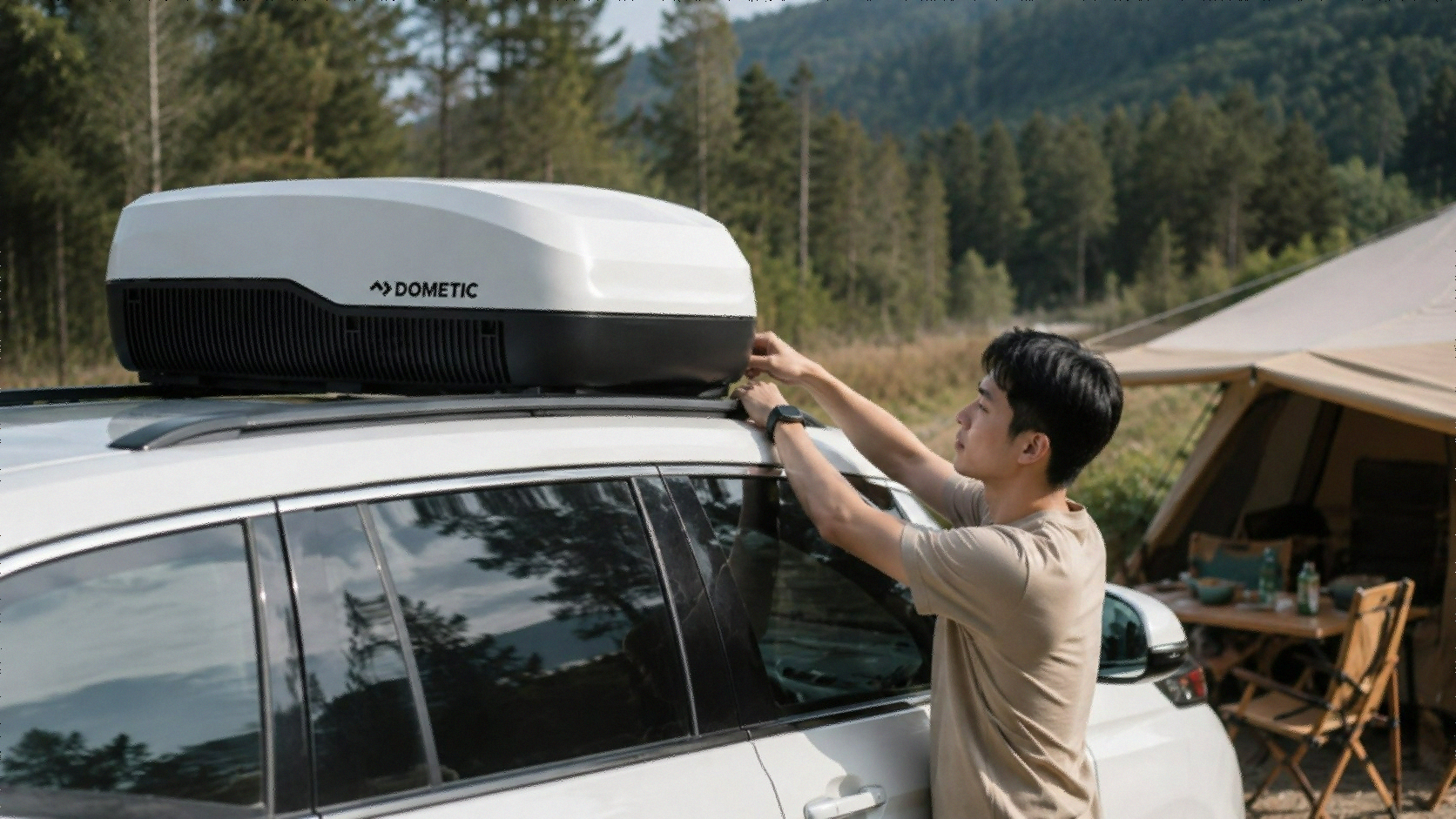
The weight difference is real — you feel it immediately trying to get this thing onto the roof solo. Still a two-person job if your back matters to you, but noticeably less of a fight than the old unit was. See Today’s Deal on Amazon
The Install: Actually Plug-and-Play
I’m not an HVAC tech. I’m someone who watches YouTube videos and swears a lot when things don’t fit. This install was straightforward anyway.
Step 1: Prep the roof. Backed my truck up alongside the rig for a staging area. A 70-lb unit going up solo is doable but sketchy — grab a friend if one’s available.
Step 2: Remove the old unit. Six screws on the interior trim ring, four long mounting bolts through the roof gasket, lift it off. Don’t forget to pull the temperature sensor out of the old unit — it needs to go back into the FreshJet 3.
Step 3: Set the new unit in place. The footprint matched exactly. Foam roof seal came pre-attached on mine. Dropped it right into position.
Step 4: Electrical connection. This is where “plug and play” actually means that. An 8-pin connector inside my ceiling assembly — unclip the old one, clip in the new one.
Step 5: Tighten the four bolts. Don’t overtighten. Use a torque wrench if you’ve got one.
Total time, working alone on a hot afternoon: about an hour and fifteen minutes. I’m a little annoyed I paid an RV tech $300 to do this years ago.
One thing worth flagging: the FreshJet 3 doesn’t include a new electrical control box or interior ceiling trim panel. You reuse your existing ones. Fine for most Brisk II swaps, but if your old trim panel is damaged, or you’re switching from a different brand entirely, budget extra for that.
Real-World Cooling Performance
The part you actually care about.
On a 102F day, this pulled my rig from 84F down to 65F in about 35 minutes — decent roof membrane, reasonable insulation, but not a new rig and not perfectly sealed. Just a normal lived-in older camper.
Startup draw hits around 2,000 watts, then settles to roughly 1,600-1,700 watts running continuously until the compressor cycles off. The fan alone pulls about 450 watts. Running this off solar and batteries is a serious draw — I wouldn’t try it with less than 400Ah of lithium and 600W+ of solar, and even then you’re draining down overnight if temps stay high.
Shore power or generator, no issues at all. Runs all day without complaint.
Compared to the old Brisk Air 2, the airflow feels noticeably stronger. Dometic’s custom blower system isn’t just marketing copy — the air actually moves better.
Noise Level: The Most Important Upgrade
The noise reduction deserves more attention than it gets.
My Brisk Air 2 was loud enough that I had to turn the TV up to hear it over the AC. The FreshJet 3 is dramatically quieter. A 4 dB reduction sounds small on paper, but every 3 dB is roughly a doubling of sound energy, so that 4 dB is a real difference you notice immediately. You can hold a normal conversation with it running. Sleep without earplugs.
If you work from the road on video calls, this alone justifies the upgrade. Nothing kills a client call faster than them asking what that noise is.
What Amazon Reviews Are Actually Saying
I read through all 247 reviews before buying, so here’s the consensus.
People keep repeating the same good points: plug-and-play Brisk II replacement confirmed by multiple buyers, much quieter than the outgoing unit, the lighter weight making solo installs manageable, and solid cooling reported even at 100F ambient.
The complaints worth knowing about cluster around packaging. Multiple people received units with cracked shrouds or damaged mounting tabs — take photos before you open the box, every time. No interior control box or trim panel is included, so you’re reusing your existing ones whether you like it or not. One person had a compressor wiring failure after two months, though that looks like an outlier rather than a pattern. And the old R-410A refrigerant stock may still be circulating alongside newer R-32 units.
I got mine undamaged, but I’d photograph the entire unboxing anyway just in case. Amazon’s support seems to have been responsive for most people who did get damaged units — one reviewer got a $137 partial refund for cosmetic damage without having to ship back a 70-lb box, which seems like a fair outcome.
How It Compares to the Competition
Since I looked at a handful of options before buying:
Against the Furrion Chill Cube 18K, the Chill Cube is genuinely in a different league on noise — variable speed inverter compressors run quieter than fixed-speed units by design. Worth it if noise is your top priority and budget isn’t a constraint. At $1,200 versus $854 though, that’s a real premium, and the FreshJet 3 cools just fine for most rigs under 30 feet.
Against 12V DC units like the Gidrox 12000 BTU 12V or the [Outequip 12V 10000 BTU], the lower voltage draw makes those genuinely compelling if you’re boondocking most of the time with a solid solar setup. But if you’re often on shore power or running a generator, the 120V FreshJet 3 gives you more raw cooling capacity to work with.
The Gidrox 10000 BTU heat-and-cool combo handles both seasons, which the FreshJet 3 doesn’t — it’s cooling-only. If you need heat too, factor that in.
And against the RecPro 15K, that’s the better budget pick if you’re not replacing a Brisk II and don’t get the compatibility advantage. The FreshJet 3 wins on brand reputation and documented performance; the RecPro wins on price if you’re starting from scratch.
The Refrigerant Situation: R-410A vs. R-32 See Today’s Deal on Amazon
Worth understanding before you buy. Older FreshJet 3 units in circulation use R-410A refrigerant. Newer production has moved to R-32, which has a lower global warming potential and is slightly more efficient.
One reviewer put it plainly: this is older stock with the 410, not R-32 — the difference between this listing and the one Camping World sells for $1,100.
If that distinction matters to you, check with the seller before buying. The R-32 version may run a bit more, but it’s worth it both environmentally and because R-410A is being phased out — future service on it could get more complicated down the line.
Who Should Buy the Dometic FreshJet 3 Series 13.5K
Buy it if:
- You’re replacing a Dometic Brisk Air 2 and want a truly plug-and-play swap
- You’re on a 25-35 foot rig and need serious cooling capacity
- Noise reduction matters to you — work calls, sleep quality
- You’re usually on shore power or running a generator
Skip it if:
- You’re primarily boondocking on solar — look at 12V options instead
- Your rig is small, under 20 feet — 13.5K BTU is overkill, and a 10K BTU unit will cost less and draw less power
- You need heating as well as cooling — look at a heat pump combo unit
- You’ve never swapped a rooftop AC and the idea makes you anxious — hire someone, though it really is straightforward
Where to Buy
The FreshJet 3 Series 13.5K BTU is on Amazon right now at $854.39, down from the $1,049.99 list price — a 19% discount — and it’s been selling fast, over 100 units in the past month.
Check current price and availability on Amazon
The 30-day return policy through Global Climate Alliance takes some of the risk out of it. If your unit shows up with packaging damage, document everything and contact support right away — most people seem to land on a reasonable resolution.
Final Verdict
The Dometic FreshJet 3 Series 13.5K BTU earns most of the praise it gets. The plug-and-play Brisk II compatibility is real, and it makes the install accessible to anyone who can follow basic instructions without calling a tech. The noise reduction is meaningful in a way you notice the first day. The cooling capacity holds up well for rigs up to roughly 30-35 feet.
The packaging issues are a real frustration for something at this price. Whether your unit arrives pristine or with cosmetic damage feels close to a coinflip, and while most people get a workable unit even when something’s scuffed, and Amazon has handled the claims reasonably — at $850 you shouldn’t be rolling dice on that.
Good unit, real improvements over the Brisk II generation, fair price for what it delivers. Just photograph your unboxing.
This article contains affiliate links. If you purchase through these links, I may earn a small commission at no extra cost to you. I only recommend products I’ve personally researched and that have strong community validation.