Disclosure: This post contains affiliate links. I may earn a small commission at no extra cost to you if you purchase through these links.
There’s a reason the Coleman Mach line has dominated RV rooftops for decades. Walk through any campground in America — Quartzsite in January, Yellowstone in July, a random KOA somewhere in Kansas — and you’ll see that white shroud everywhere. The Coleman Mach 3 Plus (model Airxcel 08-0079) is basically the Honda Civic of RV air conditioners. Everyone’s got one, everyone knows someone who has one, and it keeps running long after people expected it to die.
But we’re in 2026. Inverter compressors are a thing now. Heat pumps exist. The question isn’t whether the Coleman Mach 3 Plus works — it does — it’s whether it’s still the right choice when your old unit finally gives out or when you’re spec’ing a new build.
I’ve spent time with this unit and dug through hundreds of real owner reviews to give you the straight answer.
What the Coleman Mach 3 Plus Actually Is
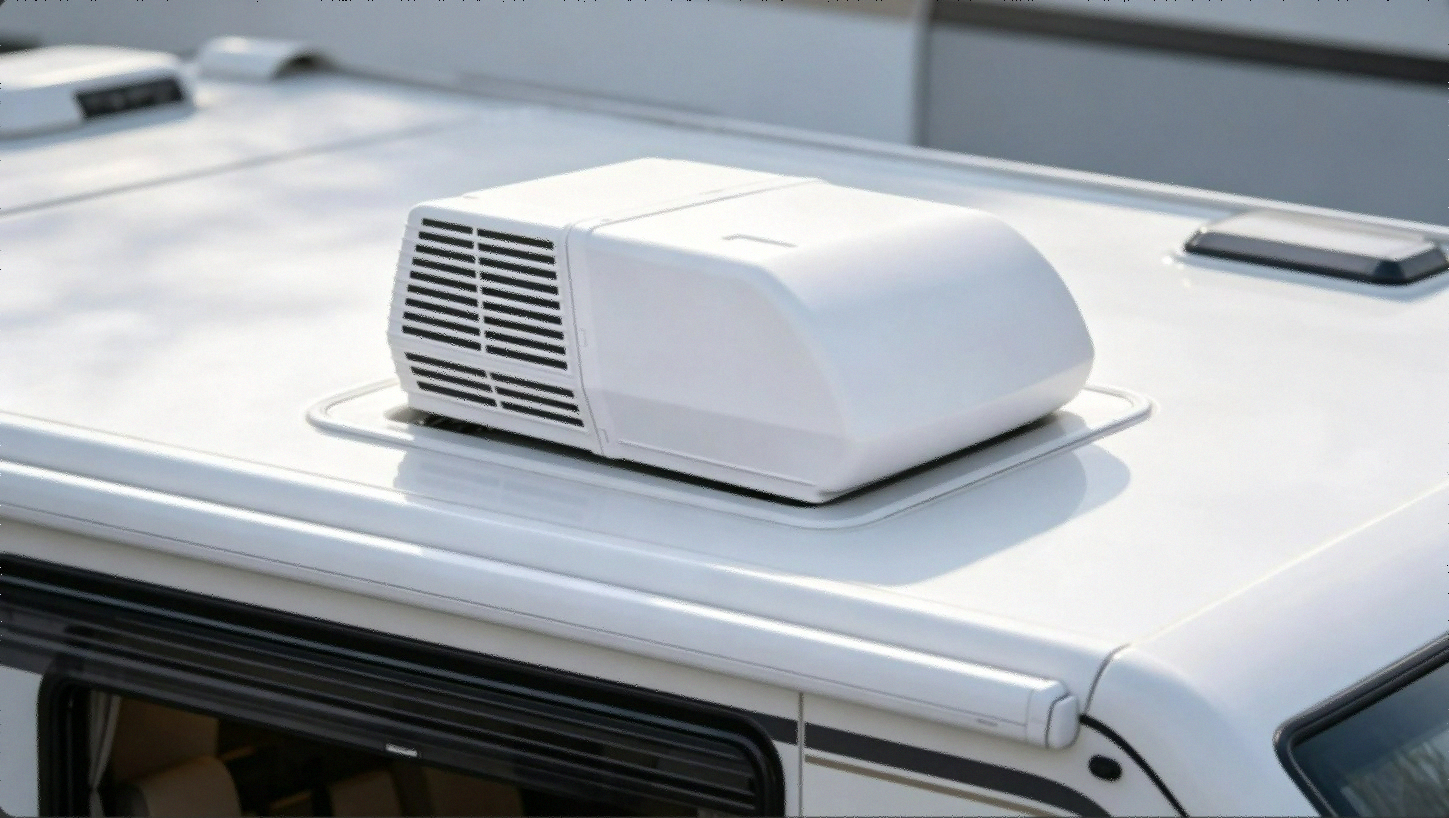
First, let’s clear up the naming confusion. The Airxcel 08-0079 is the Coleman Mach 3 Plus — “Airxcel” is the parent company that manufactures Coleman-branded RV HVAC equipment. When you see “Coleman Mach 3 Plus” or “Airxcel 08-0079,” they’re the same unit. The label on Amazon says Coleman, the part number says Airxcel. Don’t let that trip you up when you’re looking for compatible thermostats or replacement parts.
The Mach 3 Plus is positioned as “the second most powerful air conditioner in the Coleman-Mach line” — meaning it sits below the Mach 15 (15,000 BTU) but above the basic Mach 1 and Mach 8 units. It’s their mid-tier workhorse, and it’s been in essentially unchanged form for a long time. That’s both a feature and a limitation.
Key Specs at a Glance
| Spec | Value |
|---|---|
| Cooling Capacity | 13,500 BTU |
| Electric Heat Element | 5,600 BTU (optional add-on) |
| Airflow | 320 CFM |
| Power Supply | 115 VAC, 60 Hz |
| Cooling Amps (High) | 13.1 A |
| Total Wattage | 1,867.8 W |
| SEER Rating | 13.1 (5-Star Energy Star) |
| Refrigerant | R-410A |
| Product Dimensions | 41”L x 28”W x 16”H |
| Weight | ~88 lbs (39.9 kg) |
| Compressor Type | On/Off (non-inverter) |
| Amazon Price (2026) | ~$832 |
A few things worth flagging immediately: this unit uses a traditional on/off compressor, not an inverter. And the 5,600 BTU heating is electric resistance, not a heat pump. Those two facts define everything about who this unit is for and who it isn’t.
Installation: Genuinely Straightforward (With One Caveat)
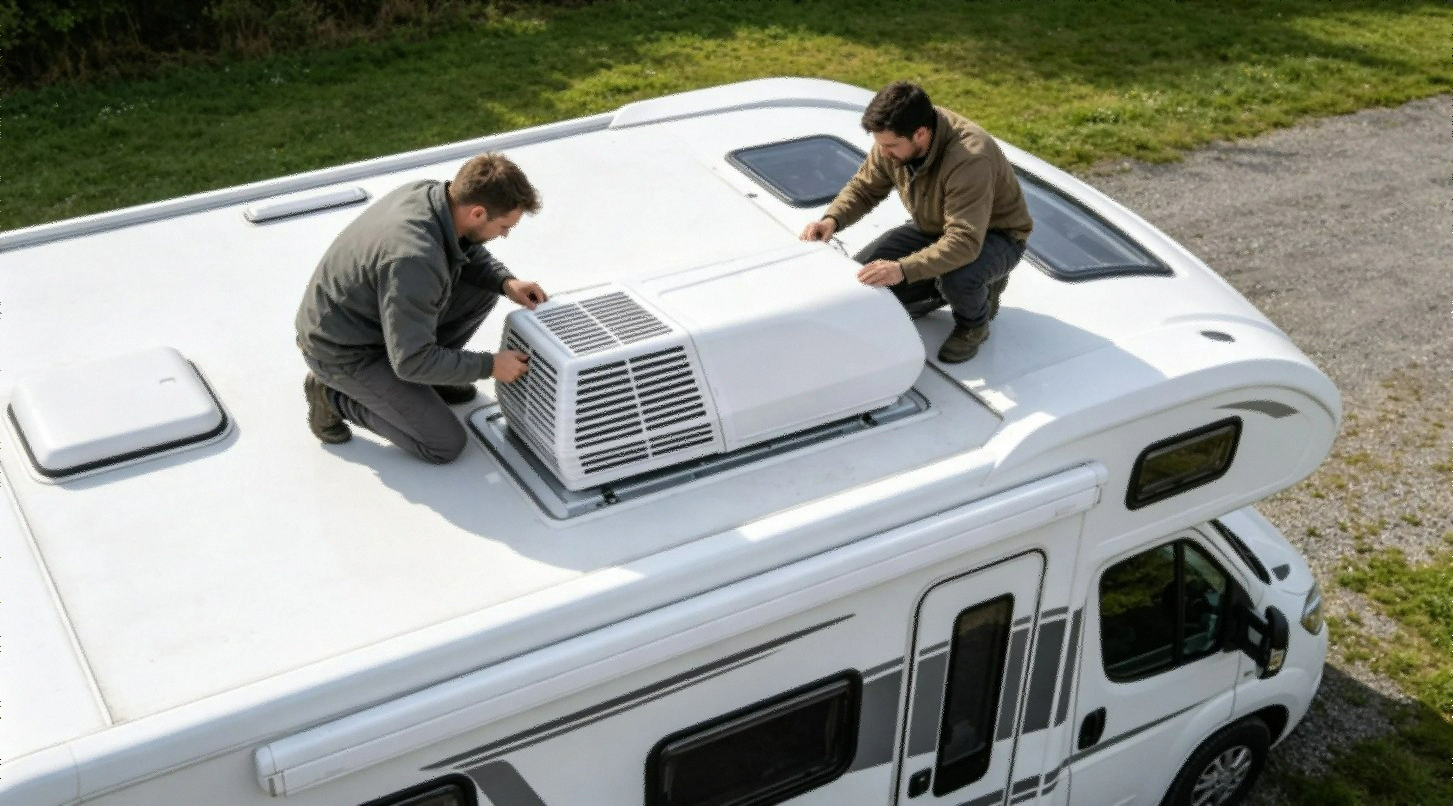
The Coleman Mach 3 Plus has earned a reputation for being a plug-and-play replacement for a huge range of existing RV installations. If your current unit uses the standard 14.25” x 14.25” roof opening, odds are good this drops right in.
Rich replaced a failed unit on his 2016 Jayco Greyhawk — had quotes of $4,000–$5,000 from repair facilities, bought this on Amazon for $810, and had cold air again in one hour. He saved himself over $3,000 in labor. That’s the Coleman Mach 3 Plus sweet spot.
Johnny Vee installed it on a Winnebago View using a drywall hoist to get it up to roof level — creative solution for a solo or small-crew install. His main gripe was the printed manual, which arrived with pages stapled in backwards and half missing. Watch YouTube before you start. The manual situation has apparently been a recurring complaint.
Jed Itasca had a stranger issue — the squirrel cage blower fan had injection molding debris on the ends that came loose on first startup, sounding like a plastic fork in a garbage disposal. Small plastic bits came out, he cleared them, unit ran fine afterward. His advice: inspect the blower fan before startup. Seems like an occasional QC lapse, not a systemic failure, but worth a 30-second check.
💡 Pro Tip: This unit weighs close to 88 lbs. Have two people minimum for roof work. Rich improvised a pulley system. Johnny Vee used a drywall hoist. Whatever method you use, don’t try to muscle it up a ladder alone — that’s how people get hurt.
⚠️ Watch Out: The unit does NOT include the thermostat control box. If you’re replacing a unit that already has the interconnect wiring run, you can reuse your existing thermostat. If you’re starting fresh, you’ll need to budget for that separately. Budalla noted this is why the Mach 3 Plus is $100–$150 cheaper than some comparably-spec’d alternatives.
Cooling Performance: Does It Actually Work? See Today’s Deal on Amazon
Short answer: yes, very well, for what it’s designed to do.
Gary O. Johnson: easy install, works great. Savannah bought one for a food truck in the deep South and noted that even in serious heat, the unit keeps things meaningfully cooler — “not very loud but not quiet either, good value for the cost.” George Wood: product worked, fit his application, cools his camper, noise level as advertised.
The 320 CFM airflow and 13,500 BTU nominal capacity are legitimate numbers. This unit has large evaporator and condenser coils with raised lance fins designed to dissipate heat efficiently. Coleman has been refining this design for decades. The all-copper tubing with gas-flux brazed joints is a known-good construction approach — Budalla replaced a 25-year-old unit with this one and noted the technology is essentially identical. That’s not a knock; it’s proof of concept.
For cooling a mid-size RV on shore power, this thing does the job.
Where It Falls Short
The on/off compressor is the fundamental limitation. Unlike modern inverter units, the Mach 3 Plus blasts at full capacity until the thermostat trips, then stops completely, then kicks back on again. In a well-insulated RV on a mild day, you might not notice. In a van or smaller Class C on a 105°F day in Phoenix, you’ll feel the temperature cycle — blast cold, shut off, warm up, blast cold again.
The startup amp draw is also notable. At 13.1 cooling amps running (and a higher surge on startup), this unit requires a solid 30-amp shore power connection or a generator. Running it off a lithium battery bank is technically possible but practically impractical for any extended period.
If you’re building or upgrading a rig for serious off-grid use, the Coleman Mach 3 Plus is probably not your unit. covers the inverter alternative in detail — the tradeoffs are real and worth understanding before you decide.
Noise Level: The Honest Answer
This is where reviews split, and I think both camps are right.
Rich says it’s not loud — normal for an RV AC. Savannah says not very loud but not quiet. Budalla says it’s nearly identical in noise to the 25-year-old unit it replaced. Matt H. found it louder than expected.
Here’s the reality: the Coleman Mach 3 Plus is a traditional on/off compressor unit in a non-ducted configuration. When it kicks on, you hear it. When the compressor cycles, you hear it. Compared to whatever cheap unit it’s replacing in a 20-year-old Class C, it might seem quiet. Compared to a modern inverter unit running at 50% capacity to maintain temperature, it’s noticeably louder.
What it is not is unusually loud. It’s normal RV AC noise. If you’ve lived with RV air conditioning before, this isn’t going to surprise you. If you’re coming from a house with a split-system HVAC and expecting similar noise levels, recalibrate your expectations.
The Durability Question
With 364 reviews and a 4.2/5 star rating, the Mach 3 Plus has a solid overall track record. But the durability feedback has some variance worth addressing.
67% of reviewers gave it 5 stars. 11% gave 1 star. The most concerning reviews involve units failing early — Matt H. had one stop cooling after 20 days, caught by a damaged internal component that arrived that way from shipping. Several Amazon reviews mention units failing within the first week.
This points to a shipping damage vulnerability rather than a design flaw. The unit is heavy (88 lbs) and takes up a lot of box space. Rough handling in transit can damage internal components that don’t show obvious external signs. The lesson: when your unit arrives, inspect the box before the installer shows up. If the box is significantly damaged, document it before opening.
The long-term story is better. Budalla’s unit is replacing a 25-year-old Coleman. The all-copper tubing and brazed joints are legitimately durable construction. If the unit arrives undamaged and gets properly installed, most owners get many years of reliable service.
Heating: What You Need to Know
The 5,600 BTU electric heat element is an optional add-on, not included in the base Airxcel 08-0079 unit. You need to purchase the heater assembly separately if you want heating capability.
And here’s the thing about electric resistance heating in an RV: it works, but it’s an energy hog. 5,600 BTU of electric heat draws significant amperage and requires shore power to run practically. It’ll take the chill off on a cool morning when you’re plugged in at a campground, but it’s not a substitute for proper winter heating in cold climates.
If you’re doing three-season travel and need heat capability, it’s worth asking whether an electric resistance add-on serves your needs or whether a unit with a built-in heat pump makes more sense. Related Post: Best RV Air Conditioner with Heat Pump 2026 breaks down the heat pump options across different price points — the efficiency difference in cold weather is significant.
Coleman Mach 3 Plus vs. The Modern Alternatives
Let’s put this in context with what else is available in the $800–$1,100 range.
| Model | BTU | Type | Heat | Price | Best For |
|---|---|---|---|---|---|
| Coleman Mach 3 Plus (08-0079) | 13,500 | On/Off | Electric add-on | ~$832 | Shore power, proven reliability, direct replacement |
| TURBRO Inverter 13.5K | 13,500 | Inverter | Heat Pump | ~$1,099 | Battery/solar, off-grid, temp consistency |
| Furrion Chill Cube 18K | 18,000 | Variable Speed | Heat Pump | ~$929 | Large rigs, serious heat, premium cooling |
| RecPro 13.5K | 13,500 | On/Off | Optional | ~$959 | Mid-range alternative to Coleman |
| GIDROX 12000 BTU 12V | 12,000 | Inverter | No | Varies | Pure off-grid, 12V DC builds |
The Coleman Mach 3 Plus wins on price, brand trust, parts availability, and compatibility with existing wiring. It loses on efficiency, startup draw, temperature consistency, and the absence of a heat pump.
For a campground-primary RVer replacing a failed unit and wanting a known-good, parts-available, easy-to-service option — the Coleman Mach 3 Plus is probably the right call.
For someone building a solar-powered rig or doing extended boondocking in temperature extremes — look at the inverter options. The upfront cost difference pays back in battery life and comfort.
Related Post: Furrion Chill Cube 18K Review is worth a read if you’re in a larger Class A or fifth wheel and the 13,500 BTU ceiling feels tight.
Energy Efficiency: The 13.1 SEER Number Explained See Today’s Deal on Amazon
The Coleman Mach 3 Plus carries a 13.1 SEER rating and 5-Star Energy Star certification. For context, SEER (Seasonal Energy Efficiency Ratio) measures cooling output per unit of energy input. Higher is better.
13.1 SEER is… fine. It’s the minimum threshold for Energy Star certification in this product category. Modern inverter RV ACs are pushing SEER ratings of 15–20+ because the variable-speed compressor runs more efficiently at partial load.
What this means practically: on a hot day when you’re running this thing at near-full capacity, the efficiency difference between the Coleman and an inverter unit isn’t huge. The gap opens up during partial-load operation — when it’s moderately warm and you just need to maintain a comfortable temperature. A traditional on/off unit like the Coleman runs at 100% and cycles; an inverter unit throttles down to 30–40% and hums along steadily. The inverter uses dramatically less power in that scenario.
If you’re running a generator or paying for shore power, the Coleman’s efficiency is acceptable. If every amp-hour matters, it’s a weak point.
R-410A Refrigerant: What Changes in 2026
The Airxcel 08-0079 uses R-410A refrigerant, which Coleman notes is “eco-friendly” compared to the older R-22 that it replaced. That’s technically true compared to R-22, but R-410A itself is being phased down globally due to its high global warming potential.
In the US, the EPA’s AIM Act is progressively reducing R-410A production and import. For the foreseeable future, R-410A is still widely available for service. But in 10+ years when this unit might need a refrigerant recharge, the landscape may look different. Some newer units (including the TURBRO we covered previously) are already using R-32, which has a lower GWP and is positioned as a longer-term option.
This isn’t an immediate concern — buy the Coleman, use it, service it. Just filing it away for whenever the recharge conversation comes up down the road.
Who Should Buy the Coleman Mach 3 Plus Airxcel 08-0079?
This is the right unit if:
- You’re replacing a failed or aging Coleman Mach unit and want plug-and-play compatibility
- You camp primarily on shore power (30-amp service works fine)
- You want proven reliability with easily sourced replacement parts
- You’re doing a quick repair and need something that goes in without surprises
- Budget matters and you don’t need a heat pump or inverter efficiency
Look elsewhere if:
- You’re building or upgrading for off-grid, solar, or battery-primary use
- You want year-round heat capability without burning propane or running a generator
- Temperature consistency and quiet operation are priorities
- You’re in a large Class A or fifth wheel where 13,500 BTU might not keep up
Real Owner Verdict Breakdown
With 364 reviews and a 4.2/5 average, here’s what the data actually shows:
- 67% five stars — overwhelmingly “easy install, works exactly as expected, replaced my old Coleman”
- 12% four stars — works well, minor gripes (noise, weight, manual quality)
- 7% three stars — works but expected better
- 3% two stars — mixed results
- 11% one star — mostly shipping damage or early failure
The 1-star cluster is worth watching. It doesn’t reflect a fundamental design problem — it reflects units that arrived damaged or had manufacturing defects that weren’t caught before shipping. The fix is inspection on arrival and prompt reporting of any damage within Amazon’s return window.
The overall picture is a reliable, proven product with a small but real quality control variance in shipping and initial units. Buy it from a seller with good return logistics, inspect it when it arrives, and you’re in good shape.
Installation Tips From Real Owners
A few things that came up repeatedly in reviews that aren’t in any manual:
On getting it up there: This unit is close to 90 lbs. A drywall hoist works. A proper pulley system works. Two people on ladders works. One person does not work. Budget for help.
On the manual: Watch YouTube install videos before you touch anything. The printed manual has a spotty reputation. The install isn’t complicated — the documentation just isn’t always reliable.
On the thermostat: The base unit does not include the control/thermostat kit. If you’re reusing existing wiring and a thermostat, that’s fine. If you’re starting fresh, add the Coleman thermostat to your order.
On the blower fan: Before first startup, pull the inside cover and visually inspect the squirrel cage fan. Jed Itasca found injection molding debris that came loose on startup. Takes 2 minutes to check, saves a minor panic.
On shipping damage: Don’t just check the outside of the box. Open it and look at the unit before your installation day. Matt H.’s unit had internal damage that wasn’t obvious externally and failed after 20 days — just outside the return window.
Coleman Mach 3 Plus FAQ
Q: Does the Airxcel 08-0079 include a thermostat? No. The base unit is the rooftop AC only. The thermostat/control kit is sold separately. If you’re replacing an existing Coleman Mach unit, you can typically reuse your existing thermostat and wiring.
Q: What roof opening does it require? Standard 14.25” x 14.25” RV roof cutout. It’s compatible with most RV manufacturers’ standard openings. Measure before ordering if you’re unsure.
Q: Can I run this on battery power? Technically yes, but practically no for any extended use. The 13.1 amp running draw (higher surge on startup) will drain even a large lithium bank in a few hours. This unit is designed for shore power or generator use.
Q: Is the electric heat included? No. The 5,600 BTU electric heat element is an optional add-on assembly sold separately.
Q: How does it compare to the Coleman Mach 15? The Mach 15 bumps up to 15,000 BTU cooling capacity and comes in around $1,054. If you’re in a larger RV (32’+ Class A, large fifth wheel), the extra BTU headroom is worth the price difference. For Class C, van conversions, or mid-size Class A, the Mach 3 Plus is sufficient.
Q: Does it require professional installation? No. Multiple reviewers installed it themselves in one to two hours. It helps to have done basic RV maintenance before, but it’s not a job that requires an HVAC tech. Watch YouTube, have a helper for the roof work, follow the torque specs on the mounting bolts.
Final Verdict
The Coleman Mach 3 Plus (Airxcel 08-0079) is exactly what it claims to be: America’s over-the-road bestseller, decades of proven reliability, straightforward installation, and competitive pricing for 13,500 BTU cooling.
It’s not a cutting-edge piece of technology. The on/off compressor is old-school. The SEER rating is adequate rather than impressive. There’s no inverter, no built-in heat pump, no WiFi app. It’s the thing that works, can be replaced with a $15 part from any RV supply store, and will probably outlast your trailer.
For the majority of RV owners — people who spend most of their camping time plugged into shore power, who want something that goes in easy and runs reliably for years — this is still a completely sensible choice at $832.
If you’re doing off-grid boondocking, running solar and lithium, or camping year-round in temperature extremes, the inverter and heat pump options have moved past what the Coleman Mach platform offers. The technology gap is real and growing.
Prices and availability are accurate as of June 2026. Amazon prices fluctuate — check current price before purchasing.