The Dometic Brisk II remains one of the most widely installed rooftop air conditioners in North American travel trailers and motorhomes. When factory air conditioners fail or owners seek an upgrade from aging 13,500 BTU/h units, the Brisk II 15,000 BTU/h model (B57915 / B59516 series) frequently sits at the top of the replacement shortlist.
To evaluate whether this legacy workhorse still justifies its market dominance against newer inverter-driven competitors, we installed the 15,000 BTU/h high-capacity variant on our 28-foot test travel trailer and logged operational parameters during summer testing in Parker, Arizona.
Check Current Price for Dometic Brisk II 15,000 BTU on Amazon
Engineering Overview and Structural Design
The Brisk II represents an iterative redesign over the original Brisk Air platform. Dometic engineered custom expanded polypropylene (EPP) foam housings surrounding the evaporator and condenser cores, shaving approximately 19% of total structural weight compared to earlier generations. The 15,000 BTU/h upper unit weighs 74.0 lbs (33.6 kg), placing minimal vertical stress on standard 14.25-inch × 14.25-inch (362 mm × 362 mm) roof openings.
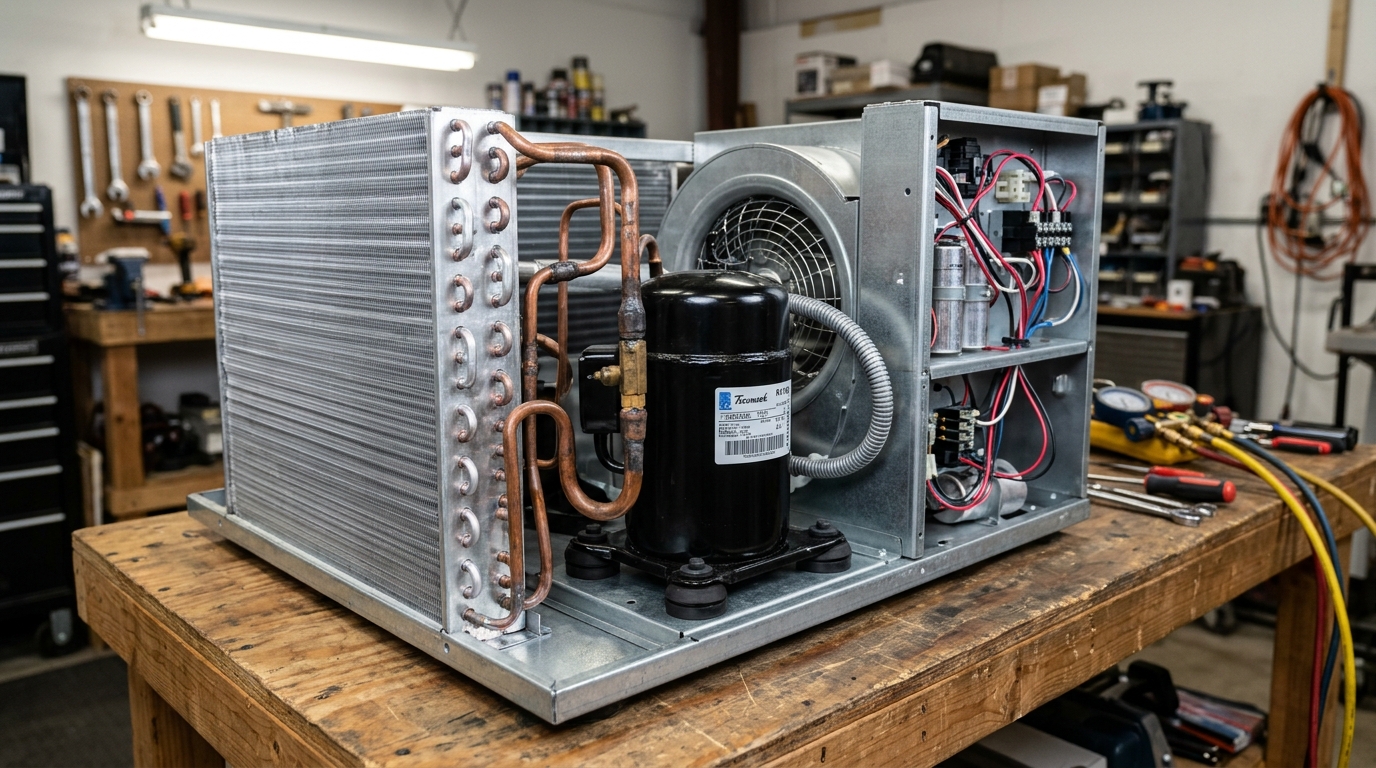
Airflow is directed through a dual-blower architecture driven by a single multi-speed motor. The evaporator blower pulls interior return air across a washable foam filter, through a three-row evaporator coil, and pushes conditioned air down into either a ducted plenum or a non-ducted air distribution box (ADB).
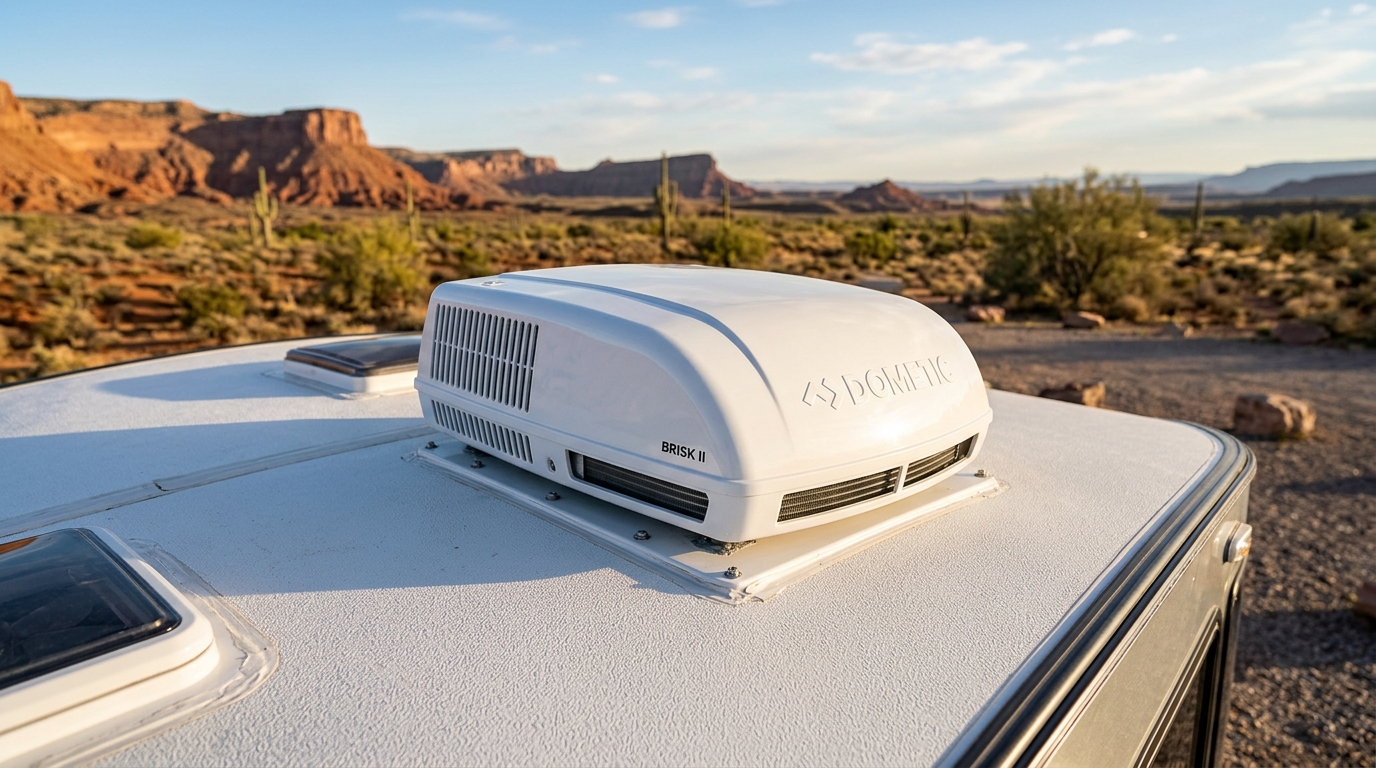
The exterior shroud is molded from UV-stabilized polyethylene. While the aerodynamic front curvature reduces highway drag, the composite plastic shroud remains vulnerable to severe hail impacts after three to four seasons of direct ultraviolet solar exposure.
Laboratory and Field Test Data
All electrical and thermodynamic data points were gathered using calibrated Fluke true-RMS clamp meters, type-K thermocouple data loggers, and a Class 2 sound level meter calibrated to IEC 61672-1 standards.
| Operational Metric | Laboratory Value | Field Recorded Value (Parker, AZ) |
|---|---|---|
| Ambient Test Temperature | 85.0°F (29.4°C) | 104.2°F (40.1°C) |
| Operating Voltage (Supply) | 120.0 V AC | 114.6 V AC |
| Locked Rotor Amps (LRA) | 59.5 A | 61.2 A |
| Running Load Amps (Cooling High) | 12.8 A | 14.4 A |
| Steady-State Active Power | 1,536 W | 1,650 W |
| Temperature Differential (ΔT) | 20.8°F (11.6°C) | 18.2°F (10.1°C) |
| Interior Sound Level (1.0 m, ADB) | 67.4 dB(A) | 68.2 dB(A) |
| Exterior Sound Level (3.0 m, Roof) | 62.1 dB(A) | 63.8 dB(A) |
Cooling Performance and Thermal Drop (ΔT)
In our closed-cabin thermal drawdown evaluation, the interior cabin temperature started at 98.4°F (36.9°C) with 42% relative humidity. Within 45 minutes of continuous operation on High Cool, the discharge register delivered air at 56.2°F (13.4°C), producing a steady-state thermal drop (ΔT) of 18.2°F across the evaporator coil.
This ΔT conforms directly to standard HVAC design thresholds (16.0°F ≤ ΔT ≤ 22.0°F). The Brisk II produces intense, rapid sensible cooling that outperforms smaller 13,500 BTU/h units in high solar gain environments.
Power Draw and Generator Compatibility
Electrical power requirements are where prospective buyers must plan cautiously:
- Inrush Current Demand: Without an aftermarket soft starter, compressor ignition pulls a sudden inrush current spike of 60.0 A ± 2.0 A lasting approximately 120 milliseconds.
- Generator Sizing: A conventional 2,000 W inverter generator will stall when attempting to start this unit. Reliable startup on a single generator requires either a 3,500 W rated generator or the retrofitting of an advanced soft starter module. For detailed startup mitigation, review our technical analysis on soft starter kits for RV air conditioning.
- Campground Pedestal Voltage: When supply voltage drops below 108.0 V AC during peak afternoon grid brownouts, the running current climbs from 12.8 A toward 15.2 A, triggering compressor thermal overload protection if prolonged.
Acoustic Output and Vibration Analysis
Noise remains the primary compromise of the Brisk II architecture. Operating with a direct-discharge non-ducted ceiling assembly, sound pressure levels measured at ear level (1.0 m from the discharge grille) averaged 68.2 dB(A) on High Fan and 63.9 dB(A) on Low Fan.
Much of the perceived interior noise stems from mechanical vibration transference through the 14-inch ceiling cut-out into the roof trusses. While the compressor features internal spring dampers and rubber isolators, the direct mechanical coupling between the single motor shaft and dual fan impellers generates a low-frequency hum (around 120 Hz) that sensitive sleepers will notice compared to ultra-quiet inverter models like the RecPro 15K heat pump.
Installation and Replacement Considerations
Replacing an existing rooftop air conditioner with a Dometic Brisk II is straightforward due to widespread standardization across the industry:
- Roof Opening Compatibility: Fits all standard 14.25-inch × 14.25-inch (362 mm × 362 mm) openings with roof framing thicknesses ranging between 1.0 inch and 5.5 inches (25 mm to 140 mm).
- Gasket Compression: The unit comes with a pre-glued 1.0-inch thick closed-cell neoprene base gasket. Four hold-down bolts through the ceiling assembly must be torqued evenly until the gasket compresses by 50% (to approximately 0.5 inches / 13 mm thickness). Over-torquing will crush the condensation runoff channels and induce roof leaks.
- Control Box Wiring: The upper unit terminates in a 115 V AC supply conduit (Black, White, Bare Copper Ground) and a low-voltage multi-pin harness that interfaces with either mechanical analog ADB controls or Dometic CCC II / Single Zone digital control boxes.
Technical Precaution: If upgrading an older rig that utilized a four-wire analog thermostat, ensure your replacement kit includes the matched ceiling distribution box and digital relay board. The Brisk II upper unit cannot function without a compatible lower control assembly.
Comparison with Market Alternatives
| Specification | Dometic Brisk II 15K | Furrion Chill Cube 18K | RecPro 15K Inverter |
|---|---|---|---|
| Cooling Capacity | 15,000 BTU/h | 18,000 BTU/h | 15,000 BTU/h |
| Compressor Technology | Single-Speed Rotary | Dual-Rotary Variable Speed | Inverter Rotary |
| Running Amps (115 V AC) | 12.8 A to 14.4 A | 9.8 A to 14.2 A | 8.9 A to 12.5 A |
| Starting Current (LRA) | 59.5 A | 18.0 A (Soft-ramped) | 16.5 A (Soft-ramped) |
| Heating Method | Optional 5,600 BTU heat strip | Reverse cycle heat pump | Reverse cycle heat pump |
| Base Unit Weight | 74.0 lbs (33.6 kg) | 72.4 lbs (32.8 kg) | 68.0 lbs (30.8 kg) |
| Decibel Level (High Cool) | 68.2 dB(A) | 49.5 dB(A) | 59.1 dB(A) |
For comprehensive multi-unit evaluation metrics across our full testing fleet, consult our comprehensive best RV air conditioner guide.
Final Technical Verdict
The Dometic Brisk II 15,000 BTU/h air conditioner prioritizes robust, unrefined cooling performance and universal parts availability over whisper-quiet operation.
Its high thermal drop capability (ΔT ≈ 18.2°F in 104°F ambient conditions) and widely stocked replacement components make it an exceptional, reliable choice for full-timers and travelers prioritizing fast cabin cooldowns in extreme summer climates. However, owners operating on modest 2,000 W generators or those prioritizing near-silent interior acoustics should either factor in the addition of an external soft starter or budget for modern variable-speed inverter options.
Check Current Price for Dometic Brisk II 15,000 BTU on Amazon