When a rooftop air conditioner dies on an RV during the middle of July, the immediate panic is followed by sticker shock. If you haul your travel trailer or motorhome into a franchised RV dealership service center, quotes for a single rooftop replacement routinely land between $1,450 and $2,850. If your coach runs dual ducted 15,000 BTU heat pumps managed by a multiplex digital thermostat, that repair estimate can easily climb past $4,500.
Yet, if you examine the actual hardware costs, a brand-new 13,500 BTU or 15,000 BTU direct-replacement rooftop unit typically sells online for between $650 and $1,150. The remaining $800 to $1,700 of that dealer invoice represents billable shop labor, disposal surcharges, freight surcharges, and dealership markup on ancillary items like ceiling distribution boxes and new neoprene gaskets.
Understanding how these costs break down — and knowing when a complete unit replacement makes financial sense compared to swapping a capacitor or a thermostat — will save you hundreds, if not thousands, of dollars.
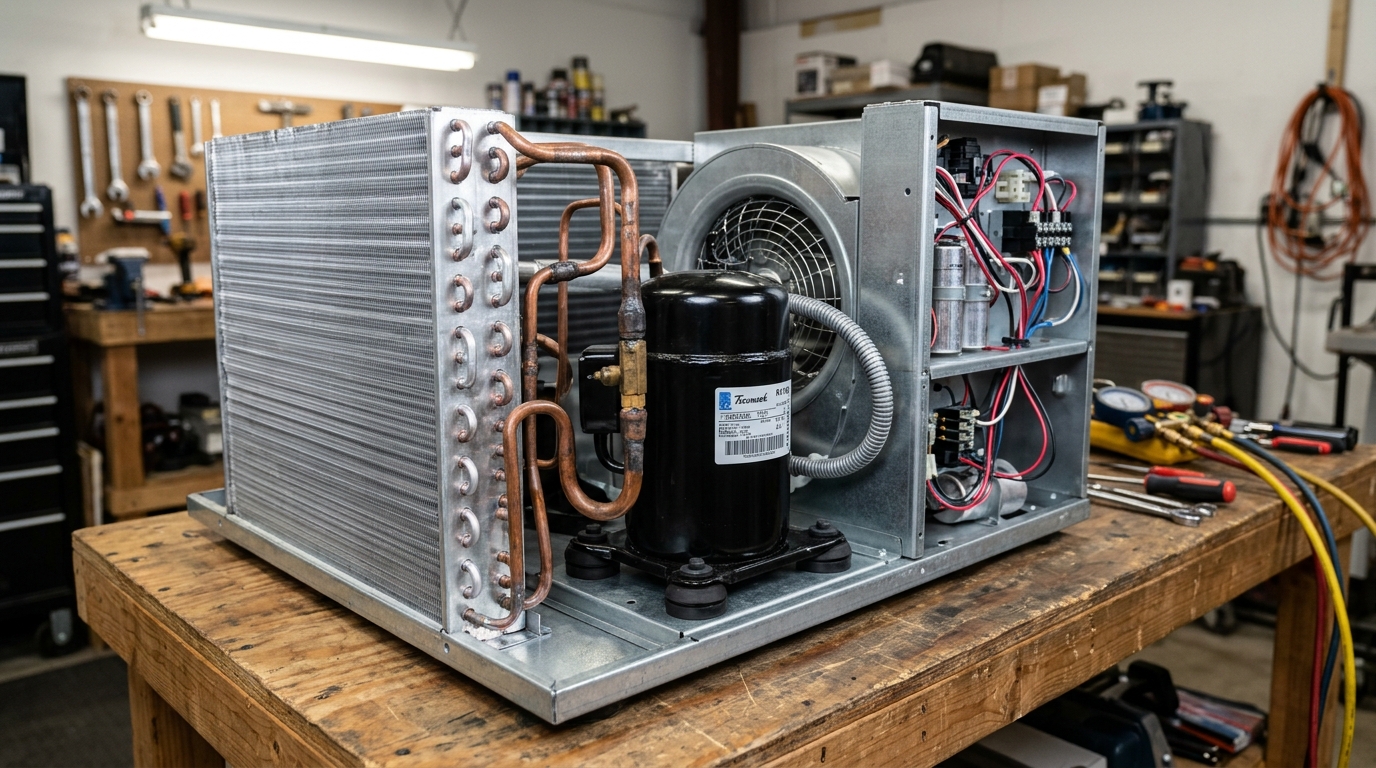
Average RV Air Conditioner Replacement Cost Summary
Depending on whether you hire a mobile RV tech, leave your rig at a dealership for three weeks, or complete the swap yourself in your driveway over a Saturday afternoon, total costs vary significantly.
| Replacement Pathway | Equipment Cost (Hardware) | Labor & Shop Supplies | Typical Total Cost Range | Turnaround Time |
|---|---|---|---|---|
| DIY Replacement (Driveway) | $650 – $1,250 | $35 – $75 (Gasket, Sealant) | $685 – $1,325 | 3 to 5 Hours |
| Mobile RV Technician (On-Site) | $750 – $1,350 | $300 – $550 (2–3 hrs + Service Call) | $1,050 – $1,900 | Same Day (Scheduled) |
| Independent RV Repair Facility | $850 – $1,450 | $350 – $650 (Standard Book Time) | $1,200 – $2,100 | 3 to 7 Days |
| Franchised RV Dealership | $950 – $1,650 | $500 – $1,200 ($180–$220/hr + Diagnostic) | $1,450 – $2,850 | 2 to 4 Weeks |
Diagnostic Fee Notice: Nearly all commercial RV dealerships charge a mandatory 1.0-hour to 1.5-hour diagnostic checkout fee (typically $150 to $225) simply to connect test gauges and verify what you already knew: the unit is not blowing cold air. Some dealerships credit this diagnostic fee toward the repair if you purchase the replacement unit directly through their parts department; others charge it as an add-on line item.
Hardware Cost Breakdown by Air Conditioner Type
Not all RV air conditioners cost the same to purchase. Capacity, ducting configuration, heat pump functionality, and compressor motor design create substantial price tiers.
1. Standard 13,500 BTU Rooftop Units ($650 – $850)
The 13,500 BTU/h non-ducted or standard-ducted unit is the entry-level baseline found on the vast majority of travel trailers under 28 feet. Renowned workhorses like the Coleman-Mach® 3 Plus or Dometic® Brisk II 13.5K run on standard 120V AC shore power and draw approximately 11.5 A to 13.5 A running load amps (RLA). They are the least expensive units to replace because mounting geometries and bolt patterns have remained standardized across thirty years of production.
2. High-Capacity 15,000 BTU Rooftop Units ($800 – $1,150)
If your RV struggles to maintain 72°F (≈ 22.2°C) in high desert ambient conditions above 95°F (≈ 35°C), upgrading from a 13.5K unit to a 15,000 BTU model like the Coleman-Mach® 15 Plus delivers an immediate 11% boost in cooling BTU headroom. Because both units share the identical 14” × 14” roof opening and 120V AC 20A breaker requirement, upgrading equipment capacity adds roughly $150 to the hardware purchase price without increasing labor installation costs. For full performance logs on this unit, read our Coleman-Mach 15 Plus review.
3. Rooftop Heat Pump Units ($1,050 – $1,550)
A reverse-cycle heat pump extracts ambient thermal energy from outside air down to approximately 40°F (≈ 4.4°C), heating the coach interior without burning LP propane. Heat pump models require four-wire or multi-conductor thermostat communication boards to operate the reversing valve. If you camp extensively in spring and autumn shoulder seasons, our in-depth evaluation of the best RV air conditioner with heat pump 2026 models demonstrates how an electric heat pump can pay for its price premium in propane fuel savings within two years.
4. Advanced Inverter and 12V DC Native Units ($1,200 – $2,600)
Variable-speed inverter compressor units and native 12V DC models (such as the Dometic® CoolAir RTX 2000 series) represent the pinnacle of off-grid boondocking comfort. While upfront hardware costs are considerably higher, their variable-frequency drives eliminate heavy 55A starting current spikes, enabling smooth operation from lithium battery banks without needing shore power or generator run time.
| Unit Specification / Category | Cooling Capacity | Operating Voltage | Average Unit Price | Best Application |
|---|---|---|---|---|
| Standard Baseline | 13,500 BTU/h | 120V AC | $650 – $850 | Small campers & secondary bedroom zones |
| High-Output Upgrade | 15,000 BTU/h | 120V AC | $800 – $1,150 | Main living zones on rigs over 26 feet |
| Heat Pump Combo | 15,000 BTU/h | 120V AC | $1,050 – $1,550 | 4-season campers & propane conservation |
| Low-Profile Aerodynamic | 13.5K / 15K BTU/h | 120V AC | $950 – $1,400 | Toy haulers & fifth wheels needing roof clearance |
| 12V DC Off-Grid Native | 6,800 – 12,000 BTU/h | 12V DC | $1,400 – $2,600 | Camper vans & boondocking solar setups |
Dealership Labor Rates and Flat-Rate Book Times
When an RV dealership service department writes an estimate for an air conditioner swap, they do not bill by actual elapsed stopwatch minutes. They bill using flat-rate labor guides (such as Spader or RVDA Labor Time Guides).
- Standard Industry Labor Rates: Current RV dealership mechanical labor rates across North America range from $150 to $225 per billable hour, with major metropolitan metroplexes frequently quoting $240/hr. Independent mobile technicians usually charge $120 to $160/hr, plus a flat $75 to $150 service call trip charge.
- Flat-Rate Book Hours for Non-Ducted Units: Typically allocated at 2.0 to 2.5 billable hours ($300 to $550 labor). This covers removing the old interior plenum, releasing the mounting bolts, breaking the roof seal, lifting the old unit down, staging the new unit, seating the new gasket, torquing bolts, and wiring the junction box.
- Flat-Rate Book Hours for Ducted Units: Allocated at 2.5 to 3.5 billable hours ($375 to $770 labor). Ducted installations require precision alignment with the ceiling duct runs, sealing the return air divider with aluminum foil tape, and verifying static duct pressure.
- Additional Shop Supplies and Disposal Fees: Dealerships routinely append $35 to $75 for “shop supplies” (rag usage, zip ties, electrical tape) and a $45 to $85 environmental hazardous waste disposal fee to recover the refrigerant and scrap the old compressor housing.
Why Repairing a Broken Compressor Is Rarely Worth It
A frequent question from RV owners is: “My air conditioner fan spins fine, but the compressor won’t pump cold air. Can’t a technician just solder in a new compressor or recharge the freon for a couple hundred bucks?”
The short answer is no, and the economics explain why:
The Sealed System Reality: Unlike residential central air conditioners or automotive AC systems that have threaded Schrader service ports, rooftop RV air conditioners are hermetically sealed, factory-crimped appliances. They contain no service valves. To replace a compressor or recharge R-410A refrigerant, an EPA Section 608-certified technician must:
- Pierce the copper refrigeration lines using bolt-on piercing valves.
- Evacuate and recover the remaining refrigerant into a recovery cylinder using an EPA-certified recovery machine.
- Un-sweat the copper joints using an oxy-acetylene torch on your RV roof.
- Braze in a new compressor, install permanent brass Schrader access valves, and replace the inline liquid filter-drier.
- Pull a deep vacuum down below 500 microns (≈ 0.5 Torr) with a dual-stage rotary vane vacuum pump to boil off all internal moisture.
- Weigh in the exact factory R-410A refrigerant charge (typically 14 to 22 ounces) with a digital charging scale.
The labor alone for a certified technician to rebuild a hermetic sealed system runs 4 to 6 billable hours ($600 to $1,200), plus $350 for the replacement compressor motor, $80 for refrigerant and filter-drier, and $150 for shop recovery equipment fees.
The total repair bill for replacing just the compressor routinely hits $1,180 to $1,780 — on an old unit with aged fan bearings and weathered aluminum coil fins! Spending $1,200 to patch an 8-year-old unit when a brand-new complete factory-warranted unit costs $799 is throwing good money after bad. In the mobile RV repair industry, when a sealed system loses its refrigerant charge or burns out its compressor windings, a 100% complete rooftop unit replacement is universally the only rational financial choice.
Minor Repairs Worth Doing Before Scrapping the Unit
Before assuming your entire air conditioner is dead, run through these two low-cost component checks that solve over 40% of non-cooling service calls:
- Replace the Dual Run Capacitor ($18 – $35): If the fan runs but the compressor emits a low humming drone every 60 seconds before clicking off on thermal overload, your run capacitor (typically 45/5 µF or 55/15 µF at 370V/440V AC) is likely blown. A swollen top dome or leaked electrolyte confirms failure. Swapping a capacitor takes 15 minutes and costs less than $30 in parts.
- Replace the Wall Thermostat or Control Relay Box ($45 – $95): Corroded slide contacts on legacy analog thermostats or a stuck 12V DC compressor relay will prevent the compressor from ever receiving the start signal. A simple jumper test across the yellow and red thermostat leads instantly confirms whether the rooftop unit operates.
How to Save $800 to $1,500 by Replacing It Yourself
If your sealed compressor has indeed failed, tackling the replacement yourself requires zero specialized HVAC licensing. The entire assembly drops onto the roof as a pre-charged, sealed package.
- Step-by-step DIY Execution: Follow our comprehensive field-tested RV air conditioner installation guide to walk through de-energizing breakers, unbolting the ceiling frame, prepping the 14” × 14” roof curb, torquing the bolts to 40–50 in-lb, and making wire nut splices.
- Cost Difference: You pay only the wholesale retail price for the new unit ($700 to $950) plus $25 for a fresh tube of Dicor® self-leveling lap sealant and new wire nuts. Total outlay: under $975, keeping over a thousand dollars of dealership labor profit in your own bank account.
Compare prices on top-rated replacement RV air conditioners on Amazon