Cooling a travel trailer presents structural and thermodynamic challenges that residential HVAC systems never encounter. Unlike a conventional home built with thick fiberglass batt insulation and dense drywall, a travel trailer relies on thin laminated fiberglass sidewalls (often with an insulation rating as modest as R-7), expansive single-pane glass windows, and a rubber membrane roof constantly exposed to direct solar radiation.
When outside ambient temperatures climb past 95°F (≈ 35.0°C), a camper parked without shade absorbs tremendous radiant heat. If your cooling unit is undersized, poorly sealed, or choking on low campground voltage, the interior quickly turns into an unbearable sauna.
Whether you are outfitting a compact 18-foot bumper-pull camper or a 34-foot dual-slide travel trailer, understanding the physics of cooling capacity, generator running loads, and airflow distribution is the only way to avoid miserable summer trips.
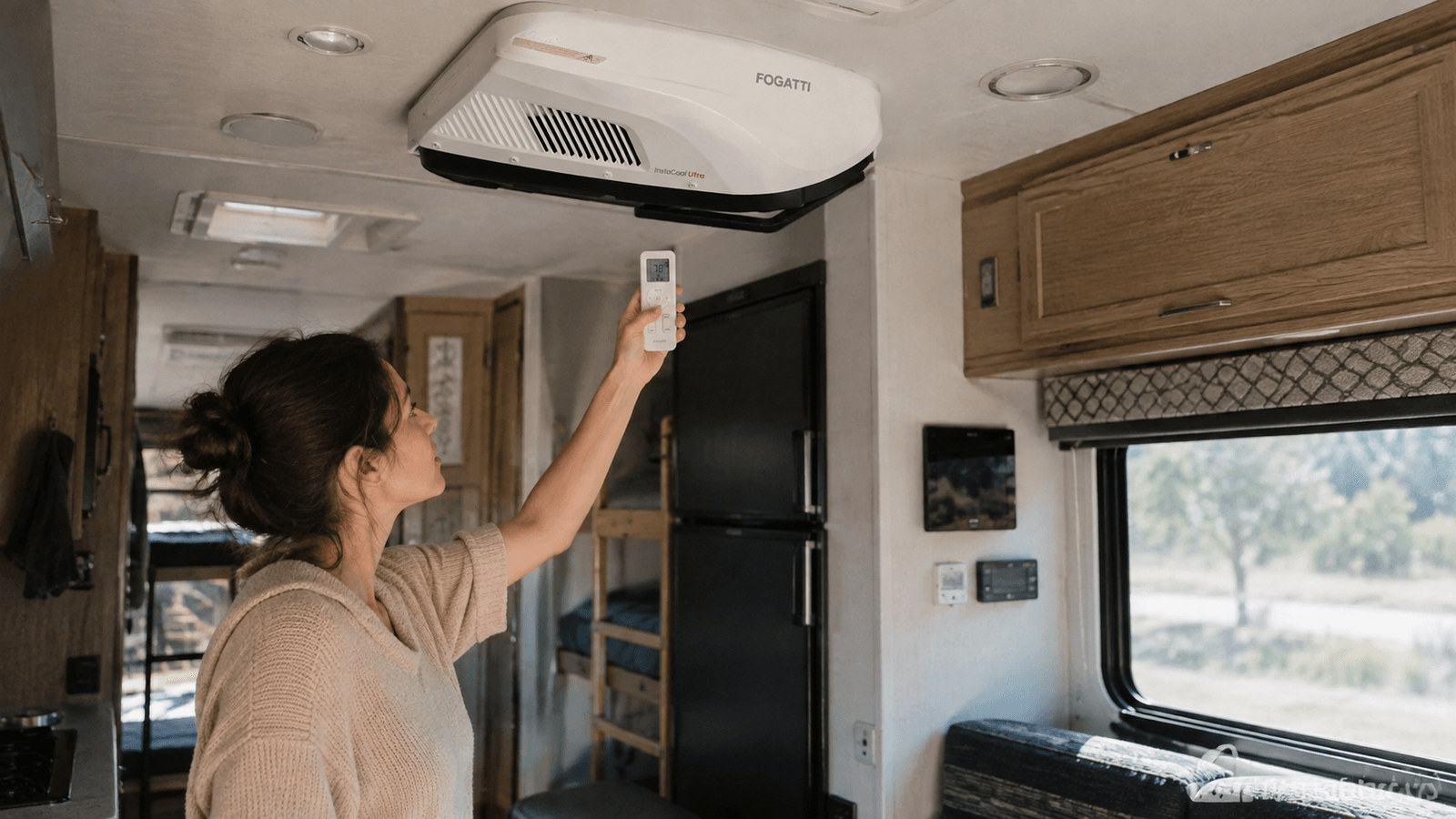
Sizing Fundamentals: 13,500 BTU versus 15,000 BTU
Rooftop RV air conditioners in North America are predominantly categorized into two cooling output ratings: 13,500 BTU/h (often abbreviated as 13.5K) and 15,000 BTU/h (15K). Selecting between these two capacities depends directly on the interior volume of your travel trailer, the number of slide-outs, and your travel geography.
| Travel Trailer Length | Slide-Out Configuration | Recommended Cooling Capacity | Electrical Service Requirement | Expected Interior Pull-Down Time |
|---|---|---|---|---|
| Under 20 Feet (Compact / Teardrop) | No slide-outs | 9,000 to 13,500 BTU/h | 30 Amp Shore Line | 25 to 35 Minutes |
| 21 to 28 Feet (Mid-Size Bunkhouse) | 0 or 1 slide-out | 13,500 to 15,000 BTU/h | 30 Amp Shore Line | 45 to 60 Minutes |
| 29 to 33 Feet (Large Family Trailer) | 1 or 2 slide-outs | 15,000 BTU/h (Single high-output) | 30 Amp or 50 Amp Service | 60 to 90 Minutes |
| Over 34 Feet (Triple-Slide / Toy Hauler) | 2 or more slide-outs | Dual Units (15K Main + 13.5K Bedroom) | 50 Amp 120/240V Service Required | 40 to 50 Minutes (Dual Zone) |
A standard 13,500 BTU unit pulls approximately 12.0 A to 13.5 A running load amps (RLA) at 120V AC, while a 15,000 BTU unit draws roughly 13.8 A to 15.2 A RLA. While a 15K unit provides approximately 11% greater heat extraction per hour, installing an oversized unit on a small 16-foot trailer can lead to short-cycling. Short-cycling occurs when the compressor cools the cabin air too rapidly without running long enough to wring out humidity, leaving the interior clammy and cold.
For larger travel trailers exceeding 30 feet, a single rooftop unit—regardless of brand—struggles to push conditioned air past the front bedroom partition. In those layouts, dual-zone ducted systems or dedicated supplemental bedroom units are essential. If you tow a popular Jayco build, see our brand-specific breakdown on Jayco AC unit sizing, Magnum Truss roof curbs, and duct transition baffles.
Electrical Demands and Generator Sizing
Running a rooftop air conditioner off-grid requires planning for two distinct electrical loads: Locked Rotor Amps (LRA, the startup surge) and Running Load Amps (RLA, steady-state operation).
The Physics of Compressor Startup Surge: When a hermetic reciprocal compressor motor starts against head pressure in the refrigeration lines, it demands an instantaneous inrush current of 45 A to 60 A for approximately 100 to 150 milliseconds. A portable 2,000-watt inverter generator rated for 1,600 continuous watts (13.3 A) cannot supply this massive current spike and will instantly trip its overload breaker.
To operate your travel trailer air conditioner reliably in dispersed camping or boondocking scenarios:
- Standalone 3,000W to 3,500W Inverter Generator: A 3,500-watt generator reliably handles both the 50A compressor startup spike and the 14A steady running draw, while leaving sufficient overhead to power your RV converter and 12V lights.
- Installation of an Advanced Soft Starter: By wiring an electronic soft starter module directly into the compressor motor windings, the inrush current spike is smoothed out and reduced by up to 65% to 70%. With a soft starter, a compact 2,200-watt portable generator (such as a Honda® EU2200i) can easily start and run a 15,000 BTU rooftop unit. To understand how microcontrollers control current ramps, consult our technical testing guide on the soft starter for RV AC.
If you are evaluating complete system replacement economics, including whether to pay dealership shop fees or handle the swap in your own driveway, review our comprehensive RV AC replacement cost guide.
Ducted versus Direct-Discharge Ceilings
Travel trailer roof air conditioners deliver cold air through one of two interior configurations:
Direct-Discharge (Non-Ducted)
The conditioned air blows directly out of the ceiling plenum louvers into the central cabin. This configuration delivers maximum CFM airflow velocity and is the easiest to service. However, it concentrates cooling in the main galley while leaving separated bunkrooms and front master bedrooms several degrees warmer.
Fully Ducted Air Distribution
Cold air discharges into insulated duct runs routed through the roof attic cavity, terminating in adjustable ceiling registers throughout the trailer. While ducted systems provide quiet, balanced airflow from front to back, they require meticulous inspection. If factory foil tape inside the ceiling plenum collapses, icy supply air dumps straight into the roof attic, causing condensation rot and severe efficiency loss.
If you are replacing an aging non-ducted unit or upgrading an existing ducted camper, follow our step-by-step physical walkthrough in the RV air conditioner installation guide.
Essential Maintenance Protocols for Travel Trailers
Road vibrations, airborne dust from gravel access roads, and tree debris rapidly degrade rooftop air conditioning performance. Follow these field maintenance rules:
- Inspect Foam Return Filters Monthly: A clogged washable filter restricts evaporator airflow, causing the coil temperature to drop below 32°F (0°C) and turning moisture into an insulating block of ice. Clean your filters in warm soapy water every 30 days of active camping.
- Straighten Condenser Coils Annually: Tree branches and hail bend delicate aluminum condenser fins on the rooftop unit. Use a plastic HVAC fin comb (12 to 14 fins-per-inch) to straighten crushed fins and preserve airflow.
- Clean Evaporator Drain Holes: Condensation draining off the cold evaporator pan must exit through weep holes onto the roof. If cottonwood seeds or pine needles clog these channels, condensed water pools in the base pan and overflows inside onto your camper bed or flooring.
For a benchmark analysis of the quietest and most reliable models for 2026 travel trailer builds, see our full lab comparison of the best RV air conditioner 2026 models.
Check current pricing and customer ratings on top travel trailer air conditioners on Amazon